
Chartered Town Planner Apprenticeship
End Point Assessment
Main guidance
Route to Chartered membership for Chartered Town Planner Apprentices
Published May 2020
Contents
1. General information
1.1 Chartered membership (MRTPI)
1.2 Chartered Town Planner Apprenticeship
1.3 The Professional Discussion
1.4 The Degree Apprenticeship Assessment of Professional Competence (DA-APC)
1.5 Application timeline
1.6 What do you submit?
Gateway
Degree Apprenticeship Assessment of Professional Competence
1.7 How is your application assessed?
1.7.1 Professional Discussion
Outcomes
Resubmissions and Appeals
1.7.2 DA-APC Written Submission
Outcomes
Resubmission and Appeals
2.1 Who is the Chartered Town Planner End Point Assessment for?
2.2 Are you eligible?
DA-APC route to Chartered Membership
2.3 Gateway declaration and Licentiate Membership
2.4 Does your experience qualify?
2.5 Calculating your relevant experience
Table 1 Counitng your experience
3.1 What is the Professional Discussion?
3.2 Scope and Structure
Table 2 - Demonstrating skills and behaviours in a Professional Discussion
3.3 Delivery of the Professional Discussion
3.4 Answering Professional Discussion questions
3.5 Example Professional Discussion questions
5. DA- APC written submission: Practical Experience Statement (PES)
5.1 What is the PES?
5.2 Scope and structure
5.3 Articulating your role
5.4 Avoiding common mistakes
5.5 Gaps in your experience
6. DA-APC Written submission: Professional Competence Statement (PCS)
6.1 What is the PCS?
6.2 Scope and structure
Table 3 - Competencies for the DA-APC
Table 4 – Knowledge, skills and behaviour in he competencies for the DA-APC
C1 Professional ethics and the RTPI Code of Conduct (Core)
C2 Spatial planning context (Application)
C3 Identifying and analysing issues (Application)
C4 Gathering appropriate information (Application)
C5 Identifying and assessing alternative courses of action (Application)
C6 Initiating and implementing a course of action (Application)
C7 Legal framework (Understanding)
C8 Politics in planning (Understanding)
C9 Economics in planning (Understanding)
C10 Reflection and review (Core)
6.3 Selecting case studies
6.4 Using case studies to demonstrate the competencies
7. DA-APC Written submission: Professional Development Plan (PDP)
7.1 What is the PDP?
7.2 Why is the PDP important?
7.3 Scope and structure
7.4 SWOT analysis
7.5 Writing goals
7.6 Writing objectives (sub-goals)
7.7 Writing an action plan
7.8 Sources of CPD
7.9 PDP checklist for success
8.1 What is the Reflective Journal?
8.2 Why is the Reflective Journal important?
8.3 Scope and structure
8.4 Referring to your Reflective Journal in your Professional Discussion
8.5 Referring to your Reflective Journal within the DA-APC written submission
9. Presenting your DA-APC written submission
9.1 General presentation
9.2 Recommended format
9.3 Diagrams, illustrations and additional materials
9.4 Confidentiality, plagiarism and ethical considerations
9.5 Word limit for written submission
9.6 Footnotes
10. Corroboration, sponsorship and supporters
10.1 The people involved
10.2 Mentors
10.3 Corroborator Declaration Form
10.4 Sponsor Declaration Form
Abbreviations
CPD – Continuing professional development
DA-APC – Degree Apprenticeship Assessment of Professional Competence
EPA – End Point Assessment
EPAO – End Point Assessment Organisation
PCS – Professional Competence Statement
PDP – Professional Development Plan
PES – Practical Experience Statement
RTPI – Royal Town Planning Institute
1. General information
1.1 Chartered membership (MRTPI)
The Royal Town Planning Institute (RTPI) is the only body in the UK that confers Chartered status to planners, the highest professional qualification sought after by employers in the private and public sectors and academia. The RTPI supports its members throughout their careers, offering them a wide of range of opportunities to learn, grow skills and share ideas. The MRTPI designation is recognised as a sign of competence and professionalism.
Chartered Members belong to an institute whose charitable purpose is to advance the science and art of planning for the benefit of the public, and those values are shared across the Institute’s diverse membership base.
1.2 Chartered Town Planner Apprenticeship
The Chartered Town Planner Apprenticeship combines an RTPI accredited degree with practical experience in the work place. To complete the Chartered Town Planner Apprenticeship, apprentices must pass through the Gateway and successfully complete the End Point Assessment consisting of the Professional Discussion and the Degree Apprenticeship Assessment of Professional Competence (DA-APC) written submission.
To pass through the Gateway an apprentice must apply to the RTPI with evidence of their qualifications and a declaration from their employer that they are ready to take the End Point Assessment.

1.3 The Professional Discussion
The Professional Discussion is a structured interview to assess whether you have developed the key skills and behaviours for the Chartered Town Planner Apprenticeship. It lasts 50 minutes and usually takes place in your workplace using digital conferencing. You will undertake a conversation and be asked questions to assess your understanding and application of the skills and behaviours gained and evidenced through the entries in your Reflective Journal.
1.4 The Degree Apprenticeship Assessment of Professional Competence (DA-APC)
The Degree Apprenticeship Assessment of Professional Competence (DA-APC) is a competency-based process, which assesses whether you have met the knowledge, skills and behaviours of the Chartered Town Planner Apprenticeship and the high standards required for Chartered membership.
It is designed to:
- raise standards of professional competence;
- empower you to drive your own professional development;
- encourage networking and participation;
- show how you manage your own learning and career direction; and
- instil a habit of lifelong learning as required by the RTPI Code of Professional Conduct.
Elements of the DA-APC written submission
The DA-APC application is focused on a written submission of three sections:
- Practical Experience Statement (PES). The PES is an overview statement, which sets out what relevant experience you have gained to meet the eligibility requirements.
- Professional Competence Statement (PCS). The PCS is an analytical statement where you use case studies to demonstrate the competencies you have developed through your experience. The competencies require you to focus not just on what you did, but also why you did it in a particular way and how you went about it.
- Professional Development Plan (PDP). The PDP is a detailed plan, which identifies and sets out how you are going to meet your personal professional development needs over the two years after your submission. It answers the important question: what next?
1.5 Application timeline
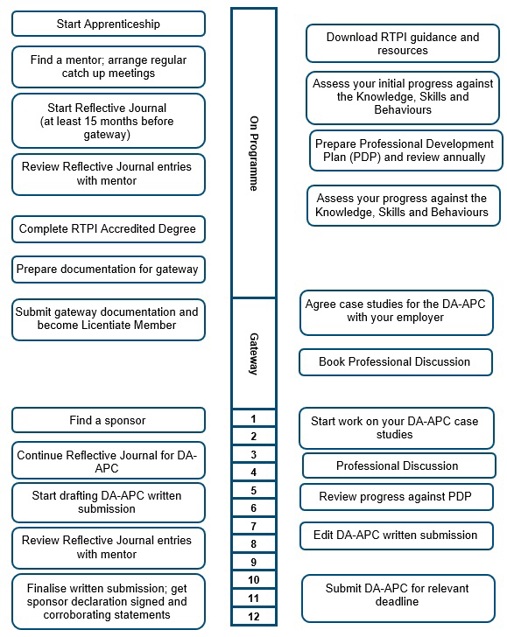
You need to have a minimum of 12 months’ (full-time equivalent) professional planning experience before being eligible to pass through the Gateway[1]. The RTPI has put together a suggested timeline of the minimum activities an apprentice might do to complete the Chartered Town Planner Apprenticeship.
You are encouraged to begin your Reflective Journal early in the process.
1.6 What do you submit?
To pass through the Gateway and apply for RTPI Licentiate membership you must submit an application form for Licentiate membership.
Supporting documents
Your application for RTPI Licentiate membership must be supported by:
- Reflective Journal covering at least 12 months’ (full-time equivalent) pre-gateway experience.
- Scanned copies of relevant English and Maths certificates (level 2)
- Scanned copies of relevant degree certificates or academic transcript
- Apprentice Employer Declaration Form completed by your employer.
Your contact details must also be submitted with your application.
Degree Apprenticeship Assessment of Professional Competence
Your Degree Apprenticeship Assessment of Professional Competence application must consist of the following:
Core documents
- Written submission of 5,500 words (+/- 10%) comprising three sections:
(1) Practical Experience Statement (PES) of approximately 1,000 words.
(2) Professional Competence Statement (PCS) of approximately 3,000 words.
(3) Professional Development Plan (PDP) of approximately 1,500 words[2].
Supporting documents
- Reflective Journal covering at least 12 months’ (full-time equivalent) pre-gateway professional planning experience and continued post-gateway experience to include your case studies and other relevant experience up to the month of submission.
- Corroborator Declaration Form(s) which cover all work experience in the application.
- Sponsor Declaration Form completed by a Chartered Town Planner.
Your contact details, education history and work experience information must also be submitted as part of your application.
Find out how to submit and relevant submission deadlines at: www.rtpi.org.uk/membership-submit.
If any of your documents are in a language other than English, you will need to provide a certified translation.
1.7 How is your application assessed?
When we receive your application:
- Pre-assessment checks are completed: These checks ensure you have submitted all relevant documentation and meet the eligibility criteria. Your Professional Discussion may be delayed or rejected if everything is not included, so please ensure you also undertake the checks yourself.
- The assessor receives your Reflective Journal: They will review your Reflective Journal for evidence of the relevant skills and behaviours and use this to structure the Professional Discussion.
- You attend the Professional Discussion (using digital conferencing) with the assessor: The assessor will ask you questions on the relevant skills and behaviours and assess whether you meet the pass criteria.
- The assessor completes a feedback report: This details the outcome of the Professional Discussion and whether you have demonstrated the skills and behaviours required.
- Post-assessment checks are completed: These checks review the assessor’s feedback report to ensure that due process has taken place.
- You are notified of the Professional Discussion outcome.
There are three possible Professional Discussion outcomes – pass, resit or retake.
- A pass outcome means you have demonstrated the required skills and behaviours. You are now able to submit your DA-APC written submission.
- A resit means you did not fully demonstrate your understanding and/or application of some of the required skills and behaviours during the Professional Discussion. You can book to attend the next available Professional Discussion.
- A retake means you need to undertake and record additional experience to enable you to demonstrate your understanding and/or application of some of the required skills and behaviours. You will be required to complete a least two months’ (full-time equivalent) further experience in the Reflective Journal (at least 400 words) before your next Professional Discussion.
You will receive a feedback report with your results. The report has a summary of your results on the front page, with assessor comments on each of the required skills and behaviours.
If you have not met the requirements you will be asked to either book another Professional Discussion date or to provide an updated Reflective Journal with at least two months’ (full-time equivalent) additional experience before you sit your next Professional Discussion.
If you feel due process has not been followed in the assessment of your Professional Discussion, you have a right of appeal but only after at least one resubmission attempt to address the unsuccessful elements. An appeal must be submitted in accordance with the RTPI appeal procedure. For any queries about appeals and the process, please contact the Apprenticeship Team on epa@rtpi.org.uk.
1.7.2 DA-APC Written Submission
When we receive your APC written submission:
- Pre-assessment checks are completed: These checks ensure you have submitted all relevant documentation, are within the word limit, have achieved a pass in the Professional Discussion and meet the basic eligibility criteria. Your application may be delayed or rejected if everything is not included, so please ensure you also undertake the checks yourself prior to submission.
- Two trained assessors receive your application: They will consider whether you have demonstrated all the competencies and whether you have acquired the appropriate knowledge, skills and reflective practices to be elected to membership. The DA-APC assessors will be different from the Professional Discussion assessor.
- Assessors review your application: They do this independently of each other and then arrange to confer and agree on a recommendation as to whether you have met the requirements.
- Assessors complete a feedback report: This details the outcome of the assessment and makes a recommendation as to whether you have demonstrated the requirements to become a Chartered Town Planner. You are formally assessed on the PES, PCS, PDP and general presentation.
- Post-assessment checks are completed: These checks review the assessors’ feedback report to ensure that due process has taken place.
- You are notified of the assessment outcome.
There are two possible assessment outcomes – successful or deferral.
- A successful outcome means you have demonstrated the requirements. If you are successful, you will pass your apprenticeship and be elected to Chartered membership. You may be referred to a PDP support phase if there were weaknesses identified in the PDP, for further details see: www.rtpi.org.uk/pdp-support-phase.
- A deferral means that you have not yet met some or all of the requirements. This is not a fail. You are being asked to provide additional information to demonstrate the relevant requirements.
You will receive a feedback report with your results. The report has a summary of your results on the front page, with assessor comments on each of the three parts of the written submission separately, as well as general presentation.
If you have not met the requirements you will be asked to either resubmit the full section or provide a supplementary statement. Any resubmission can be made up to two years from the date of your first submission. After this period you will have to submit a new application which will be assessed in its entirety by new assessors; the new application would need to comply with guidance in place at that time.
Further details about DA-APC resubmission are available at: www.rtpi.org.uk/resubmissions. Resubmission deadlines can be found at: www.rtpi.org.uk/membership-submit.
If you feel due process has not been followed in the assessment of your DA-APC submission, you have a right of appeal but only after at least one resubmission attempt to address the unsuccessful elements. An appeal must be submitted in accordance with the RTPI appeal procedure. For any queries about appeals and the process, please contact the Membership Team on +44(0)20 7929 9462.
1.8 Tips for success
- Read this guidance: this guidance is the key to your success – read it thoroughly several times, prior to both your Professional Discussion and DA-APC written submission.
- Use the resources available to you: speak to other professionals and colleagues, find a mentor, attend RTPI membership events and access online resources through the RTPI website: www.rtpi.org.uk/da-epa-resources.
- Know the work in your Reflective Journal well: review this before your Professional Discussion and ask colleagues to ask you questions about it. The Professional Discussion will be centred around this work and the assessors will both refer to your examples and ask you to use examples from your Reflective Journal to illustrate your answers.
- Arrange a mock Professional Discussion: practice makes perfect - ask colleagues and others to ask you questions based on your Reflective Journal focusing on the skills and behaviours being assessed under this method.
- Make sure you answer the question that is being asked by the Professional Discussion assessor. Sometimes it is all too easy to think you heard a question but actually it is not the one the assessor asked. Also make sure you choose the best work example to illustrate your answer.
- Revise, revise and revise: Although the questions will be centred on the work examples in your Reflective Journal, the Professional Discussion is a verbal exam and you will be expected to refer to key legislation, policy, codes and standards as relevant to the questions.
- Competency criteria are the key for the DA-APC written submission: have you sufficiently addressed each competency in your written submission? The best way to meet the competency criteria is to explain the reasoning behind your decisions and actions in the case studies. A checklist is available on the RTPI website to help you.
- Select your case studies for your DA-APC written submission carefully: choose case studies that were challenging to you personally and which showcase your involvement. You do not have to choose the biggest, most impressive project you have worked on. Use your Reflective Journal to select case studies that best demonstrate the competency criteria.
- Be critical: do not be afraid to explain how you would do things differently if you were doing a task again. Strong case studies do not need to be successful projects.
- Spend time on your PDP: a detailed plan for your future development is needed. Refer to the PDP checklist[3] to make sure you meet all of the requirements.
- Prepare: do not leave your submission until the last minute before the deadline, and allow your mentor, manager or colleagues time to review your application. Complete your Reflective Journal regularly.
- Review your DA-APC written submission: give it to someone who has never read it before – is your experience and role in the case studies clear? It is not unusual for people who are familiar with your work and your projects to read more into the text than is on the page. Remember, the assessors will only read what is presented and bring no prior knowledge of you to the process.
- Check the presentation and formatting: have you presented your DA-APC written submission in accordance with the details in the guidance, including the word counts? Make sure your Corroborator Form(s) are clearly labelled so the assessors can easily identify what they are looking for.
- Aim for success first time: if you produce an exemplary submission for Chartered membership you could be nominated for a commendation by your assessors. See: www.rtpi.org.uk/apc-commendations.
2. Eligibility and experience
2.1 Who is the Chartered Town Planner End Point Assessment For?
The Chartered Town Planner End Point Assessment, comprising the Professional Discussion and the DA-APC is the formal assessment for the Chartered Town Planner Apprenticeship. You must be a Chartered Town Planner apprentice and a Licentiate Member of the RTPI to submit for the Professional Discussion and the DA-APC.
2.2 Are you eligible?
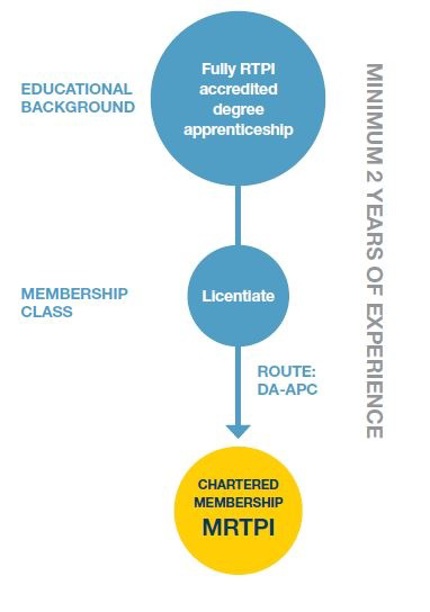
To be eligible to take the Chartered Town Planner End Point Assessment you must pass through the Gateway.
To pass through the Gateway:
- You must be a Chartered Town Planner apprentice.
- You must have achieved English and Mathematics at level 2.
- You must have a fully RTPI accredited qualification[4].
- Your employer must confirm that you are ready to take the End Point Assessment.
- You must have documented at least 12 months’ (full-time equivalent) professional planning experience in the Reflective Journal.
To apply for Chartered membership through the DA-APC:
- You must be a Chartered Town Planner apprentice.
- You must be a current registered Licentiate of the RTPI.
- You must have a minimum of 2 years’ professional planning experience (full-time equivalent) whilst a Chartered Town Planner apprentice.
- You must successfully complete the Professional Discussion.
2.3 Gateway declaration and Licentiate Membership
To pass through the Gateway and be eligible to take the Chartered Town Planner Apprenticeship End Point Assessment, you must apply to become a Licentiate member of the RTPI. Licentiate membership is the class of membership that bridges the gap between Student and Chartered membership. You will become a Licentiate member when you pass through the Gateway. The Licentiate period should be structured – during this time you will undertake the case studies for your DA-APC written submission, continue your Reflective Journal and you must comply with the RTPI Code of Professional Conduct.
You are eligible to become a Licentiate once you have been awarded a fully RTPI accredited qualification. Applying for Licentiate membership is quick and easy, please see section 1.6.
Your employer must complete the Apprentice Employer Declaration Form. In this form your employer declares that:
- you will be provided with opportunities to undertake relevant case studies;
- you have met occupational competence of the knowledge, skills and behaviours for a Chartered Town Planner;
- you have documented at least 12 months’ (full-time equivalent) professional planning experience in the Reflective Journal; and
- you are ready to take the EPA.
The fee for your End Point Assessment including your Licentiate membership application will be paid from your apprenticeship funding by your training provider.
When should you apply for Licentiate membership?
Apply for Licentiate membership as soon as you are ready to pass through the Gateway.
2.4 Does your experience qualify?
The RTPI recognises the variety of backgrounds held by planning professionals. You could be working in the public or private sectors, be employed by charities or non-governmental organisations. As an apprentice on the Chartered Town Planner Apprenticeship, your employer will ensure you gain the relevant experience to be eligible to undertake the Chartered Town Planner Apprenticeship End Point Assessment.
Examples of planning work that are eligible towards your application will include some of the points below. Please note that this is a non-exhaustive list of the broad types of work included as planning and candidates do not require experience in all these areas. You need to show how the work you do directly affects / influences planning decisions:
The preparation of plans, policies and related documents
This includes but is not restricted to activities such as:
- research and analysis of information for policy formulation;
- preparation of contributory material or actual formulation and monitoring of policy, guidelines and advice;
- spatial development strategies and statutory development plans as well as master, town, village / parish settlement and conservation plans for buildings, urban areas and the countryside;
- development briefs, design guides, environmental, economic and traffic impact assessments;
- sustainability appraisal, transportation and economic assessments and travel plans;
- associated processes of economic development, viability assessments, community engagement, preparation of materials for inquiry, advocacy and presentations to clients, which are regarded as integral to plan preparation;
- landscape / biodiversity assessments and appraisals.
Plan implementation
This includes but is not restricted to activities such as:
- statutory development management / control and enforcement and the handling of appeals at all stages;
- preparation, submission and following through of planning applications and other consenting regimes;
- implementation of plans or schemes for conservation, environmental improvement, economic development, urban regeneration, traffic and transportation, tourism, minerals, waste disposal, or derelict land reclamation, including funding and delivery options;
- planning involvement in housing and housing management, community development, environmental education and recreation, and urban design;
- site appraisal, feasibility studies, scoping exercises and all forms of study preparatory to the submission of a planning application;
- water and marine planning such as flood risk planning;
- experience gained from involvement in investigation, negotiation and resolution of breaches of planning control, preparation of notices, handling of enforcement appeals and court proceedings.
Monitoring and research
This includes but is not restricted to activities such as:
- research and analysis of information leading to the making of planning policy or planning recommendations and decisions;
- funded research for clients from the public / private / voluntary sectors;
- monitoring of plans and policies leading to reports and plan revision;
- planning submissions, or research appraisals.
2.5 Calculating your relevant experience
The experience requirements[5] must be gained at the relevant professional level. ‘Professional level’ is defined as exercising independent professional judgement to make decisions or influence planning outcomes.
The table below outlines the types of experience that can and cannot count towards the application.
Table 1 - Counting your experience
|
Experience type |
Can it count? |
|
Full- or part-time experience. To calculate part-time experience you need to pro rata your part-time hours against the 35 hour week.[6] You cannot count experience gained whilst you are undertaking the 20% off the job training. |
Yes |
|
Paid or voluntary experience. |
Yes |
|
Experience gained in the UK or overseas. |
Yes |
|
Experience that is non-consecutive. Breaks in employment for parental leave, redundancy or travelling are fine. They just need to be excluded from your overall planning experience. |
Yes |
|
Experience gained whilst undertaking a Chartered Town Planner Apprenticeship. You can only count experience gained outside of the 20% off the job training. |
Yes |
|
Experience less than three months in duration (full-time equivalent). |
No |
|
Administrative experience or technical support experience. Experience must be of the relevant professional level, as defined above. |
No |
|
Experience gained as an elected member or politician. You cannot count experience gained as an elected member, though such experience may help you to appreciate the context within which you operate. |
No |
|
Experience gained prior to registering as a Licentiate. Experience gained, whilst registered as a Chartered Town Planner apprentice, before your Licentiate period, is acceptable. However, all case studies for the DA-APC written submission must be undertaken once you have passed through gateway and are registered as a Licentiate. |
Yes |
How do you calculate your experience as an apprentice?
As an apprentice you will be spending at least 20% of your time on off-the job learning. You cannot count experience during this time. You must demonstrate how you have calculated your eligibility. For example, an apprentice working for 28 hours a week (80%) and studying for 7 hours a week (20%) over two years, would state:
- 15 months’ working for 80% of the time and studying 20% of the time is the equivalent to 12 months’ full-time work.
- 30 months’ working for 80% of the time and studying 20% of the time is the equivalent to 24 months’ full-time work.
|
|
Required Experience |
|
Gateway |
12 months’ full-time equivalent in Reflective Journal.
For an apprentice studying for 20% of the time, the full-time equivalent experience required is 15 months. |
|
DA-APC |
24 months’ full-time equivalent in PES. Combination of pre/post gateway. |
If you worked in a role that was 40% planning and 60% non-planning for 12 months, then did six months’ full-time planning, you would state:
- 12 months at 40% of a full-time role is equivalent to 4.8 months’ full-time work. Plus 6 months’ full-time work. Total: 10.8 months
3. Professional Discussion
3.1 What is the Professional Discussion?
The Professional Discussion is the first part of the Chartered Town Planner End Point Assessment, and is a structured discussion (usually undertaken using digital conferencing) to assess whether you have achieved key skills and behaviours for the Chartered Town Planner Apprenticeship. Using your Reflective Journal, you will respond to questions with examples of your work to demonstrate the skills and behaviours.
3.2 Scope and structure
The Professional Discussion will last approximately 50 minutes and the assessor will pose five principal questions to assess your understanding of key behaviours and assess your practical experience of key skills. You must give examples of your work experience in answer to the assessor’s questions. There may be one follow up question for each principal question.
Table 2 - Demonstrating skills and behaviours in a Professional Discussion
|
Skill/Behaviour |
What the assessors are looking for |
How assessed |
|
S8 – Interpersonal skills |
You answer all of the questions competently using professional interpersonal skills. |
Throughout the Professional Discussion |
|
B5 – Curiosity and a desire to improve the built and natural environment |
You consistently show a desire to improve the built and natural environment. |
Throughout the Professional Discussion |
|
B4 – A focus on outcomes and positive attitude |
You consistently demonstrate a focus on outcomes and a positive attitude. |
Throughout the Professional Discussion |
|
S3 – Creative vision and design |
You give an example, which shows you have produced a creative and innovative design strategy, policy or solution to achieve positive design outcomes for stakeholders. |
Specific Question |
|
S5 – Stakeholder management and leadership |
You give an example which shows how you used communication, negotiation, advocacy or mediation to build positive outcomes for stakeholders or a work project. |
Specific Question |
|
S6 – Project management |
You give an example of a project you have led from start to finish and explain how you evaluated to outcome of the project, identified opportunities for improvement and development. In your example you should explain how you worked both independently and as part of a team. You should also explain how you managed your work and your time. |
Specific Question |
|
S7 – Collaborative and multidisciplinary working |
You give an example, which shows how you have worked in partnership with other disciplines to achieve positive outcomes for stakeholders. You should also explain how you have demonstrated customer and client care. |
Specific Question |
|
B3 – Reliability, integrity and confidentiality on work related and personal matters |
You give an example, which shows you respect confidentiality on work related and personal matters. Your example may refer to the appropriate use of social media and information systems. |
Specific Question |
3.3 Delivery of the Professional Discussion
Once you have passed through the Gateway we will provide you with details of how to book your Professional Discussion.
The Professional Discussion will take place in your workplace using digital conferencing and will be recorded for moderation purposes. Your employer will need to provide you with access to a computer you can use for digital conferencing in a designated room free from distractions. A notice should be in place to inform others that there is to be no distraction.
3.4 Answering Professional Discussion Questions
When responding to questions in your Professional Discussion you should refer to the projects in your Reflective Journal to illustrate your experience and demonstrate applying skills in practice. The assessor will frame some questions around specific projects in your Reflective Journal and also ask you questions where you will need to give factual answers and then refer to specific projects to demonstrate your skills. The Professional Discussion is about your experience and is similar to a behavioural interview where the interviewer asks questions about your past work experiences in order to find out if you have the necessary skills. This works on the basis that your actions in the past reflects and predicts how you will behave in the future. When responding to this type of question you should adopt the STAR technique.
There are four steps to answering using this technique:
- Situation: Describe the background or context (this should just be a short reminder as the assessors will have read your Reflective Journal).
- Task: Describe the task or challenge you were faced with.
- Action: Explain the action you took, and how and why you did it.
- Result: Describe how it ended, the outcome and what you learnt.
3.5 Example Professional Discussion Questions
The assessor will review your Reflective Journal and may ask you questions about specific projects. You should give a specific example for each question and make sure you explain your role in the project that you select. As examples, the sorts of questions you may be asked include:
- How did you apply good design principles in your project x? (S3)
- It is clear that in project x you were working with many stakeholders with differing, and sometimes, conflicting objectives and priorities. How did you deal with this? (S5)
- Tell me about how you led and managed project x from start to finish? (S6)
- Using examples in your Reflective Journal explain how you build relationships with partners and what you feel is the key to successful partnership working with other disciplines? (S7)
- What do you understand by the term ‘acting with integrity‘ and using examples from your Reflective Journal explain how you have applied this in practice. (B3)
The assessor may ask you a follow-up question if appropriate.
4. DA-APC written submission
The DA-APC written submission requires apprentices to demonstrate their experience and how they have developed the relevant knowledge, skills and behaviours.
The written submission is 5,500 words and consists of three parts:
- Professional Experience Statement
- Professional Competence Statement
- Professional Development Plan
Before you can submit a DA-APC submission, you must pass the Professional Discussion, be a Licentiate member and have 2 years’ (full-time equivalent) planning experience.
5. DA- APC written submission: Practical Experience Statement (PES)
5.1 What is the PES?
The PES is the first section of the written submission, and is an overview statement, which sets out what relevant experience you have gained to meet the eligibility requirements. It should also provide the assessors with enough information to understand the context within which you work.
The relevant employer(s) or supervisor(s) must corroborate[7] all experience within the PES.
5.2 Scope and structure
The PES must refer to a minimum of 2 years’ professional planning experience (full-time equivalent). It must be current up to a month prior to submission.
You must demonstrate that your experience was at a suitable professional level. ‘Professional level’ is defined as exercising independent professional judgement to make decisions or influence planning outcomes.
It is recommended that the PES be structured in chronological order, role by role, to provide comprehensive coverage of your experience to date.
For each position you have held, the PES must include:
- the name and type of employer e.g. public sector, private sector, academia;
- the nature of the organisation (mainstream planning, local planning authority, multi-disciplinary practice, educational institution etc.);
- your own job description: a summary of the main role and responsibilities, including any line management responsibility;
- the nature of the work you undertook in the role; and
- dates and time periods covered.
It is also helpful to provide information on the size of the organisation and where you sit within the organisational structure, but this is not a requirement.
What if I have achieved more?
If you exceed the minimum experience requirements, you are encouraged to demonstrate this additional experience within the PES as long as it is supported by a Corroborator Declaration Form.
5.3 Articulating your role
The PES is a factual account of your own professional responsibilities and an overview of your experience; it does not need to focus on competencies. Where you have been involved in group tasks or projects, you must describe how you personally contributed to the project as a whole. It is not necessarily expected that you will have been managing entire projects or been involved in a project in its entirety. Some projects you have been involved in may not have reached completion when you are finalising your submission.
You need to describe the type of planning work that you undertook. If your job has changed or evolved within a single organisation over the period of practical experience, you should clearly indicate this.
Finding it difficult to explain your experience?
Make use of bullet points, tables and / or a timeline to present your experience clearly.
If you gained some of your experience in areas that were not solely planning related, you need to estimate and clearly set out the proportion of your time that was devoted to planning responsibilities (see section 2.5 for how to calculate relevant experience).
5.4 Avoiding common mistakes
The assessors will use this part of the submission to determine whether you have the right amount and type of experience. Assessors may disregard parts of your experience if:
- you only describe the function of your organisation or department rather than the work you have done; or
- you have described roles that are predominantly administrative or managerial and not planning; or
- they are not convinced you have gained the minimum amount of relevant experience; or
- they have difficulty identifying what part of the work outlined was done by you; or
- they feel a significant proportion of your work is more aligned to another aspect of the built environment such as surveying or architecture.
If you are concerned that your experience is not sufficiently robust to meet the minimum requirements, you may prefer to gain more experience before you submit[8].
5.5 Gaps in your experience
Should you have gaps in your periods of eligible experience, for example due to extended or parental leave or a career break, which are greater than normal annual leave or sickness entitlements, these periods should be excluded from the experience period presented and not included in the calculation of experience.
You should briefly explain any gaps in your experience within your PES.
6. DA-APC Written submission: Professional Competence Statement (PCS)
6.1 What is the PCS?
The PCS is the second section of the written submission, and is an analytical statement where you use case studies to reflect on the knowledge, skills and behaviours you have developed through your apprenticeship. Your PCS will be assessed against 10 competencies which group together these knowledge, skills and behaviours. Overall, you must demonstrate all competency criteria to be successful on this section.
The relevant employer(s) or supervisor(s) must corroborate[9] all experience within the PCS.
6.2 Scope and structure
All planners operating at a professional level must be able to critically assess a problem, research the issues and select an appropriate response after considering a number of options. This work is undertaken in an environment complicated by multiple stakeholders with different expectations, complex legal guidelines and political objectives.
In the PCS you must demonstrate that you are a reflective professional and a competent planner. You are not only trying to show what skills you have, you are trying to show that you learn and grow in your work by thinking about the context in which you operate. You should also show that you are aware of the factors that impact on your work and that you can analyse and critique your work to improve your performance.
Your PCS will be assessed against 10 competencies which group together key knowledge, skills and behaviours for the Chartered Town Planner Apprenticeship[10]. The competencies are all equally important, are interrelated and linked to one another. You are required to select 1 to 3 case studies[11] from your experience which will collectively demonstrate all competencies at the appropriate level. You do not need to refer specifically to the individual knowledge, skills and behaviours as you will be assessed through your demonstration of the overarching 10 competencies. Other than for the ‘core’ competencies, which should be demonstrated throughout your PCS, you do not need to address every competency in every case study.
Evidence types for compentencies - awareness to core
A minimum type of evidence is required for each competency, however, if you have experienced more in your career you are encouraged to demonstrate this.
The types of evidence range from Awareness to Core and are defined in this section. Awareness level is not required for candidates applying to Chartered membership, including apprentices, but the definition has been provided so that you can benchmark your experience.
The criteria for Core competencies need to be demonstrated throughout all case studies you present, unless indicated next to the specific criterion. Application, Understanding and Awareness competency criteria only need to be demonstrated in sufficient detail within one case study to be successful.
|
1. Awareness (Recognise): Appreciate the principles of the competency recognising they have implications for your case study (not required for Chartered membership; only required for Associate membership).
|
|
2. Understanding (Explain): Explain specific implications of the competency for your case study, which could be an observed or hypothetical scenario.
|
|
3. Application (Do): Demonstrate how you have applied the competency through your case study.
|
|
4. Core (Behave): Demonstrate repeated application of the competency through your case study and practice.
|
How to read the competencies
Each competency is structured in three parts as follows:
- Descriptor: defines the competency and its relevance to the planning profession.
- Criteria: sets out the minimum standards you must meet to achieve success with the competency. Failure to demonstrate even one criterion means your application will be unsuccessful. There are between one and five criteria per competency.
- Examples: provides examples of how the competency could be demonstrated at the relevant Awareness, Understanding, Application or Core evidence type. The examples provided are purely indicative of how whole or partial criterion / criteria might be demonstrated within a competency – they are not an exhaustive list. Using these examples does not guarantee your success; you are encouraged to consider the examples within the wider context of your case studies and experience.
Table 3 – Competencies for the DA-APC
|
Competency |
Evidence type |
|
Core |
|
|
Application |
|
|
Application |
|
|
Application |
|
|
Application |
|
|
Application |
|
|
Understanding |
|
|
Understanding |
|
|
Understanding |
|
|
Core |
Do not use the competencies as sub-headings
The competencies are interrelated and describe what you would do to manage an activity within the planning environment. You must therefore use case studies to demonstrate them, rather than a short example for each. The PCS should not be structured with the competencies as sub-headings.
For detailed information on each competency, see C1 – C10.
The competencies group together the key Knowledge, Skills and Behaviours you are required to demonstrate (Table 4). You are only required to demonstrate that you have met the competencies, you do not need to give an example to demonstrate the Knowledge,, Skills and Behaviours. Each of the competencies is explained in more detail in the following pages.
Table 4 – Knowledge, skills and behaviours in the competencies for the DA-APC
|
|
C1 – Professional Ethics and the RTPI Code of Professional Conduct |
C2 – Spatial Planning context |
C3 – Identifying and analysing issues |
C4- Gathering appropriate information |
C5 – Identifying and assessing courses of action |
C6 – Initiating and implementing a course of action |
C7 – Legal framework |
C8 – Politics in Planning |
C9 – Economics in planning |
C10 – Reflection and review |
|
K1 |
|
|
|
|
|
|
|
|
|
|
|
K2 |
|
|
|
|
|
|
|
|
|
|
|
K3 |
|
|
|
|
|
|
|
|
|
|
|
K4 |
|
|
|
|
|
|
|
|
|
|
|
K5 |
|
|
|
|
|
|
|
|
|
|
|
K6 |
|
|
|
|
|
|
|
|
|
|
|
K7 |
|
|
|
|
|
|
|
|
|
|
|
K8 |
|
|
|
|
|
|
|
|
|
|
|
S1 |
|
|
|
|
|
|
|
|
|
|
|
S2 |
|
|
|
|
|
|
|
|
|
|
|
S4 |
|
|
|
|
|
|
|
|
|
|
|
S5 |
|
|
|
|
|
|
|
|
|
|
|
S6 |
|
|
|
|
|
|
|
|
|
|
|
S7 |
|
|
|
|
|
|
|
|
|
|
|
S8 |
|
|
|
|
|
|
|
|
|
|
|
B1 |
|
|
|
|
|
|
|
|
|
|
C1 Professional ethics and the RTPI Code of Conduct (Core)
Descriptor
Members must demonstrate their commitment to the RTPI’s Code of Professional Conduct[12]. Its five core principles relate to:
- Competence, honesty and integrity
- Independent professional judgement
- Due care and diligence
- Equality and respect
- Professional behaviour
Professionals must liaise and cooperate effectively with others and may need to use different communication methods tailored to their audience. Negotiation, mediation, influence and advocacy are also key attributes.
Ethical behaviour underpins the five core principles of the RTPI Code of Professional Conduct but it is important to recognise that ethics can go beyond the requirements of law and regulation. To build trust in the profession, it is vital to behave in an appropriate manner, to recognise right from wrong, and to be able to reflect on society’s expectations of planning practice.
Criteria
In your PCS, you must:
a) Demonstrate professional behaviour, in line with the principles outlined in the RTPI Code of Professional Conduct (required throughout PCS); and
b) Reference a specific clause of the RTPI Code of Professional Conduct and show how you complied with it (required once in PCS); and
c) Reflect on how your action has minimised reputational risk to the profession, and why this built trust in the profession (required once in PCS).
|
Examples of competency C1 at CORE evidence type |
Could demonstrate criteria |
|
Show how you navigated difficult professional situations and reflect on why you believe you followed an appropriate approach. Situations could include; a request to represent the council at an appeal following a refusal against your recommendation, standing by your professional judgement when under challenge, or reflecting on the approach you take when a client insists you follow a particular course of action that goes against your advice. |
a, c |
|
Reflect on how you dealt with a real or perceived conflict of interest and why it was or was not appropriate to continue with the task. |
a, c |
|
Consider how and why you took an informed and balanced approach in a situation which presented moral tensions. |
a, c |
|
Reflect on the steps you took to ensure sensitive information was not inappropriately disclosed and why it was important for you to act. |
a, c |
|
Evidence how you have managed pressures from stakeholders; or reflect on how you dealt with personal criticism when undertaking work. |
a, c |
|
Reflect on how you dealt with the provision of gifts by clients, consultants or other stakeholders. |
a, c |
|
Evidence your compliance with relevant employer procedures in relation to behavioural standards. |
a |
|
Show through action how you have acted professionally within your case study. |
a |
|
Explain the steps you took to guard against the abuse of elected officials’ interests and reflect on why you took the relevant action. |
a |
|
Demonstrate quality customer, stakeholder or client care when faced with challenge. |
a |
|
Refer to a specific clause of the RTPI Code of Professional Conduct and explain what you did. Clauses cover areas such as; exercising independent and impartial professional judgement, conflicts of interest, disclosure, issues of discrimination, setting out fees. |
b |
|
Reflect on how you acted to help safeguard the profession or the public and the consequences if you had not taken action. |
c |
Top tips for this competency
#1 Criterion (b) requires reference to a specific clause of the RTPI Code of Professional Conduct. Your application will be deferred if you fail to do this, or do so without explaining the context and its implications i.e. how it impacted on your course of action.
#2 For criterion (c) you should consider how your actions look from the outside and whether you are acting in the public interest. Historically, acting in the public interest has been defined in terms of protecting public health, public amenity and the environment from ‘harm’. Nowadays RTPI Members serve a range of interests. Acting in the public interest involves having regard to the expectations of clients, employers, the local community and politicians as well as future generations (RTPI Practice Advice: Ethics and Professional Standards, 2017).
C2 Spatial planning context (Application)
Descriptor
The work planners do will impact on other professionals, have wider spatial implications and will affect a number of stakeholders. Professional planners need to have an understanding of the broader environment in which they work and an appreciation of the frameworks within which they operate. Planners also need to understand the inter-relationships that operate across national, regional, sub-regional and local spatial scales; as well as an ability to focus on site specific issues where appropriate.
Spatial planning (i.e. managing competing uses for space and creating places valued by people) embraces regeneration, urban design, community or neighbourhood planning, transport planning, environmental planning, economic development and many more specialist planning activities.
Criteria
In your case study, you must:
a) Set out the policy context and other relevant background information; and
b) Identify stakeholders and show how you took into account their views or how they would be impacted by your decisions; and
c) Show how you took into account broader spatial planning issues or differing spatial scales.
|
Examples of competency C2 at application evidence type |
Could demononstrate criteria |
|
Describe the physical setting of a site in relation to its surroundings and outline the policy context. |
a |
|
Explain how community input, or specific consultee input, affected your approach. |
b |
|
Analyse the impact your decisions had for stakeholders and the local community, and how that informed your engagement with them. |
b |
|
Explain how environmental, social, economic, design or inclusive planning issues informed your approach to a project. |
c |
|
Analyse the spatial context, planning history and setting; and explain how you advised in relation to wider issues such as inequalities in health, education and access, energy policy, urban design or the rural economy. |
c |
C3 Identifying and analysing issues (Application)
Descriptor
A professional planner is often presented with complex projects or problems, which requires them to extract and define issues and challenges. Planners therefore need to identify and analyse issues themselves rather than under instruction from others.
Criteria
In your case study, you must:
a) Identify more than one relevant issue; and
b) Explain your thought process in examining these relevant issues and how you reflected on the implications; and
c) Demonstrate your ability to reach appropriate, evidence based decisions.
|
Examples of competency C3 at APPLICATION evidence type |
Could demonstrate criteria |
|
Explain how you analysed issues to reach appropriate, evidence based decisions. This may be technical, administrative / procedural, political, legal, ethical or other factors. |
a, b, c |
|
Explain how you prioritise issues in your day-to-day practice and on what basis you assign those priorities. |
a, b, c |
|
Discuss and reach conclusions on: spatial matters (such as site constraints and planning history), engagement (such as conflict with consultees), client concerns, timescales, financial implications, political issues. |
a, b, c |
|
Explain how you personally weighed up issues or critically assessed a problem. |
a, b, c |
Top tips for this competency
#1 It is vital that you explain your thinking here and do not rely simply on a narrative of what the team or department did during a project. If you are using a team example, provide a critical analysis of how the project was undertaken, how you approached your role in this and what factors you personally considered.
#2 There is a common thread of analysis required for C3 Identifying and analysing issues, C4 Gathering appropriate information, C5 Identifying and assessing alternative courses of action and C6 Initiating and implementing a course of action. These competencies broadly cover the steps a planner would take to complete a project or task (analyse issues, undertake research, propose solutions and implement).
C4 Gathering appropriate information (Application)
Descriptor
The decisions a professional planner makes can have a significant impact on individuals and whole communities. To make good decisions, planners need to have the right information to hand and a robust evidence base to draw on.
Criteria
In your case study, you must:
a) Identify more than one information gathering strategy; and
b) Explain how and why you chose the particular information gathering strategies used; and
c) Demonstrate how you weighed up and evaluated information and the impact this approach had.
|
Examples of competency C4 at APPLICATION evidence type |
Could demonstrate criteria |
|
Discuss challenges you faced in obtaining data and how this influenced your approach or advice and, where the information did not provide the necessary evidence, what other approaches could have been used. |
a, b, c |
|
Explain why you used particular research methods in your case study, and reflect on their value or lack of value. This could be desk or site based and include data sources such as; plans, statistics, demographics, site visits, and public consultations or desktop research. |
a, b |
|
Explain how you interrogated data authenticity and validity. |
a, c |
C5 Identifying and assessing alternative courses of action (Application)
Descriptor
Resolving planning issues is rarely straightforward and planners typically have to consider a range of different options and solutions based on professional analysis and experience. It is therefore important that a professional planner has the ability to reach appropriate, evidence based decisions and to appraise all options with potential viable solutions in mind. Once planners have a full understanding of a project, supported by appropriate information, they will begin to develop plans or recommendations to address the issues and to achieve the outcomes they are looking for.
Criteria
In your case study, you must:
a) Identify more than one possible course of action in a planning context; and
b) Explain the advantages and disadvantages of each course of action; and
c) Justify why you chose a particular course of action and why you rejected the alternative(s).
|
Examples of competency C5 at APPLICATION evidence type |
Could demonstrate criteria |
|
Explain how you assessed a situation where planning policy had not been complied with. Outline how you identified the possible routes to achieve a resolution and then how you evaluated each alternative option before deciding on a course of action. Explain why your chosen course of action was the best option in the circumstances. |
a, b, c |
|
Discuss how you evaluated different methods of communicating an important planning issue to an applicant, colleague client or manager, and which one you chose and why. |
a, b, c |
|
Discuss how you considered different design solutions to satisfy policy criteria, explain what alternatives were discounted and why. |
a, b, c |
|
Explain how you evaluated more than one course of action, which could include; weighing up the different types of applications you could submit for a project or options to recommend refusal, approval or another solution. |
a, b |
|
Discuss the benefits and disadvantages of various draft policies or national guidance in achieving a specific planning outcome. |
b |
Top tip for this competency
Ideally you should choose case studies where you were responsible for the overall direction of the project. However, if this is not possible you should demonstrate how the tasks that were directly in your control contributed to the overall outcome or how you contributed to the development of the various options and their relative advantages or disadvantages and final decision.
C6 Initiating and implementing a course of action (Application)
Descriptor
The practice of good planning requires clear thinking, reflection on the available evidence base, determination of appropriate solutions and strong project management skills to ensure delivery. For practitioners, this includes the ability to understand and communicate the link from researching and evaluating options, to implementing solutions in a proactive and professional manner.
Criteria (for all applicants, excluding planning academics)
In your case study, you must:
a) Show personal responsibility for implementing a project or activity, articulating why the action was necessary; and
b) Demonstrate how you communicated effectively with others during implementation; and
c) Explain how your involvement was critical to the delivery of a project or activity, or met relevant project objectives
|
Examples of competency C6 at APPLICATION evidence type |
Could demonstrate criteria |
|
Reflect on how you negotiated agreements or mediated between stakeholders to progress the application / project or realise delivery. |
a, b, c |
|
Reflect on challenges, barriers or constraints to delivery within the case study and how you overcame these. |
a, b, c |
|
Explain how you engaged with other built environment professionals to seek their input and to move the project forward. |
b, c |
|
Explain a situation where you made recommendations to a client or colleague, explained the implications, and took the project forward in some way. |
b, c |
|
Reflect on the method(s) you used to keep track of activities and ensure critical paths were achieved. |
b, c |
|
Explain how you developed relationships with colleagues, applicants etc. or responded to issues arising from consultation to put ideas into practice. |
b |
Top tips for this competency
#1 The particular course of action or strategic direction could have been determined by senior management, politicians or a client. What we are seeking, however, is your role in actually implementing a project or activity.
#2 C5 Identifying and assessing alternative courses of action and C6 Initiating and implementing a course of action link closely together – you may find that one example within your case study can demonstrate both competencies.
C7 Legal framework (Understanding)
Descriptor
Planning operates in a highly regulated environment. Over time, there have been different proposals for reform to planning in different administrations within the UK and beyond. However, even when Planning Acts have been passed, it is often the case that changes happen on an incremental basis, such as when legal judgements are made by the courts and secondary legislation is made or amended. Beyond the national level, international treaties and agreements can also affect planning. A successful planner must therefore ensure they have a good understanding of the relevant legal framework which underpins planning.
In your case study, you must:
a) Explain how at least one decision or action taken in your work, complies with the relevant legal framework in relation to planning; and
b) Explain the purpose of at least one specific aspect of the legal framework or legal process and its impact on your work.
|
Examples of competency C7 at UNDERSTANDING evidence type |
Could demonstrate criteria |
|
Explain how relevant legislation informed the planning advice or recommendations given within the case study. |
a, b |
|
Reflect on how a planning solution was delivered to meet statutory and regulatory requirements in your case study. |
a, b |
|
Reflect on the impact of compliance and non-compliance with specific aspects of the legal framework within your case study. |
a, b |
|
Evidence an ability to translate legal requirements and interpret their implications competently, including any changes that need to be made as a result. |
a, b |
|
Reflect on the implications of recent interpretations of the legal framework such as legal judgements handed down by the courts or decisions received at appeal. |
b |
Top tips for this competency
#1 It is not sufficient to simply state the title of a relevant Act or other statute in your submission. To demonstrate this competency your understanding behind the legislation must be apparent.
#2 It is important to recognise the distinction between the legal framework and planning policy when addressing this competency.
C8 Politics in planning (Understanding)
Descriptor
The planning process and planning decisions often come under scrutiny, nationally and locally in the UK and abroad, on account of the level and range of impact and what it can achieve. New jobs, additional housing, or an alternative use for a plot of land whose openness is valued by members of a community are examples of this.
Whilst professional planners apply technical skills to inform judgements, ultimately, they have to balance a range of conflicting demands in the use of land, including differences between varying public opinions and the political influence that this brings. Consequently, any practitioner involved in planning should see the need for a clear and ongoing appreciation of the political system in which planning operates and the potential for politics to influence different outcomes.
Criteria
In your case study, you must:
a) Explain how the political system you operate in, influences a planning process or planning outcome; and
b) Reflect on why the political system has implications for your work.
|
Examples of competency C8 at UNDERSTANDING evidence type |
Could demonstrate criteria |
|
Explain the political nature of the area of planning in which you work and how this affected, or could have affected, the case study. |
a, b |
|
Discuss a situation where local concerns or reservations were weighed up, perhaps contrary to wider national or regional policy. |
a, b |
|
Explain how you might adapt an argument to suit a particular political audience within your case study. |
a, b |
|
Discuss why engagement with elected officials may be necessary in the case study. |
a |
|
Discuss why elected officials may have overturned planners’ recommendations in your case study. |
b |
Top tip for this competency
This competency is not simply about engaging with elected officials. While it is not always possible to anticipate the role that politics plays in the planning process, you should show an ability to learn from, and adapt to, such situations.
C9 Economics in planning (Understanding)
Descriptor
In order to deliver social and environmental objectives, the 21st century planner needs to understand the economic context of planning decisions. Professional planners need to recognise the range of ways in which they can add value to development activity and other planning decisions. Planners thus use their knowledge of how markets operate, including the economics and financing of development, to ensure that development adds value by being economically sustainable.
The financial implications for public, private and other sectors thus need to be taken into account to avoid raising local expectations or forming unachievable planning strategies; and to maximise the value from investments whilst balancing this against wider sustainability objectives. This is not the same as always being ‘pro-development’ or prioritising development interests. The ultimate aim should be to generate added value for the whole community by looking at the long term contribution of planning options as well as at their immediate impacts.
Criterion
In your case study, you must:
a) Reflect on how a planning outcome influences economic factors or how economic factors impact on a planning outcome.
|
Examples of competency C9 at UNDERSTANDING evidence type |
Could demonstrate criteria |
|
Reflect on the impact of economics for planning, such as how density or design requirements affect the viability of a development scheme, or the implications of specific infrastructure being required up-front. |
a |
|
Discuss the economic consequences of a potential planning decision or development proposal within the case study. |
a |
|
Explain how different planning approaches can affect affordability, deliverability and / or viability within a case study. |
a |
|
Explain the economic implications relating to a small scale extension such as; assessing the cost benefit for an applicant or the implications of requiring more expensive design materials on small scale proposals. |
a |
|
Explain how economics were taken into consideration when preparing planning policy. |
a |
|
Discuss the economic implications of delays in obtaining planning permission.
|
a |
|
Explain the benefits and disadvantages of a specific economic investment in relation to social and / or environmental issues. |
a |
Top tip for this competency
This competency is about economics within the planning process – not service or budget cuts within the planning profession.
C10 Reflection and review (Core)
Descriptor
Reflective practice is a distinguishing feature of a professional and is defined as “the capacity to reflect on action so as to engage in a process of continuous learning”[13]. A process of reflection and review ensures that professionals evaluate their work outcomes, are aware of how their work can be affected by external changes; and use that reflection to influence the success of future practice. It also means taking a critical look at your own learning as well as performance. The RTPI requires members to regularly reflect on learning through the Code of Professional Conduct and its continuing professional development (CPD) requirements.
Criteria
In your PCS, you must:
a) Reflect on what you did well and how you could improve your performance (required throughout PCS); and
b) Analyse how your performance impacted on your subsequent practice, or how you would do things differently in the future (required throughout PCS); and
c) Identify your areas for professional development of knowledge and / or skills based on your prior performance (required throughout PCS).
|
Examples of competency C10 at CORE evidence type |
Could demonstrate criteria |
|
Consistent reflection on areas for improvement in relation to procedures you adopted such as; recognising that there were other strategies or information, which could have been used to achieve a better planning outcome. |
a, c |
|
Consistent reflection on your areas for development such as; the need to develop your stakeholder management skills, improve your knowledge of specific policies, increase your understanding of project management following challenges that arose during the course of your project. |
b, c |
|
Consistent reflection on how your approach in a case study was affected by your previous experience. |
b |
6.3 Selecting case studies
What is a case study?
A case study is an example of work which you have been a part of – it must allow you to drill down into the details of your practice. A case study will therefore focus on a specific application, proposal, scheme, policy document, research report or project. If the project was of a large scale, you may wish to focus on one aspect, stage or phase of the project as your case study.
Selecting an area of work or a process e.g. ‘appeals’, ‘planning applications’ or ‘research programme’ is usually too broad. Instead, you are advised to focus on a specific appeal, application or piece of research.
What if the project is unfinished?
You can use a project that is unfinished or undetermined as your case study if you feel it best demonstrates the competencies. Within the case study, let your assessors know what stage the project has progressed to.
Identifying case studies
The PCS is not simply an extended PES. When you are identifying a case study with your employer you should:
- Think of a case where you will be personally challenged. It is easier to show reflective thinking when something went wrong. For example, when the application was not approved or not as you anticipated, where design proposals were not accepted during consultation or your research / proposals for mitigation were not considered sufficient. The assessors are not judging you on the outcome of the case study but on your discussion of it.
- Use your Reflective Journal to record the case studies which you undertake to demonstrate the competencies. Your Reflective Journal should provide valuable analysis.
- Determine how you will divide the section word limit. In some projects, you may have had a major role in researching and monitoring and in another you may have dealt extensively with other professionals or with a complex group of stakeholders. Alternatively, you may have been involved in one project which demonstrates all the competencies.
- Case studies must be undertaken post-Gateway, however, there may be an element of a larger project that you may have started pre-Gateway which you can undertake as a case study.
Think about confidentiality
You should ensure your submission only refers to information in the public domain and does not breach professional or commercial confidentiality. Your submission should not refer to individuals by name or make references which could make individuals easily identifiable.
6.4 Using case studies to demonstrate the competencies
How to structure a case study
One way to structure a case study is to include the following elements:
- problem definition – briefly describe the issue and provide enough background to provide the assessors with the context of the situation;
- the challenges and issues that arose and how you considered and addressed them; and
- a conclusion which summarises what you learned from the experience and how it relates to the competencies.
The RTPI also provides an indicative outline to help you structure your case study see: www.rtpi.org.uk/apc.
Writing styles for case studies
To demonstrate the competencies, it is important that you explain how you used your professional judgement in your case study to demonstrate your personal contribution. You should not expect the assessors to presume anything from the tasks you describe in your PCS. Consider your decision making process and how you approached the task in question. The PCS is not only about what you did, but about also why and how you achieved it.
You should therefore use language that shows your contribution such as:
- “I contributed to this by…”
- “I was responsible for…”
- “this project helped me to understand…”
- “the tensions resulted in the need for me to…”
- “this was a challenge for me because…”
- “as a result of changing circumstances, I…”
- “I did this because…”
- “I did this in order to…”
Please note that the use of language such as “we decided…” or “the project team agreed…” or “the decision agreed in the meeting was…” does not demonstrate your own role.
Analyse and evidence – what, why, how?
The PCS is about not only what you did, but also why you did it in a particular way and how you went about it. The main error you could make in this section is to be too descriptive and not sufficiently analytical and reflective.
Writing styles for case studies – Examples
|
Poor examples |
Improved examples |
|
“I communicated effectively with all stakeholders and secured their agreement for the proposal.” |
“I decided to communicate X to the stakeholders through Z method, as this would ensure A. This ultimately secured their agreement for the proposal.” |
|
“We implemented the strategy by doing X, Y and Z. I then revised the plans to achieve B.” |
“I was responsible for implementing X, Y and Z elements of the strategy. To do this, I prepared a timetable for A and circulated it to B to ensure X.” |
|
“I worked with expert X to understand how Y construction methods would deliver Z outcome.” |
“Expert X explained Y, I therefore concluded that Z construction method would deliver B outcome.” |
|
“Throughout this project I demonstrated due care and diligence in accordance with the RTPI Code of Professional Conduct.” |
“When the costs of the project escalated, I revised the fee proposal and sent it to the client in accordance with clause X of the RTPI Code of Professional Conduct (due care and diligence); the client confirmed their agreement.” |
Use your Reflective Journal
While your case studies should be self-sufficient and self-explanatory, you should also cross-reference your case studies to the relevant entries in your Reflective Journal, for example by using footnotes, see section 7. This provides the assessors with more information should they wish to clarify something in your case study. There should be strong linkage between all the elements of the submission.
7. DA-APC Written submission: Professional Development Plan (PDP)
7.1 What is the PDP?
The PDP is the third section of the written submission; it is a detailed plan, which sets out how you are going to meet your professional development needs in the two years after your submission. It answers the important question: what next? You are required to maintain a PDP as part of your membership and the assessors are looking to see that you understand this process.
7.2 Why is the PDP important?
All members entering the profession are required to begin a habit of lifelong learning and continuing professional development (CPD). Qualifying to enter a profession does not mean that you remain competent to practice for the rest of your life. All professions change, requiring all practitioners to continue to learn, debate, discuss and update skills or knowledge on an ongoing basis.
The PDP represents the planning stage of the CPD cycle[14].
The RTPI Code of Professional Conduct states that members must:
a) at least once a year prepare a PDP for the next two years identifying their personal professional development needs;
b) in any two year period undertake a minimum of 50 hours’ CPD activity related to the undertaking or managing of planning; and
c) maintain a written record of their CPD activity.
It is a requirement to continue the reflective practice of preparing a PDP throughout your membership and the assessors are looking to see that you understand this process.
Please note that every year the RTPI carries out an audit of PDP and CPD records from a randomly selected sample of its membership. For more information on CPD monitoring please visit the RTPI website: www.rtpi.org.uk/cpd.
7.3 Scope and structure
The PDP consists of:
- SWOT (Strengths, Weaknesses, Opportunities, Threats) analysis: The SWOT analyses your current personal strengths and weaknesses as well as the opportunities and threats that could impact on your ability to meet your career goals. It should clearly link to the PES and / or PCS, and inform your approach to the goal, objectives and actions.
- Goal(s): A goal should be a high-level strategic statement of what you want to achieve. Each goal should be clearly set in the context of furthering your planning skills and knowledge. It should specify the end result i.e. what you will be able to do or be as a professional in two years’ time, as a result of carrying out your plan. You must identify one or two goals within your PDP.
- Objectives: The objectives are sub-goals that narrow down and identify the developmental areas of knowledge and skills you will need to gain to achieve your goal. They are therefore a way of breaking down your longer term goals so that you can begin to work towards or prepare for it. You must identify two to four objectives for each goal.
- Action plan: The actions are the specific details of the CPD activities you will carry out to gain the skills and knowledge needed to meet your objectives. They need to include what you will do, where, when, why and how, what you will gain from it and how you will measure that development (meeting the SMART model[15]). You must draft two to four SMART actions for each objective.
The RTPI provides a compulsory template for the PDP that reflects this structure. When writing your PDP you should use the PDP checklist[16]. Additional PDP resources are also available at: www.rtpi.org.uk/pdpresources.
Your PDP is not inflexible and should not prevent you from taking advantage of (and recording) valuable but unexpected CPD opportunities. However, it does allow you to plan your professional development in a structured way and evaluate all your CPD activities against carefully identified needs.
Personal or business development?
Your PDP must focus on your own personal professional development – what are you getting out of the plan? Your PDP is likely to be unsuccessful if it benefits an employer, business or organisation but does not clearly benefit or develop you. For example, whilst developing networking skills might be an appropriate objective, growing your professional network is not.
7.4 SWOT analysis
Your SWOT analysis is presented in a grid so that you can easily assess your current circumstances.
Example SWOT analysis
|
Strengths For strengths, you might include:
Be confident about what you are good at – use your strengths to inform your goal.
|
Weaknesses For weaknesses, you might include:
Your weaknesses should be used to inform the goals, objectives and actions for your plan. You are expected to address the majority of the weaknesses you have identified. |
|
Opportunities For opportunities, you might include:
Consider what opportunities can be integrated into your goal. |
Threats For threats, you might include:
What threats could affect your ability to meet your goals?
|
Watch out for weaknesses
There should be a clear link between your “weaknesses” and the goals, objectives and actions identified. The majority should be based around planning knowledge, skills or experience.
You do not need to list more than five weaknesses (at least three are required). Your PES and PCS should support and help to explain which weaknesses you are taking forward and why.
7.5 Writing goals
You must identify one or two goals within your PDP.
For a goal, you might like to think about:
- where you would like to be working (perhaps in terms of organisation, sector or even country);
- the nature of the work you would like to be doing (e.g. types of spatial planning role or specialism);
- what challenges will you face at work;
- the level you would like to be working at; and / or
- any gaps in your knowledge or skills or any emerging trends that you need to be aware of (bear in mind that this would need to be strategic enough so it can be broken down further in the latter parts of the plan).
Goals can be career aspirations, like developing a specialism, moving sector or gaining a promotion, as long as the planning context is clearly explained and the associated objectives are focused on furthering skills and knowledge.
Be aware that a goal such as ‘to obtain a promotion’ is, by itself, too broad. Instead, identify what type and level of work you will be doing.
Example goal: I will be working as a senior planner within Organisation X dealing with large-scale residential planning applications with minimum support.
Keep your goal focused and strategic
Your goal does not need to include a lengthy explanation – one or two sentences will do. Consider the question: as a professional planner, where do you want to be in two years? You should take time to carefully consider your goals, as a reliance on vague or generalised statements will result in the PDP being deferred.
Goals that should generally be avoided include:
- ‘To become a Chartered / Associate / Legal Associate Member’. This goal is not very meaningful. The whole process leads up to this, and once an application is submitted it is essentially out of your control. It also provides no indication as to how you would like to develop professionally in terms of knowledge and skills.
- ‘To progress my career’. This goal is too vague to be meaningful. With this kind of goal you should consider what direction your progress will take, in what time frame, or indeed what you mean by ‘progress’?
- ‘To gain a promotion’. This goal is, in itself, too vague and would need to be broken down to explain the planning context. What type of promotion are you aiming for? What specific knowledge and skills will you need to gain, to be in such a role? This should lead to the setting of other, shorter-term objectives focussed on CPD activity.”
7.6 Writing objectives (sub-goals)
You must identify two to four objectives for each goal.
Objectives can be:
- focused on a specific area of knowledge or skill, relating to the goal;
- shorter-term than your goal, and are likely to be addressed in the next 6-18 months.
They do not have to be SMART[17] or measurable.
Improvements in professional skills such as negotiation, presentation or management are acceptable objectives as long as these are within the context of your planning career aspirations and the overarching goal(s).
Example objective: Develop my presentation skills.
Need help identifying your development areas?
The RTPI provides a Core CPD Framework, developed with input from members, employers and the wider profession, which highlights the skills and knowledge areas members need to meet the planning challenges of today and the future, see: www.rtpi.org.uk/cpdframework.
7.7 Writing an action plan
You must draft two to four SMART actions for each objective.
Your Actions must meet the SMART model:
|
Specific: |
identify the specific CPD activity[18] to be undertaken e.g. what reading, research, work-based learning or training course will you do?. |
|
Measurable: |
identify your learning objectives and consider key performance indicators, or ways in which to consolidate your learning. |
|
Achievable: |
show you have funding, approval, time off to undertake the activity. If you cannot show that the action is achievable, you need to have a back-up plan in place. |
|
Relevant: |
to you in your work setting and objective. |
|
Time-based: |
specify the dates the action will begin and end – all actions need to take place within the plan period. |
Activities and tasks do not need to be sequential. You can carry out two or more activities concurrently. While your PDP is a two-year plan, the majority of actions can take place within the first year of the plan, if appropriate.
A good action plan should be detailed enough for someone else to implement. It should answer questions such as:
- What will be done?
- How will it be done?
- Who will do it?
- When will it happen?
- Do you need senior colleague or line manager approval?
- Is there a budget for this training?
- Do you have permission to work shadow someone?
- Does it impact on your existing role?
The PDP template has columns to help you to ensure your action plan is SMART.
Example actions
|
Action |
How will you measure your learning? |
Start date and end date |
|
(Specific, Achievable and Relevant to an objective on environmental regulations within planning)
Agreed with my manager to give a presentation on changes to environmental regulations within planning at our staff CPD event. |
(Measurable)
Feedback forms will show that my colleagues understood and learnt from the session. |
(Time-based)
14 July 2020 |
|
I will review the following free resources on environmental regulations within planning:
|
I will note down my learning and incorporate them into future projects on X and Y. |
April – August 2021 |
|
Action |
How will you measure your learning? |
Start date and end date |
|
(Specific, Achievable and Relevant to an objective on leadership skills)
Attend XXX Leadership Skills course. This will be self-funded and completed in my own time as I am a sole practitioner. |
(Measurable)
My increased confidence in speaking with be noted by clients and stakeholders at relevant meetings. |
(Time-based)
5 November 2020
|
|
I will mentor a junior planner to improve my coaching and leadership skills. If no junior planner is available to mentor, my back-up plan is to read X book on leadership. |
I will seek feedback from the junior planner to determine how I have performed and how I could improve my mentoring. |
December 2020 – April 2021, fortnightly meetings |
7.8 Sources of CPD
The RTPI accepts an extensive range of activities as appropriate CPD, which can be free or very low cost. This means you have a great opportunity to select activities that are appropriate to your needs. Some examples of valid development activities include:
- online learning modules;
- attending planning inquiries or hearings;
- formal events such as conferences, seminars or workshops;
- short courses;
- formal qualifications;
- structured targeted reading on a particular topic e.g. journals, online, policy papers;
- volunteering;
- work-shadowing or placement;
- mentoring or coaching;
- supervised academic research;
- preparation of materials for training courses, technical meetings or the technical press;
- involvement in a professional group;
- secondments;
- project work (beyond your day-to-day work);
- involvement in RTPI Nation or Region, chapter or network.
See also: www.rtpi.org.uk/cpdframework.
What actions are appropriate for a PDP?
Your Action Plan should only contain activities that are developmental for you e.g. reading or research, work shadowing, attending courses, work-based learning etc.
Actions that focus on doing your day job, applying for jobs or achieving professional membership are not usually developmental and should be avoided. Work based learning is acceptable, but you must highlight what you will learn from it (e.g. how taking on a new area of work will develop specific knowledge and skills).
Business development activity is also unlikely to form a SMART action, unless it is clearly linked to a personal development objective.
7.9 PDP checklist for success
Your PDP will be assessed against the following checklist:
- Your PDP must be on the template prescribed by the RTPI and available on the RTPI website: rtpi.org.uk/apc
- Your SWOT links to your PES and / or PCS (either partially or in its entirety).
- Your Action Plan addresses the majority of weaknesses identified in the SWOT.
- You have identified one or two goals.
- For each goal identified, you have two to four objectives which focus on skills and knowledge.
- For each objective identified, you have two to four SMART actions[19].
- Your PDP focuses on at least 50% planning related skills or knowledge. It is acceptable for other professional skills to make up the remainder of the plan.
- Your PDP covers the two-year period after the date of your submission. For example, if you submitted in January 2020 your PDP would run from January 2020 to January 2022.
- Your PDP is within the word limit for the written submission (guide of 1,500 words)[20].
These points must be met for the PDP to be successful.
Does the PDP need to be corroborated?
You are not required to have your PDP corroborated although you should indicate that you have the relevant support for any actions which require it (e.g. budget in place for attendance on a training course).
8. Reflective Journal
8.1 What is the Reflective Journal?
You must submit a Reflective Journal that critically reflects on your work, highlighting key tasks, activities, milestones and projects. The Reflective Journal is a stand-alone document excluded from the word limit of the written submission. It is not assessed but it supports your submission, and you should cross reference to specific experiences and projects mentioned in the PES and PCS. It should not include extraneous materials such as cuttings, plans etc.
The RTPI provides a template for the Reflective Journal, which you can amend to meet your preferred style of writing. For further information on the Reflective Journal, see the Reflective Journal Advice Note at: www.rtpi.org.uk/apc.
The relevant employer(s) or supervisor(s) must corroborate[21] all experience within the Reflective Journal.
8.2 Why is the Reflective Journal important?
Your Reflective Journal forms a fundamental part of the learning and reflection that will develop your competence as a professional planner. While it is not formally assessed, the Reflective Journal will form the foundation of both your Professional Discussion and your DA-APC written submission. The Reflective Journal can provide additional insight for the assessors to understand the context of your experience and help reinforce demonstration of competencies where the PCS may be considered marginal.
The Professional Discussion assessor will review your Reflective Journal for evidence of the relevant skills and behaviours and use this to structure the Professional Discussion. You will be expected to draw on examples from the Reflective Journal to answer the assessor’s questions. You should use the Reflective Journal to highlight examples that demonstrate the skills and behaviours assessed through the Professional Discussion.
The Reflective Journal will make your written submission easier to prepare as you do the required critical thinking when gaining the experience, rather than at the end of the period. You should use your Reflective Journal to highlight any particular experience that goes towards demonstrating the competencies (and to identify competencies you are not meeting). This will assist you when you come to select appropriate case studies to use in your submission.
The Reflective Journal – look beyond your apprenticeship
The Reflective Journal is a valuable career development tool and you are encouraged to view it within this context (rather than as just a tool to support your End Point Assessment). If detailed, the Reflective Journal functions as a work portfolio, which can be shared at appraisals, with your employer and when applying for jobs.
8.3 Scope and structure
Your Reflective Journal must cover a minimum of 1 year of professional planning experience during your apprenticeship (full-time equivalent so 15 months whilst you are studying). It is important that the Reflective Journal is recent, so that you are demonstrating your competence at the point you make your submission.
You must continue your Reflective Journal once you have passed through gateway as you will be required to submit it again as part of your DA-APC written submission.
You are encouraged to focus on the quality of content of your Reflective Journal rather than quantity. There is no minimum or maximum word limit for the Reflective Journal but you would generally be expected to complete at least two entries a month, with each entry focusing on a specific task or activity you have undertaken.
Reflective Journal entries which were completed prior to your apprenticeship do not count towards the experience requirements of the Chartered Town Planner Apprenticeship but may be included.
Key elements of a reflective journal
Your Reflective Journal should be completed regularly and entries should contain four key elements:
- description of the nature of professional work / task you undertook;
- skills and behaviours that you developed;
- knowledge / understanding you gained;
- future development of your skills / knowledge/behaviours.
‘Knowledge / understanding’ refers to learning concepts, principles and information. ‘Behaviours’ are how you act as a professional planner. ‘Skills’ refers to the ability of using that information and applying it in a context. Skills + behaviours + knowledge = competence.
You may prefer to complete the Reflective Journal fortnightly or monthly, or to update your Reflective Journal after completion of a task or project. Updating the Reflective Journal after a large task can make it more difficult to manage and you may be in danger of missing out important sections of your work that you may want to refer to in your submission.
Your Reflective Journal can either be process-led where you include an overview of all your workload with some examples in detail. Alternatively, it can be project-led where you cover one or two larger projects in detail.
Getting the most out of your reflective journal
The Reflective Journal is more than just a work log or timesheet. It should highlight key learning milestones and achievements from your experience. Repetition is an indication that the Reflective Journal is not being completed effectively.
You can avoid repetitive entries by reviewing the ‘Nature of professional work / task undertaken’ column and ensuring entries are sufficiently rooted in real, specific examples of your work.
For further information on the Reflective Journal, see the Reflective Journal Advice Note.
8.4 Referring to your Reflective Journal in your Professional Discussion
The assessor will review the Reflective Journal before the Professional Discussion and will use this to structure the questions that they ask you. During your Professional Discussion you should refer to examples from your Reflective Journal to show how you have demonstrated the relevant skills and behaviours.
You may take the Reflective Journal to the Professional Discussion but this should only be used as an aide memoire and you should not be reading from the Reflective Journal.
Your Reflective Journal should be of the same standard as the rest of the submission, including standards of presentation and the level of English used. Pages of your Reflective Journal must be numbered.
8.5 Referring to your Reflective Journal within the DA-APC written submission
Within your PES and PCS, you should refer to entries in your Reflective Journal to emphasise, clarify or elaborate upon an area of experience; however, you must fully demonstrate all the competencies in your submission. The Reflective Journal should provide background information only – the key information and / or argument showing how you satisfy the relevant competency must be fully contained in the submission (e.g. in the PCS) itself.
When referring to your Reflective Journal, clearly indicate where the assessors can find the reference, for example, by using footnotes.
Where you make reference to the Reflective Journal, you should ensure the information is of the same standard as the rest of the submission, including standards of presentation and English language. Pages of your Reflective Journal must be numbered.
9. Presenting your DA-APC written submission
9.1 General presentation
The submission is a demonstration of your professionalism and a reflection of the standard of your work. Your application will therefore also be assessed on its presentation and may be deferred if it:
- contains spelling mistakes;
- uses incorrect grammar and punctuation;
- is poorly laid out and / or not professionally presented.
In addition to the above, for your application to pass the RTPI’s validation checks, the submission must; be in English, be within the word limit, the PES and PCS must have page and paragraph numbers and the PDP template must be used.
This is a professional qualification and submissions that include inappropriate information, or breach confidentiality, are likely to be unsuccessful.
9.2 Recommended format
The following format for the written submission is recommended:
- word processed in Arial 11pt font;
- double spaced for easier reading and assessment;
- your membership or contact reference number is on each page;
- referencing, where required, should be to the Harvard style (i.e. author, date).
Details on how to submit your application can be found online at: www.rtpi.org.uk/membership-submit.
Do not forget to proof read
Build time into your application preparation to ask someone to read your submission. It may help to ask a non-planner to read your submission to see if they can understand what you do.
9.3 Diagrams, illustrations and additional materials
You are permitted to include illustrations in your written submission, though this is not a requirement. It is unlikely that more than two illustrations would be needed in the main body of the submission.
Appendices, including any additional materials including reports, cuttings or diagrams, are not permitted to accompany the written submission. Assessors will base their decision on the work described and reflected upon within your written submission and will not take into account opinions of a third party (appraisals, references, performance reports etc.).
9.4 Confidentiality, plagiarism and ethical considerations
Your written submission should be written in the spirit of the RTPI Code of Professional Conduct. This means that you need to:
- maintain professional confidentiality (for example, when referring to material that may be considered professionally sensitive you may wish to anonymise names and locations);
- avoid specifically naming colleagues or other professionals, regardless of whether this is in a positive or negative light;
- ensure the submission is entirely your own work and appropriately reference other sources of material (if applicable).
If that proves to be difficult, please contact the RTPI Membership Team to seek advice.
The RTPI will investigate all suspected instances of plagiarism by candidates and take disciplinary action if necessary; and you may be asked to adhere to administration procedures which seek to address plagiarism.
Your submission is confidential
All submissions are treated as confidential and our assessors are bound by a confidentiality agreement.
9.5 Word limit for written submission
The word limit for the written submission is 5,500 words +/-10% (i.e. 4,950 – 6,050 words). The submission itself is indicative of your research, analysis and report writing skills. The
Reflective Journal is excluded from the word limit, but separate guidance on its length is provided[22].
The submission should be divided, approximately, in the following proportions:
PES – 1,000 words
PCS – 3,000 words
PDP[23] – 1,500 words
You must include a word count at the end of each section of the submission.
Exceeding the word limit will result in delay and possible rejection of your written submission.
9.6 Footnotes
Footnotes must only be used for cross referencing (e.g. within your written submission or to other documents) or explaining abbreviations. Footnotes are not included in the word limit.
Excessive use of footnotes, or using footnotes to include additional information, and therefore increasing your word count, will result in you being asked to review your submission. Competencies or experience demonstrated only or predominantly in footnotes will not be deemed successful.
10. Corroboration, sponsorship and supporters
10.1 The people involved
Many people will assist you in the Chartered Town Planner Apprenticeship End Point Assessment process once you have completed your training and passed through gateway. The roles these people will play are explained below.
These people get involved...
Early on:
Mentor: Mentor: Critical friend who will help you throughout the process. Having a mentor is not compulsory. They can, however, be a useful tool and resource. Mentors can provide you with career advice, planning related advice and specific advice on competencies.
During EPA:
Corroborator: Employer or supervisor who has first-hand experience of your work and will confirm the accuracy of your claims. You must get all the work experience in your DA-APC written submission corroborated.
Sponsor: RTPI Chartered Member who countersigns your application declaring that they consider you a professional who reflects the values of the Institute.
Assessment:
Assessors: Trained and fully qualified RTPI members who assess your application. Assessors come from a range of different backgrounds and sectors. For details on how our assessors are trained and operate, see: www.rtpi.org.uk/assessors.
Throughout the process:
Employer: Your employer supports you throughout the process, ensuring you can complete your off the job learning and gain experience in the work place.
At the Gateway your employer will provide you with case studies for you to undertake your DA-APC written submission.
Your employer will ensure you have access to the equipment and space you need to take your Professional Discussion.
The RTPI Membership Team and Professional Development Team are available to support you from beginning to end. They can advise on queries about the process and regularly publish resources to assist you. The Professional Development Team will support you during your Chartered Town Planner Apprenticeship and can provide support if you are required to resubmit your Professional Discussion. The Membership Team will deliver RTPI membership events will offer advice and support you in becoming a Licentiate and during the DA-APC written submission. After you have submitted your DA-APC application, the Membership Team will complete relevant validation checks and can help if you are required to resubmit your DA-APC application or are considering an appeal.
Can one person be my corroborator, sponsor and mentor?
Your corroborator, sponsor and mentor could all be the same person if they can fulfil each of the roles defined above. They must complete the relevant form for each role.
10.2 Mentors
Mentors are not compulsory and may fulfil a different role for those practitioners who have extensive experience. A mentor can help you get the most from the application process, provide you with additional support and help you with reflection. The RTPI therefore encourages all apprentices to consider working with a mentor.
The mentor's role
Mentors can fulfil a variety of different roles: a coach, a counsellor, a facilitator of networking opportunities, or simply a sounding board. However, mentors will generally:
- make themselves available to provide advice and support you either face-to-face, by email or over the phone;
- attend meetings with you at mutually agreed times;
- offer advice in setting specific and measurable objectives;
- offer guidance on the production of a PDP;
- offer advice, where appropriate, on the final written submission;
- guide you towards becoming more critically reflective of your own practice and progress; and
- give you support and advice on professional matters.
Confidentiality is central to the mentoring process and open discussions will strengthen the relationship and lead to better outcomes. It is not the role of the mentor to lead the application process, which will always be your responsibility.
Finding a mentor
If you feel that you would benefit from having a mentor, it is your responsibility to find one as this is part of your professional development. Your mentor does not have to be a Chartered Town Planner, however, they do need to understand the Chartered Town Planner Apprenticeship assessment process (i.e. read this guidance). Your mentor could be someone you know already from your own professional networks; other avenues for finding a mentor include networking through RTPI networks or at RTPI regional or national events.
Current assessors are not able to act as mentors, nor comment on specific applications, though they can give general advice on the application process and principles.
The RTPI provides a Mentoring Advice Note to assist mentors.
10.3 Corroborator Declaration Form
Your DA-APC written submission must be accompanied by completed Corroborator Declaration Form(s), which are available on the RTPI website. Corroboration is a vital part of the application as it ensures the integrity of all submissions.
Who can corroborate?
The Corroborator Declaration Form must be completed by your supervisor(s) or employer(s). You cannot have your application corroborated by subordinates. Corroborators need to read your application (excluding the PDP) and confirm the accuracy of your claims. They therefore must have first-hand experience of your work. Your corroborators do not have to be members of the RTPI.
Although you are likely to stay with the same employer for the duration of your apprenticeship, if you do change employers you should maintain relations with your previous employer. This will make it easier to obtain corroboration at a later stage, when you have finalised your DA-APC written submission.
Corroborator declaration form of requirements
Your corroborator must provide the following information in the Corroborator Declaration Form:
- your name;
- your role within the organisation;
- your relationship to the corroborator;
- start and end dates of the corroborated time period[24];
- details on the work you have undertaken during the corroboration period; and
- confirm that the corroborator has read the relevant parts of your application and that they agree with your claims.
For further details on corroboration, see the Corroborating Your Submission Advice Note.
How many Corroborator Declaration Forms do I need?
The number of Corroborator Declaration Forms you submit will be dependent on your work history. All experience in your application must be supported by a Corroborator Declaration Form. If you are unable to obtain corroboration for a certain time period, please see our Corroborating Your Submission Advice Note.
10.4 Sponsor Declaration Form
Your DA-APC written submission must also be accompanied by a completed Sponsor Declaration Form, signed by a current Chartered Member of the RTPI. The Form is available on the RTPI website. Your sponsor must declare that they have read and support your application and that they consider you a professional who reflects the values of the RTPI.
You must have known your sponsor in a professional capacity for a minimum of six months.
[1] See section 2 of this guidance for further information on eligibility and experience.
[2] The RTPI provides a template for the PDP which is compulsory to use at: www.rtpi.org.uk/da-epa-resources. When calculating your word count, you should only count words which you add to the template.
[3] See section 7.9 of this guidance.
[4] Find out if you have a fully RTPI accredited qualification at: : https://www.rtpi.org.uk/become-a-planner/study-at-university.
[5] See section 2.2.
[6] To ensure that experience is gained over a sustained period, candidates can only claim a maximum of 35 hours relevant experience each week. If you work more than 35 hours a week, you cannot pro rata this experience to exceed the full-time requirement.
[7] See section 10.3.
[8] See section 2 for experience requirements.
[9] See section 10.3.
[11] For information on how to structure case studies, see section 6.3 and section 6.4.
[12] The RTPI Code of Professional Conduct is available at: www.rtpi.org.uk/professionalstandards.
[13] Schon, D., (1983). The Reflective Practitioner. Basic Books: New York.
[14] See section 7.8 for a list of types of CPD.
[15] See section 7.7.
[16] See section 7.9.
[17] See section 7.7 for a definition of the SMART model.
[18] See section 7.8 for acceptable forms of CPD.
[19] See section 7.7 for an explanation of the SMART model.
[20] The word count for the PDP only includes the text you enter into the template.
[21] See section 10.3.
[22] See section 8.1.
[23] The RTPI provides a template for the PDP which is compulsory to use. When calculating your word count, you should only count words which you add to the template.
[24] If the corroborator is unable to verify the entire period of employment in a role, additional corroboration will be required.