

Part three: A guide to consenting considerations for planners
This resource is part of the RTPI’s SALEP (Spatial Approaches to Local Energy Planning) suite of guidance, analysis and in-depth case studies on integrating energy planning with town planning across the UK.
It was produced in collaboration with Regen.
It provides readers with an overview of:
- Climate and energy targets across the UK, and how they are reflected in policies across different nations;
- The electricity transmission and distribution networks across the UK;
- The consenting (planning) regimes in different UK nations for major and local energy projects; and
- The different levels of energy infrastructure-related spatial and development plans in different UK nations.
In addition, Part 12 reviews policy themes and technologies which are less well supported by policy and guidance in each of the nations. Part 13 then provides recommendations to the UK Government and devolved administrations on what additional guidance should be provided to ensure that local planners and decisions makers have the tools they need to effectively plan for new low carbon energy infrastructure.
You can read this document in full below or you can download as a Word or pdf version.
Contents
2. Cross-technology considerations
6. Battery Energy Storage Systems (BESS)
12. Key issues addressed in policy and guidance
13. Recommendations to the government and devolved administrations
This resource provides an overview of the major siting constraints and considerations for renewable energy projects in the UK.
In addition, Part 12 reviews policy themes and technologies which are less well supported by policy and guidance in each of the nations. Part 13 then provides recommendations to the UK Government and devolved administrations on what additional guidance should be provided to ensure that local planners and decisions makers have the tools they need to effectively plan for new low carbon energy infrastructure.
As an overview, this is not an exhaustive list of every consideration or consent required but rather a summary of the most relevant policy documents and guidance sources. It unpacks the technical considerations that apply to the following technologies:
- Onshore wind;
- Offshore wind;
- Solar;
- Battery energy storage systems (BESS);
- Hydropower;
- Tidal;
- Hydrogen production;
- Pylons and grid infrastructure; and
- Heat networks.
This list represents the technologies identified by Regen and the RTPI as both the most crucial for driving forward the transition to net zero, and those that local planning authorities are most likely to be involved in applications for in the coming years.
The figure below illustrates the change in technology mix required to achieve the UK Government’s Clean Power 2030 (CP2030) target (DESNZ, 2025), as identified by NESO (NESO, 2030). CP2030 aims to achieve a clean power system by 2030, meaning that clean power sources should produce at least as much power as Great Britain consumes in total over the whole year, and at least 95% of Great Britain’s generation.
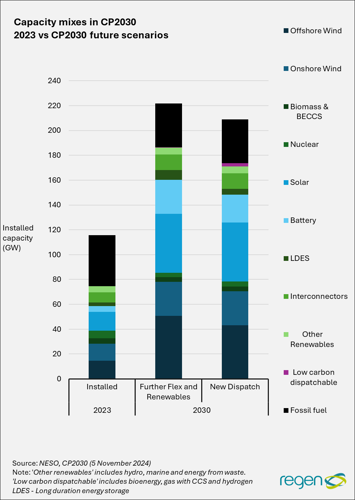
Onshore wind is a key technology identified by NESO for reaching CP2030 (DESNZ, 2025). It estimates that at least 13.6 GW more capacity is required.
Offshore wind is also a key technology, with indications that The Crown Estate will conduct leasing rounds once a year to accelerate deployment. CP2030 advice suggests that an additional 28.4 GW is needed.
Solar PV has been a consistent area of renewable development in England and is beginning to see greater deployment in the devolved administrations. CP2030 estimates an additional 32.3 GW of solar capacity could be installed by 2030.
Battery Energy Storage Systems (BESSs) are being rapidly deployed across the UK, with projects now reaching gigawatt capacity. BESSs have explicit support from NESO as a vital technology to balance the grid in a future high-renewables energy system, with a projected increase of 18 GW by 2030.
While hydropower has not seen much development in recent years and doesn’t feature in CP2030, it is a mature technology with strong future potential in nations with significant resource, such as Scotland. Pumped hydro storage has been omitted from this report due to both the infrequency and scale of these projects.
Tidal energy is a technology which has received a lot of attention for its potential role in providing reliable, predictable energy to the grid. Projects such as Meygen, the Orbital O2 and the Morlais demonstration zone are proving themselves successful tests of the technology, which may see deployment in some of the tidal estuaries around the UK.
Hydrogen has been widely discounted as a domestic heat fuel – with the National Infrastructure Commission recommending that the UK government should not support its rollout (NIC, 2023). Nonetheless, hydrogen production has significant potential for industrial processes and specific transport applications where energy density is of significant concern, such as aviation.
To achieve the scale of renewable energy increase needed in the UK, more grid infrastructure is needed. New substations or major extensions to existing substations may require planning permission from local planning authorities (LPAs). LPAs are also statutory consultees for large-scale grid infrastructure projects.
The Climate Change Committee (CCC) estimates that, by 2050, heat networks will provide 20% of the UK's heat – requiring significant investment in this infrastructure which currently delivers around 3% of the UK’s heat demand.
Section 2, below, summarises the considerations that should be applied to all technologies in the list.
Each subsequent section (3 – 11) provides guidance on constraints specific to individual technologies.
Below we have set out the national-level siting considerations in policy and guidance that apply across all technologies.
The National Planning Policy Framework (NPPF) sets the planning framework in England for all renewable technologies up to 50 MW and, currently, all onshore wind and battery storage projects (MHCLG, 2024). In December 2024, the UK government published an updated NPPF confirming that the threshold over which onshore wind and solar projects are considered as ‘Nationally Significant Infrastructure Projects’ (NSIPs) will move to 100 MW, with a transitional period until the end of 2025 as this policy change comes into effect).
The government has also published national planning guidance for renewable and low-carbon energy to support LPAs in developing policies (MHCLG, 2023). As well as covering several specific technologies in detail, the guidance gives the following generic siting considerations that must be considered for all renewable and low-carbon energy developments:
- Proximity of grid connection infrastructure;
- Size of site;
- Availability of resource (wind, solar, hydro, etc.);
- Vehicle access; and
- Set-back distances for safety (inflexible buffer zones and separation distances are to be avoided, local context such as topography should be considered).
The National Policy Statements (NPSs) for energy infrastructure also give advice on siting energy infrastructure and apply to NSIP projects in both England and Wales. NPS EN-1 sets out a list of generic impacts for consideration (DESNZ, 2023):
- Air Quality and Emissions;
- Historic Environment;
- Biodiversity And Geological Conservation;
- Dust, Odour, Artificial Light, Steam, and Insect Infestation;
- Traffic and Transport;
- Resource and Waste Management;
- Civil and Military Aviation and Defence Interests;
- Land Use, Including Open Space, Green Infrastructure, and Green Belt;
- Coastal Change;
- Noise and Vibration;
- Landscape and Visual Effects;
- Socio-Economic Impacts;
- Hydrology and Flood Risk; and
- Water Quality and Resources.
Wales’ policy for renewable energy planning is primarily determined by ‘Future Wales, the National Plan 2040’ (Welsh Government, 2021), which is supported by Planning Policy Wales (PPW) (Welsh Government, 2024), as well as guidance provided by NPS EN-1.
Policy 17 in Future Wales provides guidance to all projects, while Policy 18 does so only for Developments of National Significance (DNSs), which is defined as projects over 50 MW. Both policies provide criteria for assessing projects. In addition to the constraints in Table 1, Future Wales states that:
- Proposals of DNS scale in national parks and Areas of Outstanding Natural Beauty (AONBs) will not be permitted;
- Proposals should demonstrate that they do not have an unacceptable adverse effect on the environment;
- Proposals should describe the net benefits the scheme will bring to local communities;
- Proposals requiring new grid infrastructure should be designed to minimise visual impact on communities and individual dwellings;
- Proposals should cause no negative impact on designated sites or protected habitats and species without overriding public interest, and should provide proper compensatory measures;
- Proposals must include biodiversity enhancement measures to provide a net benefit;
- Proposals should cause no unacceptable impacts by way of shadow flicker, noise, reflected light, air quality or electromagnetic disturbance;
- Proposals should cause no impact on mid Wales low flying tactical training area;
- Proposals should consider the materials needed/generated to ensure sustainable use and management of resources;
- Proposals should have acceptable provisions for decommissioning, including effective restoration; and
- Proposals should consider the cumulative impact of existing and consented renewable energy schemes.
PPW contains additional guidance to LPAs. It states:
- That all steps of proposals should consider:
- Capacity of, and effects on, the transmission network;
- Grid connection issues; and
- Impacts of climate change on the location, design, build and operation of renewable and low-carbon energy development.
- That all projects are expected to include an element of local ownership, as detailed further in the local and shared ownership guidance (Welsh Government, 2022)
The Design Commission for Wales provides an additional list of design objectives for energy projects (Design Commission for Wales, 2023), including:
- Maximise benefits to local communities;
- Avoid negative environmental impacts on nature and wildlife;
- Enhance the ecological diversity of the site to provide a net benefit;
- Minimise environmental impact with sustainable construction throughout all stages;
- Make meaningful changes to the landscape through design; and
- Site design should be informed by local vernacular.
Scotland’s National Planning Framework (NPF4) sets out the following key considerations for renewables:
- Development must maximise net economic impact, including local and community socio-economic benefits;
- Development proposals which impact sites of international or national designations:
- Must include an “appropriate assessment” of the implications of conservation objectives for special areas of conservation or protection;
- The objectives of the designation and area integrity will not be compromised;
- Any adverse effects are outweighed by social, environmental or economic benefits of national importance; and
- Proposals in NatureScot’s ‘Wild Land Areas’ must include a wild land impact assessment.
- The project design and mitigation must address the following impacts:
- Impacts on communities and individual dwellings (residential amenity, visual impact, noise, shadow flicker, etc.);
- Significant landscape impacts (to be localised and include mitigations);
- Public access;
- Aviation and defence interests including seismological recording;
- Telecommunications and broadcasting installations;
- Road traffic and trunk roads, including during construction;
- Historic environment;
- Hydrology, the water environment and flood risks;
- Biodiversity and bird impact;
- Trees, woods and forests;
- Decommissioning (including ancillary infrastructure) and site restoration; and
- Cumulative impacts.
- Use of prime agricultural land must be minimised and have a plan for restoration; and
- Development on peatland or carbon rich soils requires a detailed site assessment on soil and climate impacts (Scottish Government, 2024).
Alongside NPF4, there are also guidance documents for projects requiring consent under sections 36 and 37 of the Electricity Act 1989 (Scottish Government, 2022). As of March 2025, the process for approval under this act is currently under consultation, mainly focusing on requirements to undertake pre-application consultations (DESNZ, 2024).
Although England’s NPS EN-1 doesn’t officially apply in Scotland, it states that its advice may be used by Scottish Ministers.
In Northern Ireland, projects are dealt with differently depending on their capacity. The project thresholds are set by the ‘Planning (Development Management) Regulations (Northern Ireland) 2015’:
- Projects under 5 MW are handled by the LPA.
- Electricity generation projects that are 5 MW or more, and all onshore development associated with the construction of an offshore electricity generating station, are classified as major developments, which means they must give 12 weeks’ notice to the LPA in line with section 27 of the Planning Act (Northern Ireland). These applications can be determined by either the LPA or the Northern Ireland Department for Infrastructure (DfI), depending on the project's specifics and significance.
- Projects of 30 MW or over are prescribed as ‘major developments prescribed for the purpose of section 26(1) of the Planning Act (Northern Ireland) 2011’ and must obtain consent from the DfI under section 39 of the Electricity (Northern Ireland) Order 1992.
LPAs in Northern Ireland are guided by the National Planning Policy Statement (NPPSs), along with Planning Policy Statement 18 (PPS18), and its best practice guidance The DfI is in the process of producing updated guidance regarding renewable and low-carbon energy (see Revised Regional Strategic Planning Policy – Renewable and Low Carbon Energy, Depart for Infrastructure, 2023).
The NPPS and PPS18 provide the following guidance:
- The proposal and associated buildings/infrastructure will not have an unacceptable adverse impact on:
- Public safety, human health or residential amenity;
- Visual amenity and landscape character;
- Biodiversity, nature conservation or built heritage interests;
- Local natural resources, such as air quality or water quality; and
- Public access to the countryside.
- Proposals will be located as close as possible to the resource;
- Any instances of unavoidable damage during construction, operation or decommissioning must have a minimisation and mitigation plan;
- Adverse effects on natural and built heritage should have mitigation measures;
- Developments on peatland should provide detailed reports on existing and potential hazards and mitigation/restoration measures (resultant risk could still cause rejection); and
- Proposals should each have decommissioning and landscape restoration plans.
Across each country there are two universal requirements:
- Consulting the Ministry of Defence (MOD): Developers must consult the MOD if the rotor diameter of any turbine is greater than 2m or has a distance to the blade tip of greater than 11m (Ministry of Defence, 2021).
- Noise: Developers must follow the good practice guidance on noise provided by the Institute of Acoustics (IoA) (IoA, 2013). The simple assessment requires that the turbine noise not exceed 35dB, or a developer may undertake a background noise survey and prove that the noise of the turbine will not exceed this by more than 5dB. This is usually conditional to a 10m/s wind speed, though a developer may use the wind speed at the maximum sound power level of the turbine.
In December 2024, the UK government published an updated NPPF confirming that the threshold upon which onshore wind projects are considered NSIPs will move to 100 MW for both technologies (with a transitional period until the end of 2025 as this policy change comes into effect). This means that planning permission for any project under 100 MW will be decided by the relevant LPA.
A ministerial statement published in July 2024 removed footnotes 57 and 58 from paragraph 163 of the adopted NPPF, removing the previous constraints for onshore wind applications related to allocating areas and demonstrating community support.3 This change was also reflected in the updated NPPF.
The renewable and low-carbon energy guidance for onshore wind outlines several considerations and requirements:
- Safety consultations should be undertaken with:
- Nearby buildings (noise considerations usually provide enough separation);
- Power lines;
- Air traffic control/radar (statutory within 15km, advisory within 32km);
- Weather radar; and
- Strategic road network (see national highways advice for further detail) (Department for Transport, 2022).
- Consultation with Ofcom regarding electromagnetic transmission networks;
- Ecological considerations (bats and birds);
- Shadow flicker (only for properties within 130 degrees either side of North);
- Cumulative impact (separately for landscape and visual impact);
- Decommissioning plan; and
- Pre-application local community consultation (for projects with more than two turbines or with a hub height greater than 15m) (Welsh Government, 2011).
Onshore wind farm projects between 10MW and 350MW in Wales are considered to be Developments of National Significance and require consent from the Welsh government. For projects over 350MW, the Secretary of State handles consenting under the Nationally Significant Infrastructure Projects (NSIP) process.
Designing for Renewable Energy in Wales sets out a list of siting factors and design considerations for all wind farms, including:
- Exposed places that are open, high and relatively prominent;
- Land ownership;
- Access;
- Site topography;
- Proximity to settlements;
- Design of lighting to minimise visual impact while satisfying health and safety and navigation requirements;
- The potential to allow continued agricultural use;
- Visual prominence arising from turbine blade movement;
- Avoiding excessive turbulence (turbine separation distance should be roughly 4-5 rotor diameters);
- Consulting with NATS and Operators of Officially Safeguarded Civil Aerodromes;
- Ornithology (Consulting with Natural Resources Wales (NRW), and the Royal Society for Protection of Birds); and
- Siting/design/impact of ancillary infrastructure (substations, transmission lines, access tracks and control buildings).
Best practice guidance on planning implications for renewable and low-carbon energy reinforces many of these requirements (Welsh Government, 2011).
Applications for onshore wind farms with a capacity below 50 MW are made to, and determined by, the relevant LPA. Those with a generating capacity above 50 MW require energy consent from Scottish Ministers under section 36 of the Electricity Act 1989. They are also classed as 'national developments' (as defined in the Scottish Government's NPF4).
Policy 11 of NPF4 specifies that development proposals in national parks and scenic areas will not be supported, and that consented wind farms are expected to operate in perpetuity. The Scottish onshore wind policy statement expands on several of the most relevant impacts covered in section 2.3 in relation to onshore wind (Scottish Government, 2022).
The Scottish Government also published a planning advice note in 2014 which contains additional non-prescriptive guidance for LPAs (Scottish Government, 2014), including:
- Buffer zones should not be established around natural heritage areas – proposals should be considered on merit;
- Warning signage for ice throw (where turbine blades develop ice build-up, and then sheds the ice while revolving) as an added precaution to equipment safety standards; and
- Up to 2km separation buffer to the edge of villages, towns and cities. Individual assessments of local geography and circumstances should always be considered.
NatureScot has also produced guidance aimed at both developers and planners detailing environmental considerations (see Onshore Wind Turbines: Planning Advice, Scottish Government, 2014). Though it doesn’t provide any new considerations, it is a useful source for further detail and reinforces many of the other given considerations.
PPS18 policy RE1 and the best practice guidance from PPS18 together suggest that developers should consider the following matters for onshore wind:
- Impact on road, rail or aviation safety:
- For road and rail, a separation distance of tip height plus 10% is advised; and
- Aviation safety refers to radar interference and risk to low-flying aircraft.
- Local amenity impacts such as noise, shadow flicker, reflected light, ice throw, electromagnetic interference (communications, radar, air traffic control or other) – there is an advised buffer of 10 rotor diameters (minimum of 500m) to occupied buildings;
- Overall environmental and social benefits;
- Potential impact of the project on nature conservation including direct and indirect effects on protected sites, habitats and sensitive species, and, where necessary, management plans for satisfactory co-existence of the site and any identified species;
- Impacts on ground conditions including peat stability and risk of landslide or bog burst;
- Impact on drainage, sedimentation of water bodies and other hydrological effects;
- Adequacy of local access roads during construction;
- Cumulative effects due to other projects (visual and noise);
- Location of proposed borrow pits and quarries and remedial works;
- Waste storage/disposal from construction/site clearance; and
- Approval for grid connection and related works.
The Department of Agriculture, Environment and Rural Affairs (DAERA) has produced a guide to wind energy installations, covering the key environmental considerations and required information, including:
- Environmental considerations:
- Collision risk to birds/bats from rotating blades.
- Required information/documentation:
- Turbines: number of, positioning, height and blade diameter, hardstanding dimensions;
- Infrastructure: access/internal tracks, transformers/substations and transmission lines, haul routes, site drainage plans;
- Surveys/assessments: ecology, hydrological/hydrogeological, landscape/visual impact; and
- Mitigation/compensation: pollution prevention measures, habitat management/mitigation plan, species mitigation (DAERA, 2025).
The Northern Ireland Environment Agency (NIEA) and the DfI have also produced extensive guidance for developers and LPAs for visual impact assessments in Northern Ireland specifically related to wind developments (NIEA, 2010).
Offshore wind projects fall under the category of NSIP (or each devolved nation’s equivalent of this) meaning the LPA will be a statutory consultee. The licensing and consents that offshore wind projects require are predominantly the responsibility of the relevant marine licensing authority for the project. Local authorities may hold responsibility for approving aspects of the associated onshore infrastructure for offshore wind.
Our research did not identify any published guidance documents for either developers or LPAs relating to offshore wind.
NRW has produced guidance for Wales focused on guiding developers through the Environmental Impact Assessment (EIA) process and the required consents for marine works (Natural Resources Wales, 2025).
The Scottish Government has produced an offshore wind policy statement, though it makes little reference to LPAs or onshore infrastructure planning (Scottish Government, 2020). An offshore consenting and licensing manual published by the Scottish Government states that LPAs will be consulted on marine licenses and onshore components (Scottish Government, 2018).
Northern Ireland has no offshore wind projects to date, though a draft offshore renewable energy action plan underwent consultation in early 2023 (Department for the Economy, 2023).
Relevant case studies that may prove useful as examples of planning applications for offshore wind include:
- England: The Dogger Bank South wind farm off Yorkshire (RWE & Masddar, 2024)
- Wales: Gwynt y Môr off Denbighshire (Tethys, 2005) and Awel y Môr off Denbighshire (DESNZ, 2023)
- Scotland: Seagreen in East Lothian (East Lothian Council, 2023).
In December 2024, the UK government published updates to the NPPF confirming that the threshold over which solar projects are considered NSIPs will move from 50 MW to 100 MW. This means that planning permission for projects under 100 MW will be decided by the relevant LPA.
The UK government’s renewable and low-carbon energy guidance states that in considering large-scale ground-mounted solar, LPAs should consider the following (Natural England, 2021):
- Solar farms should use previously developed, non-agricultural land where possible;
- Greenfield land should be shown to be necessary, with poorer quality land given preference (see advice from Natural England on land grading);
- If applicable, proposals should allow for continued agricultural use and/or encourage biodiversity improvement around arrays;
- Planning conditions should ensure installations are removed and land is restored when the solar farm is no longer in use;
- The effect on landscape, neighbours and aviation of glint/glare;
- The extent to which there may be additional impacts if solar arrays follow the daily movement of the sun;
- The need for and impact of security measures such as lights and fencing; and
- The potential to mitigate landscape and visual impacts, such as through native hedges.
In Wales, unless material considerations indicate otherwise, the LPA determines solar projects of under 50 MW. Solar projects between 50 MW and 350 MW are covered by the Planning (Wales) Act 2015 and are considered DNSs. These projects must seek planning permission from Welsh Ministers. Solar projects with a generating capacity of above 350 MW are classified as NSIPs.
‘Designing for renewable energy in Wales’ gives the following design considerations for solar arrays:
- Considerations which make for suitable sites:
- Low-grade farming land;
- Non-designated locations;
- Suitable solar orientation;
- Appropriate capability of connecting to the grid/facility it serves;
- Capability of screening with perimeter planting/possibility of integration with existing landscape pattern; and
- Low impact on existing settlements and communities.
- Possibility of splitting arrays into smaller ‘fields’ to aid screening and better fit the landscape;
- Use of colour in panels and their support structures to reduce landscape contrast;
- Potential to provide continued agricultural land use; and
- Considerations of siting and design for ancillary infrastructure (substations, cables, access tracks, control buildings, etc.).
The planning implications document, contains a few other considerations:
- Glint and glare potential;
- Ecological impacts from security fencing on mammals, and lighting on bats; and
- Agricultural land of grade 3a and above should only be used if no other options are available (due to presence, need, environmental or historical reason.
In Scotland, the LPA decides on solar projects up to 50 MW. Solar projects above 50 MW must seek consent from Scottish Ministers through the Scottish Government's Energy Consent Unit.
The planning advice note produced for solar projects gives the following planning considerations:
- Ecological impacts from construction;
- Potential impacts on communities from loss of traditional land usage; and
- Glint and glare impacts.
Further details on the ecological and environmental impact considerations of solar developments are provided by NatureScot, in addition to further information on visual impacts (NatureScot, 2025).
The best practice guidance to PPS18 focuses mainly on domestic and commercial solar PV installations but makes note of the potential impact of shading from nearby trees, buildings or other structures on overall efficiency.
DAERA has also published guidance on solar energy, which gives the following environmental considerations (DAERA, 2025):
- Potential damage to habitats (bogs, heathlands and low-nutrient grasslands);
- Species disturbance/displacement; and
- Modification to waterways/pollution of water environment from maintenance chemicals.
The planning regime for batteries varies across the nations. In England and Wales, LPAS are responsible for all standalone BESS applications.
In Scotland, LPAs are only responsible for applications up to 50 MW as they are treated as generating stations (Scottish Government, 2020). Projects greater than 50 MW must seek consent from Scottish Ministers under Section 36 of the Electricity Act (1989) through the Scottish Government's Energy Consent Unit.
In Northern Ireland, under The Planning Regulations (Northern Ireland) 2015, any project up to 30 MW requires permission from local authorities as a generating station (Department for Infrastructure, 2020). However, the advice to treat BESS as generating stations has undergone judicial review and it is recommended that the chief planner’s update is read along with this review (High Court of Justice in Northern Ireland, 2021).
Multiple organisations have published guidance applying to all four nations in the United Kingdom. The Energy Institute has a guidance note focused on storage planning which advises LPAs to review (Energy Institute, 2019):
- The site restrictions, including the area immediately around the installation;
- Type of housing structure(s) (trade-off between vernacular design and fire risk);
- Grid connection capacity;
- Site security and its impacts on maintenance, visual impact, noise and safety;
- Intended project use;
- Noise assessment compared to the background, and arising from cooling methods;
- Heating/cooling methods;
- Lifetime maintenance requirements (site access for equipment/on-site storage);
- Fire safety and emergency procedures; and
- In the case of colocation with other technologies, risk and hazard analysis should be completed for each technology on its own and the potential impacts on each other.
Although they are not statutory consultees, the emphasis on fire safety and risk has led the National Fire Chiefs’ Council (NFCC) to produce a guidance document on BESS considerations (NFCC, 2022). This document, though still relevant, is under consultation to provide up-to-date information on current technology and, as such, the specifics of the guidance are expected to change (NFCC, 2024). Current considerations include:
- Inclusion of detection, monitoring and fire suppression systems;
- Appropriate access for fire services (decided through consultation) and two separate access tracks to account for wind conditions;
- Advised inter-unit spacing of 6m unless evidence shows safety for smaller distances;
- Advised spacing of 25m around the site boundary with buildings located upwind as far as possible, reductions should have mitigation measures;
- Appropriate water supplies and run-off measures to be decided with fire services; and
- Emergency response plan.
The Department for Energy Security and Net Zero (DESNZ) has published health and safety guidance produced by Frazer-Nash including advice on design and planning, predominantly for developers, most of which supports existing advice from the NFCC (DESNZ, 2024).
In England, the Renewable and Low Carbon Energy Guidance is only focused on the requirements regarding fire safety, linking to the published guidance from the NFCC.
Our research found no published guidance from Wales, Scotland or Northern Ireland for planners regarding BESS.
Hydropower projects with a capacity of up to 50 MW are determined by the relevant LPA. Larger projects fall under the NSIP regime.
Run-of-river hydropower in England requires the following licences from the Environment Agency:
- Abstraction licence;
- Impounding licence;
- Fish pass approval (if a fish pass will be installed/modified in the scheme); and
- Flood risk activity/land drainage consent (Environment Agency, 2023).
Other points of consideration are:
- Co-location with protected areas (may require consultation with Natural England);
- Powerhouse:
- Visual impact assessment (size, visibility, noise, design, finish); and
- Heritage impact if using a historic powerhouse.
Under the Infrastructure Wales Act 2024, hydropower projects with a capacity of up to 50 MW are determined by LPAs. Applications for projects between 50 MW and 350 MW are made directly to the Welsh Ministers under the DNS regime and projects over 350 MW are consented by the Secretary of State under the NSIP process.
Constructing a hydropower plant requires several licences, each of which is granted by NRW (NWR, 2023):
- Abstraction licence;
- Impoundment licence;
- Fish pass approval; and
- Flood risk activity permit.
An additional ordinary watercourse consent is needed if permanent or temporary works are in, or adjacent to, an ordinary watercourse (a designation for upland tributaries of larger rivers). This is to be assessed and granted by the lead local flood authority within the local authority.
NRW is a statutory consultee for LPAs when assessing the environmental impacts of hydropower schemes and suggests several impact considerations (NWR, 2023):
- Physical building appearance;
- Ecology;
- River morphology; and
Hydropower projects with a capacity of up to 50 MW are determined by the relevant LPA. Larger projects must seek consent from Scottish Ministers through the Scottish Government's Energy Consent Unit.
The primary licence required in Scotland is the Water Environment (Controlled Activities) Regulations (commonly referred to as a CAR licence), which is controlled by Scottish Environment Protection Agency (SEPA). SEPA has produced a guidance document for developers on how to obtain a CAR licence for their project (SEPA, 2015). SEPA is also responsible as a consultee for ensuring that spatial plans have regard to river basin management plans.
The Scottish Government provide the following planning guidance on hydro schemes (Scottish Government, 2013):
- Engage with SEPA, Scottish Natural Heritage, environmental non-government organisations and other water users as key consultees;
- Consider land ownership, access, grid and transmission constraints;
- Good practice should be ensured during construction (including considerations of work schedules to avoid breeding seasons for sensitive species); and
- Mitigate against impacts where possible. This may be part of either the planning or the water licence consent (depending on what is deemed appropriate by LPAs and consultees).
The NIEA is responsible for approving abstraction licences in Northern Ireland, the process of which is provided in a document published by DAERA (DAERA, 2018).
In the best practice guidance to PPS18, the DfI suggest a list of planning considerations:
- Siting and landscape (minimising the impact of built structures and pipes/powerlines), any built structures should consider their design and incorporate vernacular building materials where possible;
- Hydrological and ecological consultations with NIEA, the Department for Culture Arts and Leisure and, where appropriate, the Loughs Agency;
- Fisheries interests and fish passages;
- Noise should be dampened by the turbine house – an assessment should be completed if the site is close to residential properties;
- Construction disturbance to the water environment and any operational disturbances from routine maintenance; and
- Public access and recreation during construction and operation.
Much like offshore wind projects, licenses for tidal projects are typically granted by the relevant marine authorities, though LPAs may have a role in granting planning permission to the near and onshore infrastructure. Unlike offshore wind, none of the four nations have published any guidance or policy documents specifically for tidal energy.
The Planning Act 2008 notes that offshore generating stations are nationally significant if they are over 100 MW. In practice, previous tidal projects of below 100 MW in England have applied through The Crown Estate, the former Department of Energy and Climate Change (DECC) and the Isle of Wight Council, suggesting no clear capacity cut-off for local versus national consenting.
Marine Licenses are required for all the marine elements of a proposed offshore development. Any Development Consent Order (DCO) granted by the Secretary of State may include provisions deeming the grant of a Marine Licence for operations carried out wholly in England and English waters. NPS EN-3 contains considerations specific to tidal stream devices, including:
- Seabed geology and foundation conditions;
- Water depth; and
- Impact on intertidal and subtidal seabed habitats and species.
Under Section 36 of the Electricity Act (1989), Welsh Ministers are responsible for consents for projects between 1 MW and 350 MW in the Welsh inshore area (out to 12 nautical miles) and projects between 50 MW and 350 MW in the Welsh offshore area (beyond 12 nautical miles, out to 200 nautical miles). Offshore energy projects over 350 MW are consented by the Secretary of State under the NSIP regime.
Consent from Scottish Ministers under Section 36 of the Electricity Act (1989) is required for generating stations above 1 MW in Scottish inshore regions and above 50 MW in Scottish offshore regions. The same principles of LPA involvement which apply to offshore wind also apply to tidal energy.
Onshore components of tidal projects are subject to the tests outlined in section 2.4. LPAs are responsible for approving the onshore components of offshore projects up to 30 MW except if the Department for the Economy (DfE) deems the project to be of appropriate significance to take over the application.
Case studies for tidal energy include:
- England: Perpetuus tidal energy centre in the Isle of Wight (Isle of Wight Council, 2025);
- Wales: Morlais demonstration zone project in the Isle of Anglesey (Welsh Government, 2021); and
- Scotland: MeyGen in the Highland council area (MeyGen, 2011).
Green hydrogen is a new technology, and very little explicit guidance is given in any of the overarching planning frameworks. Research and consultation with hydrogen developers by DESNZ reinforces this, stating that there is a lack of understanding, guidance and flexibility in the approval process (DESNZ, 2023). The only document identified through our research was ‘Planning for onshore green hydrogen’ by RenewableUK, which also identifies the challenges around a lack of official guidance . Key details from this document are:
- Issues raised by consultees which require addressing:
- Noise (electrolysers and compressors);
- Vehicle movements for deliveries;
- Drainage, water supply and pollution, especially in water-constrained areas; and
- Health & safety.
- Key regulatory regimes:
- Hazardous substances consent;
- Control of major accident hazards;
- Environmental permitting; and
- Water abstraction and discharge licencing.
A practice note published by Thomson Reuters for hydrogen projects sets out useful advice on the licences and planning process, although it is focused on guiding developers, funders and off-takers, rather than planners, and is not specific to green hydrogen (Nardell, et al, 2021).
Scotland has a hydrogen policy statement (2020), though it doesn’t provide guidance, only committing to further developing a clear framework and plan (Scottish Government, 2020). More recently, Scottish Government published its Hydrogen Action Plan (2022), which does state a goal to produce consenting guidance, though this was intended to be published in 2023 and has not yet come out (Scottish Government, 2022). The Scottish Government worked with University of Edinburgh, University of Strathclyde and University of Aberdeen to design the Introduction to Hydrogen for the Public Sector course for all local planning professionals throughout Scotland which consists of a series of three videos available to access online (Improvement Service, 2025).
Northern Ireland has no explicit guidance or documentation around hydrogen, though the 2015 planning regulations do give scales for when storage projects become major developments. Major developments are defined as having a storage capacity expected at 30,000 tonnes or more, while prescribed major developments have a capacity of 200,000 tonnes or more, or include underground geological storage.
A report by Marubeni Europower, funded by the Welsh Government, gives a case study example of a project in Bridgend (Marubeni Europower, 2023). The report is aimed at local authorities, taking them through the planning process. The report includes a list of required application documents which are typical of any planning application, and a list of likely local requirements. The likely requirements are:
- Flood consequences assessment if the project is within zones C1 or C2 as specified in Technical Advice Note 15 (Welsh Government, 2021);
- Coal mining assessment if the project is within a coal authority consultation area;
- Air quality/odour assessment – mainly related to vehicle movements if there are nearby sensitive receptors;
- Contaminated land/ground investigation assessment;
- Tree survey if there are trees within or adjoining the site;
- Foul and surface water drainage survey;
- Landscape and visual assessment;
- Ecological assessment;
- Noise assessment dependent on nearby noise-sensitive receptors;
- Transport assessment;
- Hazardous substances consent if two or more tonnes of hydrogen will be stored or used; and
- Control of Major Accident Hazards report if five or more tonnes of hydrogen will be stored.
NPS EN-5, on electricity network infrastructure, states that the policy outlined in NPS EN-1 still applies to grid infrastructure (DESNZ, 2023). It also outlines further constraints for siting and good design:
- Siting is determined by:
- The location of new generating stations or infrastructure,; and/or
- System capacity and resilience requirements from the Energy System Operator (particularly relevant to the future delivery of the Strategic Spatial Energy Plan (DESNZ, 2024)).
- Good design:
- Resilience to climate change;
- Environmental and biodiversity net gain;
- Land ownership/access rights for construction and maintenance;
- Consideration of effects from electromagnetic frequencies; and
- Assessment on the possibility of avoiding use of sulphur hexafluoride in high-voltage switchgears, and justifications if it is used.
Under the electricity act 1989 section 37, overhead lines are decided at the LPA level if they are either:
- Less than 20 kilovolts (kV) and intended for a single customer; or
- Less than 132 kV.
Additionally, LPAs determine applications for cables related to Welsh generating stations of less than 350 MW.
Guidance on the consents regime for overhead lines (OHLs) states that developers must provide project details to LPAs and allow LPAs to either raise objections to the Secretary of State within two months or request to add conditions to the planning permission (DECC, 2014).
Any OHL project that has a voltage of over 20 kV, or is not entirely within the land or control of the installer, falls under Guidance on Applications for Section 37 consents without an EIA (Scottish Government, 2019). In such cases, the responsibility for approval of the OHLs lies with Scottish Ministers. Section 4 highlights that developers are required to inform LPAs of developments while seeking approval for OHLs less than 132 kV. Though it provides no guidance to LPAs, it does reinforce the importance of land permissions.
Substation planning permissions are granted by LPAs under the Town and Country Planning (Scotland) Act 1997 (Scottish & Southern Electricity Networks, 2025), information on some of the required consents and their clauses are outlined by Scottish and Southern Electricity Networks (Scottish & Southern Electricity Networks, 2025). Although guidance exists on the consenting responsibility and process, research showed no guidance for LPAs on consenting the infrastructure. NPS EN-5, however, does note that planners in Scotland might use it for guidance (CIBSE, 2021).
Our research found only limited guidance on the constraints on, or requirements for, the approval of grid infrastructure in Northern Ireland. The Planning (Development Management) Regulations (Northern Ireland) 2015 refers to the scale at which power lines become major developments, and prescribed major developments, which require pre-consultation with the DfE:
- Major development:
- Power line where the voltage exceeds 33 kV, if the purpose is to supply more than one customer.
- Prescribed major development with DfE pre-consultation:
- Voltage is 110 kV in a double circuit OHL or exceeds 275 kV; and
- The line length is more than 15km.
Our research did not find any guidance for LPAs for the approval of heat networks, or much advice on the technical constraints which apply to them. However, multiple organisations have put together developer-focused guidance, including:
- The heat network code of practice from CIBSE (CIBSE, 2021);
- The London heat network manual (LHNM) (Greater London Authority, 2021); and
- An applicant guidance document from Salix (Salix, 2025).
Though produced by the Greater London Authority, the LHNM is intended to provide general guidance for heat networks.
In terms of issues for planners to consider, our interview with heat network expert, Paul Barker from 1energy, identified two separate aspects of heat networks which require consideration: pipework and the energy centre.
11.1.1 Pipework
Heat networks are not currently considered as a statutory utility, meaning that planning permission is required for installing the pipework. However, the Energy Bill Policy Statement sets out plans to further regulate heat networks meaning that, in the future, heat network pipework will not need planning permission, though developers will continue to need to put in place appropriate easements and wayleaves (DESNZ, 2023).
At present, planning permission is required for pipework. This can create issues if during project development the route for the pipework needs to be changed – meaning that consent needs to be sought for the change.
Some local areas have set up Local Development Orders (LDOs) for heat networks, including Exeter, Leeds and Bristol, allowing developers a more straightforward route to seeking and amending permissions. LDOs are planning tools that grant permitted development rights for specific types of development within defined areas, streamlining the planning process and encouraging certain developments. For example, Bristol City Council has implemented an LDO to facilitate the installation of its heat network (Bristol City Council, 2023). This LDO permits the installation, maintenance and operation of the heat network infrastructure, including underground pipes and ancillary infrastructure, within designated areas of the city.
11.1.2 Energy centres
Energy centres for heat networks can take several forms – e.g. air source heat pumps, ground source heat pumps, water source heat pumps, energy from waste, gas-fired combined heat and power, and bioenergy. The relevant planning considerations will depend on the technology type and size. Considerations might include noise, visual impact, air pollution, flood risks and biodiversity net gain.
Heat network zones are due to be introduced in England from 2025 (DESNZ and BEIS, 2025). Heat network zones will be broad areas that would make suitable locations for heat network developments, identified through a national modelling exercise. Proposals consulted on in 2023/24 include provision for local authorities to take the role of Zone Coordinator, responsible for refining, designating and implementing the zone (DESNZ, 2024). In some cases the Zone Coordinator may be another body but the expectation is that in most cases it will be the local authority.
Once the zone is designated, the Zone Coordinator will award the right to develop all or part of the heat network zone to a heat network developer. Certain developments within the zone will be required to connect to the heat network as it is built out or if it is already in place. Current proposals are that these would include new buildings, existing communally heated buildings and some existing non-domestic, non-communally heated buildings.
In Wales, heat network priority areas have been mapped in Future Wales – The National Plan 2040. The National Plan states in Policy 16:
“Within Priority Areas for District Heat Networks, planning authorities should identify opportunities for District Heat Networks and plan positively for their implementation. Large-scale mixed‑use development should, where feasible, have a heat network with a renewable/low-carbon or waste heat energy source. Planning applications for such developments should prepare an Energy Masterplan to establish whether a heat network is the most effective energy supply option and, for feasible projects, a plan for its implementation.”
Scotland has the clearest consenting regime, the Heat Networks (Scotland) Act 2021 (Legislation.gov.uk, 2021). Section 20 states that local authorities will be the consenting authority for heat networks if:
- Designated by Scottish Ministers after they consult with that local authority; and
- The local authority makes a written request to Scottish Ministers that they be designated as the consent authority.
Otherwise as per section 21, the consenting authority for a project would be the Scottish Ministers. If a local authority rejects an application, an appeal can be raised to Scottish Ministers who may direct that the application be referred to them over a local authority. A heat network zones guidance document was produced to support the act, which provides a list of statutory and recommended consultees (Scottish Government, 2023). Most of the guidance in this document is to aid the identification of suitable sites rather than considering the planning issues.
In Northern Ireland, no specific advice or policy exists at present, however, the DfE is proposing to establish a regulatory framework (Department for the Economy, 2025).
For all countries, established technologies such as onshore wind, solar and hydropower are well covered, while newer technologies have more varied approaches. Overall, these newer technologies lack clear guidance, in particular hydrogen infrastructure, heat networks and BESS.
Grid infrastructure tends to have clear planning regimes, though very little guidance to assess applications with. This issue extends to other technologies like offshore wind and tidal energy, where LPAs may be involved as statutory consultees and potentially responsible for assessing elements of the onshore infrastructure.
Below, we discuss the key areas where policy and guidance may need further development in each of the four nations.
While NPS EN-1 contains overarching advice for England and Wales, it is somewhat vague about how its list of impacts should be considered. Future Wales takes the overarching guidance a step further and details some specific issues that Welsh project proposals should seek to address in their applications.
Grid infrastructure may be the focus of NPS EN-5, which encourages reference to EN-1, but it similarly lacks the kind of detail which may be useful to planners. The closest it contains to planning guidance is a section on good design principles which, while useful, is focused on developers, not planners. Similarly, guidance to assess the onshore grid components of offshore wind or tidal projects has not been produced, leaving these technologies in the same situation as grid infrastructure.
Heat networks are similarly unclear, a lot of guidance has been produced for prospective developers, though no official planners’ guidance has been produced by either the UK government or Welsh Government. The upcoming developments to heat networks, such as zoning and the regulatory shift to heat networks as statutory utilities, will clarify the planning regime. As part of the changes, a consultation was produced which, among other things, was intended to determine the role of local government in delivering zoning. Despite mentions of interactions with the planning system, it is not clear if specific planning guidance is due to be produced.
Guidance for hydrogen infrastructure has been produced for developers by independent organisations, yet no official planning guidance has been published. The Welsh Government has backed a guide produced by Marubeni Europower which currently appears to be the only report produced for local authorities.
No officially published guidance has been produced for BESS from either England or Wales, though the renewable and low-carbon energy page links to the non-statutory NFCC guidance.5 The most detailed guidance is from the Energy Institute, although this isn’t referenced by any official material.
Scotland’s NPF-4 is the most detailed of all the overarching policy documents, setting out considerations, areas which require mitigation and covering issues related to land use. This is further backed by several individual technology-specific documents for well-established technologies. Given the level of detail included in the NPF-4, it could be seen to make up for a lack of published guidance on newer technologies, though notably, specific guidance is still lacking for these technologies compared to the other nations.
The UK government’s NPS EN-5 does state that Scottish Ministers may find it useful as a reference for grid infrastructure projects. Although it contains the clearest guidance to consenting regimes, there is no officially published guidance for Scotland for grid planning. As with England and Wales, the onshore components of offshore projects are similarly reliant on EN-5 due to a lack of specific guidance.
Heat networks in Scotland are well supported. However, while the heat network zone guidance provides recommendations for who developers should consult, it contains no advice for LPAs to assess the energy centres or pipeline aspects of heat network development.
Hydrogen developments are also well supported in Scotland but are similarly impacted by a lack of guidance. The promised consenting guidance may solve the issue, although if any progress has been made to produce this document it has not been identified through this research.
NPF-4, along with the instruction that BESS be treated as generating stations, may provide LPAs with enough guidance to assess BESS, though there is still no official guidance for the technology to assess the fire concerns that are highlighted in other countries’ guidance.
PPS18 in Northern Ireland contains more descriptive guidance for assessing project proposals than NPS EN-1, though it still requires several supporting documents for each technology as it only covers generic considerations.
Like other nations, the consenting regime for grid infrastructure is very clear in Northern Ireland, though guidance on the consenting of infrastructure is lacking. Onshore grid infrastructure associated with offshore projects is also missing guidance. While there are no active offshore projects in the country’s waters, the offshore renewable energy action plan is a statement of intent to develop offshore wind. It is unclear if the action plan will address these issues, though a planning, licensing and consenting working group has been established.
Heat networks in Northern Ireland have no real guidance outside of that provided by independent organisations in Great Britain. The framework which has been planned has no delivery date attached to it and no indication of whether it may address planning issues.
Although the regime around hydrogen storage is given clarity in the 2015 planning regulations, no guidance is given for the consenting of other hydrogen infrastructure, with no specific commitments to produce guidance or strategy documents around hydrogen in the near future.
As in Scotland, BESS are generally treated as generating stations in Northern Ireland, making the PPS18 guidance generally applicable, though there is no published guidance from the government. BESS also received little to no mention in any official published material.
In terms of overarching policy, Scotland provides a leading approach, with the NPF providing a supporting framework and covering the considerations associated with energy infrastructure in detail.
However, additional guidance may be needed for newer and emerging technologies to support local authority decision makers across the UK. We describe these below.
For grid infrastructure, a consenting guide covering cables, towers and substations could simplify the planning process for network expansion at a local authority level, both for planning teams and developers. The same guide could also cover the relevant onshore elements of offshore projects for local planning teams, covering any further considerations for where undersea cables make landfall.
Heat networks in Great Britain are currently awaiting significant policy changes and, without knowing what those changes look like, it is difficult to know the role of local planners in determining applications. Best practice guidance for heat networks would be useful in setting planning policy, determining projects and shaping heat network development.
Hydrogen guidance is lacking across the UK, likely as it is an emerging technology with few projects currently operational. Further development could be encouraged with clear guidance for developers and planners on the role of hydrogen and its status in the consenting regime and planning system. At the time of publication, we are aware of guidance being developed by UK government. This guidance should include consideration of whether hydrogen is being produced from green sources.
BESS have many unique considerations, as evidenced by the guidance from the NFCC. Official guidance would enable clarity for planners when assessing projects, which is especially crucial in Northern Ireland where viewing batteries as generating stations is not a clear position.