

This route is for apprentices.
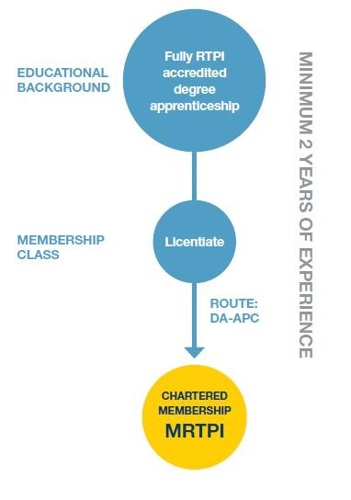
The Degree Apprenticeship End Point Assessment is the final stage of the Chartered Town Planner Apprenticeship and enables an apprentice to become a Chartered Town Planner (MRTPI) whilst gaining practical experience in the work place. As part of this scheme, apprentices complete a Degree Apprenticeship Assessment of Professional Competence (DA-APC).
Eligibility
To be eligible to submit your End Point Assessment application:
- You must be an apprentice registered on the Chartered Town Planner Degree Apprenticeship.
- You must have met the gateway requirements:
- Level 2 English and Maths
- RTPI accredited qualification
- At least 12 months recorded in the Reflective Journal
- You must be a current registered Licentiate (apprentice) of the RTPI.
- You typically will have 2 - 5 years experience with a minimum of 20% of-the-job training.
 What is the Degree Apprenticeship End Point Assessment?
The End Point Assessment (EPA) is the final assessment you need to complete to achieve your apprenticeship certificate. It has been developed approved by the Institute for Apprenticeships & Technical Education (IfATE). The EPA consists of two methods, both of which must be completed:
- Method 1: Professional Discussion
- Method 2: DA-APC
Method 2 can only be completed upon successful completion of Method 1. For both methods, you must submit a Reflective Journal documenting your work experience.
What is the Reflective Journal?
Your Reflective Journal must be submitted for both methods of the Degree Apprenticeship End Point Assessment:
- Method 1: Professional Discussion. For this method, your Reflective Journal must cover a minimum of 1 year of recent experience (full-time equivalent) from the apprenticeship period (prior to becoming a Licentiate of the RTPI).
- Method 2: Degree Apprenticeship Assessment of Professional Competence (DA-APC). For this method, your Reflective Journal must be continued to cover the experience gained whilst registered as a Licentiate of the RTPI and any case studies you use within the DA-APC application.
What is the Professional Discussion?
Apprentices will have a 50 minute discussion with an independent assessor. Apprentices will be asked questions about their experience and their understanding of relevant skills and behaviours. The Professional Discussion will usually take place in the apprentice's workplace using digital conferencing facilities.
What is the DA-APC?
Apprentices must prepare a 5,500 word written submission (+/-10%) demonstrating their experience and how they have developed their competence. There are three parts to the submission:
- Practical Experience Statement (PES)
- Professional Competence Statement (PCS)
- Professional Development Plan (PDP)
Your DA-APC submission must contain the following items:
To complete your application for Chartered membership through the DA-APC route, you will need the following:
- A copy of any relevant degree certificate or transcript to confirm you have been awarded the qualification/s. From June 2026 onwards, for the DA-APC route only, it is now optional to submit a copy of your degree certificate or transcript as part of your DA-APC application.
- A signed sponsor declaration form.
- Corroborator declaration form/s.
- Your written submission, including the three components: PES, PCS and PDP.
- Your reflective journal.
- Your employment history.
Download the main guidance from our Resource Centre.
Submitting your application
2026 new applications:
Please submit your application via the online joining portal. The RTPI will accept files up to 10 MB each. If an individual document is larger than this, please contact the Membership team for advice on how to resave your submission in a smaller file size.
See the how to submit page for more information on how to submit your application online.
All first-time and resubmissions from February 2026 onwards should be made via the online joining portal. We will no longer accept applications via email.
Fees
The Degree Apprenticeship End Point Assessment is funded as part of the Chartered Town Planner Degree Apprenticeship. An End Point Assessment Fee is paid by the university out of the apprenticeship funding.


