

Part four: Analysis and recommendations - how to integrate local energy planning and town planning across the UK
This resource is part of the RTPI’s SALEP (Spatial Approaches to Local Energy Planning) suite of guidance, analysis and in-depth case studies on integrating energy planning with town planning across the UK.
It was produced in collaboration with Regen.
It provides readers with an overview of:
- Climate and energy targets across the UK, and how they are reflected in policies across different nations;
- The electricity transmission and distribution networks across the UK;
- The consenting (planning) regimes in different UK nations for major and local energy projects; and
- The different levels of energy infrastructure-related spatial and development plans in different UK nations.
You can read this document in full below or you can download as a Word or pdf version.
Table of Contents
2. Key opportunities in integrating energy and town planning
3. Key challenges in integrating energy and town planning
4. Recommendations - How can local authorities help planners be better equipped?
5. Recommendations - What should change at the national level?
Local Area Energy Planning and Local Heat and Energy Efficiency Strategies
In the introduction to this SALEP resource suite, we described the central role that decarbonising the UK’s energy supply systems will play in meeting the country’s net zero ambitions. To rise to this challenge, across the UK local authorities have been investing in energy planning processes, such as Local Area Energy Planning (LAEPs) and, in Scotland, Local Heat and Energy Efficiency Strategies (LHEES) (Scottish Government, 2022).
How is local energy planning used by local authorities?
These energy planning processes are emerging as useful tools to support the transition to a decarbonised energy system at the local level. They provide a strategic framework for identifying opportunities for renewable energy generation, heat and transport decarbonisation. They can also drive energy efficiency, and can be tailored to the specific needs and characteristics of the local area.
Energy planning can serve several key functions for local authorities. It can:
- Define the scale of the net zero challenge – this helps to build leadership support and convening stakeholders around a shared vision;
- Enable community and stakeholder engagement – this steers their area’s net zero ambitions and focus, while building consensus;
- Identify opportunities for renewable energy, heat and energy efficiency projects -this strengthens local authorities’ role in leading or facilitating projects and forming partnerships with potential delivery partners;
- Inform engagement with Distribution Network Operators (DNOs) – this facilitates collaboration on network investment and potential future engagement with the Regional Energy Strategic Planner (RESP); and
- Support wider net zero planning – by providing evidence that could be used for the development of a net zero-compliant spatial plan.
However, to date, energy plans, particularly LAEPs, have not realised their full potential in delivering action against each of these potential use cases. Part of the reason for this is a lack of integration with town planning.
What is the role of in facilitating the energy transition?
Town planning can play a crucial role in enabling the successful delivery of energy projects, helping an area to deliver on the net zero ambitions outlined in its energy plan. Effective local planning policies can ensure that energy projects are considered in the wider context of local development, balancing infrastructure needs with environmental and community priorities.
Why do we need to integrate energy planning with town planning?
Integrating energy planning with town planning is key to ensuring that energy projects and programmes identified through an energy plan have the policy backing, public engagement, and regulatory teeth, to be developed.
Meanwhile, data, analysis and engagement produced through energy planning processes can be used to develop robust evidence to underpin net zero compliant town planning policies. Aligning evidence bases, adopting a holistic approach to planning and engaging meaningfully with communities, local authorities can address many of the challenges currently facing both energy and town planning processes. This integration can unlock the full potential of energy plans, including LAEPs, enhancing their impact and ensuring they contribute effectively to local and national energy transition goals.
What are the challenges of integrating energy and town planning?
As this report reveals, despite strong interest from planners and local authority stakeholders, integrating energy planning with town planning remains difficult due to:
- A lack of clear guidance and support;
- Limited resources within local authorities and mismatched timings; and
- Separate development of energy and town planning processes.
As a result, there are only limited examples of where effective integration has happened, with the two processes largely being developed separately from each other.
This is clearly a huge missed opportunity, and indeed risk, in the UK’s pursuit of net zero.
This report explores the development and implementation of energy plans across the UK, and examines the barriers and opportunities for their integration with town planning.
In doing so it draws on the six energy planning case studies included in this suite of SALEP resources:
It concludes by making recommendations to local authorities and central government. These are also summarised below.
Challenge 1: Planners and energy teams often work in isolation, leading to missed opportunities for integrating energy and town planning.
Recommendation 1: Local authorities should establish formal governance structures to integrate planning and energy teams. This could include:
- Creating cross-departmental working groups or steering committees; and
- Embedding energy planning discussions in local plan development cycles.
Challenge 2: Energy plans procured from external consultants often lack consistency in data outputs, miss upskilling opportunities for local authority teams, and overlook meaningful community involvement.
Recommendation 2: When commissioning energy planning processes, local authorities should set clear contractual expectations with consultants regarding:
- The specific types of analysis outputs required;
- Data-sharing protocols to enable long-term use by local authorities;
- Training and knowledge transfer for local authority staff to enhance internal capacity; and
- Defined community engagement processes to ensure public input is incorporated.
Challenge 3: Development plans are not consistently aligned with net zero goals, limiting their effectiveness in driving decarbonisation.
Recommendation 3: The UK Government (in England) should strengthen the requirement for local plans to be net zero compliant, ensuring that:
- Net zero compliance is a statutory requirement in all local plans;
- Clear, enforceable criteria define what a ‘net zero compliant’ plan entails; and
- Support is provided to local authorities to achieve this.
Challenge 4: There is a lack of clarity on the distinct roles of town planning and energy planning, and methods of integration, leading to potential inefficiencies in policy and project delivery.
Recommendation 4: The UK Government and devolved administrations should issue guidance clarifying:
- The respective roles and interactions of town planning and energy planning; and
- Best practices for integrating energy planning into local planning policies.
Challenge 5: Inconsistencies in data across energy planning processes make it difficult for local authorities to develop coherent strategies.
Recommendation 5: The UK Government and devolved administrations should provide guidance on standardising data outputs from energy planning to ensure that data is provided in accessible and usable tools, and that local authorities are provided with clear instructions or support for its use.
Challenge 6: Local planning authorities face chronic resource constraints, limiting their ability to engage with energy planning.
Recommendation 6: The UK Government and devolved administrations should address resourcing challenges by providing more funding and support to increasing local authority resourcing.
Challenge 7: Many planning officers lack the necessary expertise to engage with energy planning processes effectively. This can create unnecessary delays and overall increased costs.
Recommendation 7: The UK Government and devolved administrations should fund training programmes for local planning authorities to improve knowledge on:
- The overall energy system as well as technology-specific requirements; and
- Best practices for integrating energy planning into local plans.
Energy plans, such as Local Area Energy Plans (LAEPs), across the UK, and Local Heat and Energy Efficiency Strategies (LHEES), in Scotland, can provide a strategic framework for identifying opportunities for renewable energy generation, energy efficiency and local energy resilience, tailored to the specific needs and characteristics of the local area.
However, the creation of an energy plan does not always directly lead to action or investment. In this context, town planning can play a key role in the delivery of energy projects. This is because it can:
- Through formal community engagement, consultation and planning committees, provide an established means for communities to have their voices heard. Used effectively, these mechanisms can increase the quality of development and build consensus for needed net zero infrastructure.
- Through formal plan making processes, ensure that energy plans are integrated with other needs, strategies, and types of development as part of a coherent whole. This prevents conflicts between land uses and helps to identify synergies.
- Through deciding plan applications based on that policy, ensure that local authorities have the regulatory ‘teeth’ to shape development outcomes in a positive way.
But for this integration to be achieved and effective, there needs to be alignment between energy planning and town planning.
Overall, by aligning energy planning with town planning, local authorities can develop robust local policies that facilitate the timely and efficient deployment of energy projects, reducing delays, mitigating opposition and ensuring that energy developments reflect local spatial priorities.
To date, there has been no clear support in place to help local authorities align these two key areas, leading to an overall lack of integration. As a result, tangible examples of where an energy plan has informed local plan development are very limited.
This research explores the integration of energy planning and town planning at the local level, identifying the key challenges and opportunities arising in aligning these two critical areas. Through doing so, we answer the following research questions:
- What are the opportunities of closer integration between energy planning and town planning?
- What are the current obstacles in integrating energy planning and town planning?
- What are some of the shared obstacles across UK nations, and what specific differences in context might affect the effectiveness of connecting local-level energy and spatial plans?
- How can planners be better equipped to meet this emerging need for integrated energy and town planning?
- What should central policy look like to achieve the desired outcomes?
In order to answer these questions, two key research methods were used: case study research and online workshops. The case study research provided a detailed exploration of how energy planning, including LAEPs, LHEES in Scotland and other energy planning approaches, have been integrated with local plans in six local authorities across the UK. Additionally, two online workshops brought a range of experts together to consider the opportunities and challenges of integrating energy planning with town planning.
See the appendix for more detail on the research methods.
Energy planning across the devolved nations of the UK reveals varied approaches, which are shaped by differing statutory frameworks and requirements. As such, there is no clear guidance or support in place for local authorities across the UK to integrate energy planning with town planning.
In Scotland, LHEES are statutory, ensuring that all local authorities develop comprehensive plans to decarbonise heat and improve energy efficiency. However, LAEPs are not statutory, meaning their adoption and implementation are not uniformly required.
The Welsh government has commissioned LAEPs for all 22 local authorities in the nation. Once the development of all LAEPs has been completed, Energy Systems Catapult will work with the Welsh Government to aggregate all 22 LAEPs to support the creation of a National Energy Plan. This aims to ensure consistency and alignment with national energy goals, providing a structured framework for energy planning across the country.
Planning policy Wales (12) provides recognition of the need for LAEPs to interact with planning policy. It notes that “using LAEP or other development plan evidence, local authorities should identify challenging, but achievable targets for renewable energy in local/ regional plans and strategies or development plans”, and that “In order to facilitate local and regional energy planning, local authorities must develop an evidence base (which can include LAEP) to inform the development of renewable and low carbon policies”.
In England, the approach to energy planning is more fragmented. Energy plans are not statutory, and their adoption varies widely among local authorities. Some councils have undertaken ambitious LAEP initiatives, while others have taken bespoke approaches or have yet to develop formalised plans, leading to significant disparities in energy planning practices.
Northern Ireland has a more limited engagement with energy plans. They are not statutory, and only Belfast has published a LAEP to date. This reflects the unique challenges faced by the region, including its smaller energy market and changes in government processes (for example, planning only became a local government responsibility in Northern Ireland in 2017).
While, to date, integration has proved difficult, this research has identified some opportunities for alignment. By leveraging the strengths of both town planning and energy planning frameworks, local authorities have opportunities to create more cohesive, sustainable and adaptable strategies for decarbonisation.
In particular, integrating energy planning with town planning presents significant opportunities to:
- Provide a more holistic approach to energy planning;
- Engage communities in the energy system; and
- Provide an evidence base for local plans and planning practice.
This section explores each of these key opportunities in this integration process.
An effective energy planning process brings together local authority energy teams, spatial planners and key stakeholders, such as Distribution Network Operators (DNOs). Bringing together stakeholders from across the local authority and wider energy sector can help to create a more holistic approach to energy planning.
Achieving better integration matters because including spatial planners in the energy planning process ensures that wider settlement and infrastructure considerations are integrated into energy strategies. Such integration can help to ensure that energy projects identified through the energy plan support broader spatial objectives, taking into account policies and plans set out in the local plan. For example, this could involve providing greater clarity on where a heat network might be developed in relation to anticipated large-scale developments, ensuring that the necessary use case for the heat network will be established. When implemented successfully, this can prevent siloed decision-making.
Moreover, where energy plans facilitate collaboration between spatial planners and DNOs, they can improve alignment of utility and network planning with spatial development priorities. Such integration can also be valuable in terms of upskilling planning teams. Specific strategies for enabling this collaboration could include establishing working groups, as used when developing Belfast’s LAEP, to bring together cross-disciplinary experts to focus on specific areas such as housing, environmental protection etc.
Energy plans can serve as effective tools for engaging communities in the energy system, building trust and fostering support for energy projects. This can result in those projects potentially facing less opposition when it comes to the submission of planning applications. However, as with other elements of the energy planning process – and specifically the LAEP process – to date, experience of community engagement has varied. Some local authorities have taken the approach of prioritising swift publication and a focus on action and deliverability. Meanwhile, other local authorities have used energy planning as an opportunity to focus on engaging people in the local energy system, potentially through facilitating structured conversations about the needs and wants of local areas.
Example - community engagement in Cornwall: As part of the development of their LAEP, Cornwall Council included a Residents Energy Panel. This follows a citizens assembly model, whereby a group of randomly selected people, representative of the wider community, come together to discuss and make recommendations on a specific issue. Participants learn about the topic through input from experts and stakeholders, engage in guided discussions to explore different perspectives and work collaboratively to develop recommendations or actions.
Many local authorities that have focused on undertaking a high level of community engagement have highlighted the value of de-risking projects for developers. By involving communities early, energy planning can potentially reduce future resistance to projects. It is worth noting that energy plan engagement has been separate from any engagement in the planning process.
In some areas, the high-level nature of energy planning has been considered to have created challenges in community engagement; this was most notable in the case of Oldham (discussed below) where the local authority was concerned that the published LAEP was not reflective of community level preferences in each area. This raises questions on the potential need for energy plans to be considered at a more local level and feed into bottom-up approaches.
From the case studies - community-led Energy Planning in Oldham : Oldham’s Local Area Energy Plan (LAEP) was procured and published by the Greater Manchester Combined Authority. While the LAEP provided a strategic overview of energy planning, local authority officers felt it did not fully reflect local community priorities. They expressed concerns that the lack of community input in the process could create challenges when translating the plan into real-world action.
To address this gap, Oldham Council has introduced Community-Led Energy Planning (CLEP), a method that breaks down the published LAEP into individual wards to "test the LAEP against reality." This approach aims to align strategic energy planning with community needs by enabling local residents to engage with the LAEP’s insights and shape priorities for their own areas. By bridging the gap between top-down strategies and local aspirations, CLEP seeks to create energy plans that are both practical and community-driven.
So far, Oldham has developed two community-led energy plans. However, there is no clear mechanism to ensure these plans carry weight in decision-making, leaving questions about how they will influence policy and investment at the local level.
Where timings align, energy plans can provide a useful evidence base for town planning, providing a detailed insight into energy system needs. This is likely to be successful in cases where local authority planners have been fully involved in the energy plan development process, ensuring an alignment with energy and wider development objectives.
For example, a local authority integrating an energy plan into its spatial plan might identify priority areas for renewable energy development or heat network development that align with urban growth zones, enabling cost-effective infrastructure investments. By leveraging the strengths of both planning and energy planning frameworks, local authorities can potentially create more cohesive strategies. A positive example of this can be seen in the case of Perth and Kinross (discussed below) where the LAEP and LHEES have been used to develop an energy, heat and cooling topic paper that will be used to provide a detailed evidence base for the local plan. However, it is important to consider that this integration must be done carefully, as in both England and Scotland Local Area Energy are not statutory documents (although LHESS are statutory in Scotland). Challenges, therefore, arise as to how the evidence base is used to inform policy.
From case studies - LAEP and LHEES as an evidence base in Perth and Kinross: To support the development of the updated Local Development Plan in Perth and Kinross (LDP3) the council has prepared an ‘Energy, Heat and Cooling’ topic paper. This paper sets out key information to ensure that the future LDP3 will align with both national and local energy goals. Crucially, the topic paper serves as the mechanism for integrating insights from the Local Heat and Energy Efficiency Strategy (LHEES) and Local Area Energy Plan (LAEP) directly into the plan’s development.
By leveraging data from these energy plans, LDP3’s spatial strategy should be better equipped to account for future renewable energy developments and heat networks, fulfilling national planning policy expectations for local energy systems. While the development of LDP3 is currently at an early stage, the evidence available to support heat and renewable energy policies in the plan should enable it to be more detailed, clear, and actionable than its predecessor.
Where timetables align, there are clear opportunities for the evidence and projections produced from energy plans to inform local plan development and vice versa.
The list below sets out some examples of how evidence created through energy plans could be taken forward into developing planning policy options. Similarly, where planning policies are in place these should be taken into account in developing the energy plan’s evidence and analysis.
2.4.1 Energy generation and storage
Energy plan evidence and analysis:
- Operational energy projects (the baseline) and in-development projects;
- Resource areas (locations identified as being suitable for renewable installations based on a number of technology specific and locally specific criteria); and
- Projections of future deployment (scenarios or pathways for the amount of renewable energy and storage that may be installed in an area in the future).
Planning policy options:
- Criteria based renewable policies (planning policies that set out criteria for developing renewables in the local area);
- Policies restricting deployment of high carbon technologies;
- Area or site allocations e.g. allocating certain areas for renewables /safeguarding policies; and
- Local Development Orders.
2.4.2 Energy infrastructure
Energy plan evidence and analysis:
- Understanding current grid infrastructure and constraints; and
- Identifying where grid issues are delaying/will delay energy projects.
Planning policy options:
- Inputting to applications on grid infrastructure.
Industrial and commercial
Energy plan evidence and analysis:
- Existing (baseline) and in-development industrial and commercial sites;
- Decarbonisation projections; and
- Waste heat sources identification.
Planning policy options:
- Energy standards for new industrial and commercial developments, including policies requiring waste heat to be used.
2.4.3 Hydrogen
Energy plan evidence and analysis:
- Hydrogen uptake projections.
Planning policy options:
- Inputting to applications on hydrogen projects.
2.4.4 Community energy
Energy plan evidence and analysis:
- Engaging with community energy organisations; and
- Identifying potential community-scale projects.
Planning policy options:
- Community energy policies e.g. giving weight to community ownership; and
- Supporting neighbourhood plan development.
2.4.5 Transport
Energy plan evidence and analysis:
- Electrical vehicle and charger baseline, charger locations and uptake projections; and
- Active travel and behavioural change reflections.
Planning policy options:
- Local transport plans, including charger strategy and active travel plans.
2.4.6 Heat networks
Energy plan evidence and analysis:
- Optimal area by area low-carbon heating plans, including identification of potential heat networks.
Planning policy options:
- Heat Network zone allocations;
- Safeguarding energy centre locations; and
- Heat network design.
2.4.7 Homes
Energy plan evidence and analysis:
- Energy efficiency baseline (initial assessment of energy efficiency in a given area);
- Uptake of low carbon heat technologies; and
- Retrofit priorities.
Planning policy options:
- New developments and regeneration areas – locations and building standards;
- Consequential improvement policies e.g. requiring energy efficiency requirements to existing properties when applying for planning permission to extend; and
- Heritage and energy efficiency guidance and policies.
2.4.8 Fuel poverty and vulnerability
Energy plan evidence and analysis:
- Fuel poor / vulnerable customer densities by area; and
- Projections of future levels of fuel poverty by area.
Planning policy options:
Helping to inform local regeneration priorities.
To date, the examples are largely untested and there will be further opportunities for innovative approaches – if closer integration between town planning and energy planning becomes more widespread.
Taking the example of wind energy, resource areas and deployment projections developed through an energy plan could be used as evidence for criteria-based renewable policies, to allocate or safeguard wind sites or to inform local development orders. However, in developing the energy plan, any existing planning policies on wind should be reviewed to inform the resource assessment and projections. The interaction between the energy plan and local plan should be an integrated, iterative process.

Energy plans can and should be regularly updated as progress towards net zero is made; they should not be a static product or report that is developed once. As a result, energy planning data has the potential to provide an ongoing benefit to town planning beyond the local plan, providing ongoing evidence on the needs and development for energy and heat to inform future applications and the design of energy and heat schemes. Data exchange between energy planning and local planning should, therefore, be an ongoing process, providing ongoing value to both planning and energy teams. This has been seen to be valuable in examples such as Belfast (discussed below) where cross-disciplinary teams have been established to explore and make use of the data.
However, as discussed in section 3, to date not all energy plans have provided data in a format that has proved useful.
From the case studies - Belfast’s use of LAEP data: A dedicated data group within the Net Zero Belfast Delivery Group aggregates and analyses energy and spatial data, drawing contributions from local universities, GIS specialists and other city stakeholders. They aim to extract meaningful insights from LAEP data and other sources, enabling the development of tools and frameworks to support urban planning and energy projects.
The raw data from the LAEP, in Excel format, has been disaggregated by electoral areas to make it more accessible to elected members and planners, supporting evidence-based actions.
The group have created online dashboards that visualise energy systems at a neighbourhood level. These dashboards display metrics such as Energy Performance Certificate (EPC) ratings and energy demand, providing stakeholders with the information needed to make informed decisions about projects such as retrofitting schemes.
Due to the challenges of timing during the policy process for local plans and energy plans, local authorities have taken a variety of other approaches to integrating energy plan findings into local planning, including the following:
2.6.1 When updating local plan ahead of developing an energy plan
- Creating hooks in planning policies: For example, Bristol is trying to embed flexible policy wording – or ‘hooks’ – into its Local Plan. This approach ensures that planning remains coherent and adaptable to evolving energy priorities.
2.6.2 For those with opportunities to update all or part of a local plan once the energy plan is produced, or while the energy plan is in development
- Energy plan evidence as local policies evidence base (if timing aligns): For example, Perth and Kinross – Energy, Heat, and Cooling topic paper, used to ensure that the LHEES and LAEP directly inform the development of .
- Exploring opportunities to designate areas: For example, heat networks through policies plans.
- Making reference to the energy plan in policy wording: For example ‘The Oldham Local Area Energy Plan identifies opportunities for low carbon energy including solar, hydrogen, heat pumps, electric vehicle charging and a district heat network.’
2.6.3 When the energy plan is in place and local plan is already in place
- Use of Supplementary Planning Documents (SPDs): For example, Bristol has used SPDs to encourage developers working on large-scale development projects to collaboratively plan for shared energy infrastructure. However, challenges have arisen in other locations where attempts were made to retroactively convert a completed document into an SPD. This approach has often failed due to the specific requirements necessary for creating an SPD.
- Use of Planning Conditions: For example, in Bristol, planning conditions have been used to ensure that major redevelopment projects in the city centre allocate space for an energy centre to support the heat network.
- Use of Local Development Orders (LDOs): For exampke, some local areas have set up LDOs for heat networks, allowing developers a more straightforward route to seeking and amending permissions.
2.6.4 Anytime
- Neighbourhood plans: Neighbourhood planning provides a potential opportunity to take forward energy policies at the local level through a bottom-up approach.
Local authorities across the UK are increasingly recognising the importance of integrating energy planning with town planning to support sustainable development and energy transition goals. However, this integration is far from straightforward. Our stakeholder interviews and workshops identified four central challenges:
- Lack of clarity of the purpose of energy plans in relation to town planning;
- Timing misalignments between energy planning and town planning;
- The consistency of data availability varies significantly across local authorities; and
- Many local planning authorities do not have the resources and skills to enable effective integration.
While there is often significant enthusiasm from planners and other local authority stakeholders to integrate energy plan findings into local planning, achieving this in practice has been challenging.
A key obstacle is the lack of clarity surrounding the purpose and scope of energy planning in relation to town planning. This ambiguity limits opportunities for actionable steps, leaving many local authorities unsure of how to proceed after undertaking an energy plan. This overarching challenge urgently needs to be addressed to ensure that energy and town planning work together effectively.
The lack of clarity gives rise to several critical issues identified by stakeholders in the workshops and interviews. These related to:
- The scope and impact of energy plans. It is often unclear what the specific objectives of an energy plan are in relation to town planning and what tools or levers local authorities can use to implement any recommendations.
- Integration with local plans. Determining what parts of an energy plan can feed into a local plan and how to achieve this alignment is a key unresolved question.
- Legal coordination methods. There is insufficient guidance on the legal mechanisms for coordinating energy plans and local plans, particularly as local plans are statutory documents, whereas energy plans are not (with the exception of LHEESs in Scotland).
Challenges have also occurred:
- Where the energy plan was undertaken at a combined authority level without detailed input from a constituent local authority - this can lead to an energy plan that is largely not reflective of local needs in that local authority area;
- Where local authority priorities weren’t reflected in the energy plan – for example, in the case of Oldham’s LAEP, where onshore wind wasn’t considered despite the local council being keen to progress onshore wind;
- Where coordinated cross-department governance arrangements, particularly between the energy and planning teams were not established within the local authority, leading to issues with understanding how to deliver an energy plan;
- Due to variability in energy planning methodologies across local authorities - this further complicates alignment and consistency, which makes it difficult to establish standardised approaches or share best practices; and
- Where planning authority insights were not reflected in the energy plan (as occurred in Denbighshire, see below).
Addressing these challenges at the national level (as discussed in section 5) is essential to unlock the full potential of energy.
From the case studies - challenges of local planning input in Denbighshire: In Denbighshire, the local authority planning team contributed a significant amount of information and data to the LAEP process. This included insights based on local planning policies, their own expertise, and the renewable energy resource assessment that Welsh local authorities are required to produce when developing a new Local Development Plan. However, this information was not reflected in the final LAEP, and it remains unclear why this was the case. As a result, there is now a concern that differences between the LAEP and the renewable energy resource assessment could lead to confusion for the public when both documents are published.
Both planning and energy teams have faced challenges in aligning their work effectively. Planners have noted that a lack of understanding about the remit of planning within other council departments has made collaboration more difficult. For example, while planning does cover a broad remit, there is sometimes an assumption that planning has wider powers than it has in reality, for example that it has control over retrofitting existing homes. Misconceptions like this can lead to unrealistic expectations and create barriers to effective joint working. Addressing these issues will require better communication and clearer integration between planning and energy teams to ensure that their respective contributions are fully recognised and utilised.
The timeliness of local plan making and energy planning processes not being aligned is one of the central challenges local decision makers face when attempting to integrate energy plans with local plans (see Section 2.6 ‘The use of planning tools to help integrate energy into town planning at various points in the policy process’ for more on the integration of both types at planning at different moments in policy processes). Updating local plans is a very long process that usually only occurs every five years or longer. This is due to the cycles of updates, consultation processes and regulatory requirements, it is thus not possible to simply update a local plan to reflect the energy plan.
Though local plans typically undergo lengthy and infrequent updates, energy plans need to be more dynamic, reflecting the rapidly evolving energy landscape. While it is essential to ensure energy plans remain flexible and responsive, this dynamic nature makes them harder to synchronise with the relatively static local planning processes. Delays or mismatches between the schedules of local plans and energy plan updates can hinder the effectiveness of both processes.
In some cases, the timing of an energy plan has worked well with the timing of a local plan update. This is particularly notable in the case study of Perth and Kinross, where the fortunate timing of the LAEP and the LHEES meant that the council was able to develop an Energy, Heat and Cooling topic paper to help ensure that the findings of the energy studies will directly inform the development of the new local plan. In this instance, the Scottish Government’s statutory requirement to produce a LHEES created a catalyst for action. While such instances benefit from fortunate timing, for many local authorities the timing of the energy plan has not been so well aligned with local planning.
Local authorities have struggled in situations where an energy plan has been developed shortly after the update of a local plan, leading to the need to explore different potential methods of integration. Many local authorities are calling for support in understanding how planning can be used to help bring forward the findings of their energy plan, as there is currently no support or guidance available. To date, local authorities have been trying different approaches of using planning tools to bring forward elements of energy plan findings (see Section 2.6), including, in England, SPDs, LDOs and planning conditions.
However, the lack of guidance and support for this creates challenges. Policy uncertainties, such as the move away from SPDs in England, add to this confusion. As the energy system continues to undergo rapid transformation and as energy plans are updated, there will need to be consideration and guidance of the most suitable methods to integrate key findings of energy plans into town planning.
In some cases, data provision from an energy plan has provided a useful benefit to local planning authorities (see section 2). However, data availability, consistency and format have been seen to vary significantly across local authorities. This research revealed cases where the data has either not been provided or not been provided in a format that has been useable by planning teams. This has led to situations where the potentially useful data created through the energy planning process has not been able to be used by the local planning authority.
The establishment of more standardised approaches to data collection and sharing as part of energy planning processes and training to support local planning authorities to use this data could help in developing spatial policies, such as site identification, that align with energy planning goals.
From the case studies - the challenge of inconsistent data provision: A number of local authorities highlighted difficulties in obtaining and using data from energy plan providers. For example, one local authority participating in our workshop noted that their LAEP provider initially withheld access to underlying data meaning that it could not be used by the planning team.
The capacity of local planning authorities to integrate energy plans into town planning can be further hindered by resource and skill shortages. Case studies, such as Belfast, have highlighted that full integration of planning and energy teams uses a lot of time and resources that are unlikely to be available in many authorities. Effective integration involves regular meetings and exchanges of information, adding to already busy workloads.
Currently, many local authority planning departments already face resourcing and workload challenges. Local authorities will, therefore, often lack sufficient personnel to engage in the integration process effectively. Further adding to this challenge is technical knowledge. Many planners may not have detailed knowledge of the whole energy system, requiring a period of training and upskilling to enable them to be fully involved in the energy planning process.
From the case studies - the need for upskilling: When meeting with the cross-Leicestershire planning group, there was a real enthusiasm and desire from the planners to be upskilled in the energy system. For most planners, the LAEP is the first time they are learning about the whole energy system, with the planner representing the group in the LAEP meeting noting that it had been a steep learning curve. Additionally, planners in Leicestershire identified the challenges of ‘language barriers’ between energy and town planning, with a need for clarity or a glossary of terms.
From the case studies - resource constraints: While Belfast's collaborative approach delivered clear benefits, it required significant staff time and resources. The council identified funding as a key challenge, noting that more could be achieved with additional resources.
What became clearly apparent from this research was the pivotal role of enthusiastic planners who are driving the integration of energy plans into town planning. These individuals are often at the forefront of local authority efforts to align energy and spatial priorities, despite the challenges posed by limited resources and institutional barriers.
Across the case studies and workshops, there was a keen desire from local planning authorities to learn from each other and explore the best ways to integrate energy plans with local planning.
From this research, we have two key recommendations for local authorities on how to help planners and build upon this enthusiasm:
Challenge 1: planners and energy teams often work in isolation, leading to missed opportunities for integrating energy and town planning.
Recommendation 1: Local authorities should establish formal governance structures to integrate planning and energy teams. This could include:
- Creating cross-departmental working groups or steering committees; and
- Embedding energy planning discussions in Local Plan development cycles.
Challenge 2: energy plans procured from external consultants often lack consistency in data outputs, upskilling opportunities for local authority teams, and meaningful community involvement.
Recommendation 2: When commissioning energy plans, local authorities should set clear contractual expectations with consultants regarding:
- The specific types of analysis outputs required;
- Data-sharing protocols to enable long-term use by local authorities;
- Training and knowledge transfer for local authority staff to enhance internal capacity; and
- Defined community engagement processes to ensure public input is incorporated.
These changes at local government-level are directly linked to, and should be considered alongside, those we recommend to central government (as laid out in Part 5 of this report).
4.2.1 Local authorities should ensure that the governance measures are in place to involve planners in the energy plan, and vice versa.
The integration of energy and town planning hinges on meaningful collaboration between planning and energy teams. Lessons from workshops and case studies highlight the importance of:
- Ensuring clarity on roles within local authority departments: This research revealed the other departments within local authorities may have misunderstandings regarding what is within the scope of planning. Clarity on roles and remits could enable more effective cross department collaboration.
- Involving planners in energy plan development: Early involvement of planners in the energy planning process ensures alignment with local spatial objectives. Mechanisms to facilitate this include creating joint workshops at the inception of energy plans, developing shared project timelines, and establishing formal consultation protocols to ensure planner input is integrated throughout the process. There should also be clarity regarding how input provided by planners will be used. Several local authorities emphasised this need, calling for more support to facilitate planner participation.
- Locating energy officers within planning teams: Embedding energy officers within planning departments can foster closer collaboration and more seamless integration of energy considerations into spatial plans. This can help with the ‘language barriers’ that have been identified between energy and planning terminology.
- Ongoing communication: Effective integration requires early and continuous dialogue between stakeholders. For example, in Oldham, those working on the Community-led Energy Plans assumed that the plans could become an SPD once completed. However, the planning department identified that these could not become an SPD as they had not been designed as such. These examples emphasise the importance of cross-council engagement. The example of the Net Zero Belfast Delivery group (below) also highlights the value of ongoing communication and cooperation across departments.
Example - Net Zero Belfast Delivery Group: The Net Zero Belfast Delivery Group was established to help foster collaboration across local authority departments and with key external stakeholders. This had a key positive impact on the development of the LAEP.
Daily communication and regular cross-departmental meetings were used to align the planning and LAEP teams and prevent conflicts in the two plans.
Since LAEP publication, the Net Zero Belfast Delivery Group has continued to provide a basis for ongoing communication and collaboration.
4.2.2 When procuring energy plans, local authorities should ensure that they are clear with external consultants on expectations around analysis outputs, data sharing, upskilling and community involvement
Local authorities should have clarity in what will be included as part of the energy plan process. This should include ensuring that external consultants transfer all data and analysis to the local authority in a useable format and upskill officers on using it. It should also include confirmation that best-practice guidance is being followed.
Community engagement is a valuable part of the energy planning process, providing an opportunity to involve people in the net zero energy transition in their local area. This can help build local support for projects. As such, guidance has been produced on how to engage communities in the LAEP process.
In practice, the role of community engagement in the energy planning process has varied significantly, leading to some criticisms that the process does not facilitate community buy-in. As such, we recommend that local authorities ensure that best practice in community engagement is being followed, being clear on how local communities will be involved throughout.
4.2.3 Five tips for local authorities going through an energy planning process
Based on the research, we have set out our top-tips for local authorities who are currently developing their energy plan to ensure effective integration with town planning. These recommendations are high-level due to the variation expected in terms of time and resources available, as well as the variation in timing of the local plan updates.
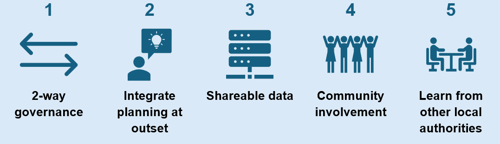
Tip 1: Establish strong two-way governance arrangements: involving planners in the energy plan and energy experts in planning.
Tip 2: Consider which methods could be used to integrate with planning policy at the outset: depending on the timing of your energy plan and local plan update explore different ways of integration (see table 2 above), ensuring the energy-related evidence needed for the local plan is developed through the energy plan.
Tip 3: Ensure data is shared and usable: require any external consultants to transfer all data and analysis to the local authority in a useable format, including upskilling officers on using it. Consider establishing a cross-council data group to explore how the energy plan data can be used for planning
Tip 4: Consider how communities are involved in the process: consider how community engagement will be undertaken to ensure that the energy plan reflects community needs and preferences. Best-practice guidance can be used to assist this process.
Tip 5: Learn from other local authorities: this report contains case study examples from a range of local authorities across the UK. There is value in contacting other nearby local authorities to explore what has worked well for them and also what lessons they have learnt.
While there is growing enthusiasm for integrating energy planning with town planning, local authorities are taking varied approaches and encountering numerous challenges. Despite a strong desire to share knowledge and best practices, a lack of coordination and support hinders effective collaboration.
Addressing these challenges requires changes at the national policy level, tackling both short-term issues, such as local authority resourcing and training, and, significantly, the longer-term challenge of how energy and town planning can co-evolve to work more effectively together over time. This long-term evolution is essential to ensuring that spatial and energy planning are not treated as separate processes but as interconnected systems that support the development of renewable energy infrastructure.
Rather than duplicating efforts, these processes must work in tandem, integrating energy and town planning data alongside community engagement. This holistic approach will enable better-informed decisions on the siting of future renewable energy and heat infrastructure, ensuring efficiency, sustainability, and local acceptance.
This section outlines several recommendations for central government to support the integration process:
Challenge 3: Local plans are not consistently aligned with net zero goals, limiting their effectiveness in driving decarbonisation.
Solution 3: Government should strengthen the requirement for local plans to be net zero compliant, ensuring that:
- Net zero compliance is a statutory requirement in all Local Plans;
- Clear, enforceable criteria define what a "net zero compliant" plan entails; and
- Support is provided to local authorities to achieve this.
Challenge 4: There is a lack of clarity on the distinct roles of town planning and energy planning and methods of integration, leading to potential inefficiencies in policy and project delivery.
Solution 4: Government should issue national guidance clarifying:
- The respective roles and interactions of town planning and energy planning; and
- Best practices for integrating energy plans into local planning policies.
Challenge 5: Inconsistencies in data across energy planning processes make it difficult for local authorities to develop coherent strategies.
Solution 5: Government should provide guidance on standardising data outputs from energy planning to ensure that data is provided in accessible and usable tools, and that local authorities are provided with clear instructions or support for its use.
Challenge 6: Local Planning Authorities face chronic resource constraints, limiting their ability to engage with energy planning.
Solution 6: Government should address resourcing challenges by providing more funding and support to increasing local authority resourcing.
Challenge 7: Many planning officers lack the necessary expertise to engage with energy planning processes effectively. This can create unnecessary delays and overall increased costs.
Solution 7: Government should fund training programs for Local Planning Authorities to improve knowledge on:
- The overall energy system as well as technology-specific requirements; and
- Best practices for integrating energy planning into Local Plans.
From the case studies - the need to strengthen national renewable energy planning policy: Alongside the recommendations provided, a stronger policy position for renewable energy at the national level, particularly in England, would help to increase ambition and clarity. This could include aligning the policy wording in the National Planning Policy Framework with the National Policy Statements, which require “substantial weight” to be applied to low-carbon infrastructure and which identify all forms of renewables as a Critical National Priority.
Each of these recommendations are unpacked in more detail below.
Planning policies often lack the clarity and enforcement mechanisms needed to ensure that local planning decisions consistently align with national climate goals. The Climate Change Committee (CCC) report, Spatial planning for Climate Resilience and Net Zero, highlights the need for stronger statutory requirements to embed climate action into all aspects of planning. A strengthened net zero duty would create a clearer mandate for aligning the priorities of local plans and other town planning tools with net zero pathways and evidence set out in a local authorities’ energy plan. There would need to be clear, enforceable criteria to define what a "net zero compliant" plan entails in order to ensure that town planning directly contributes to reducing carbon emissions and supports climate adaptation measures. Strengthened monitoring and reporting mechanisms should be introduced to evaluate the effectiveness of local plans in delivering climate objectives. Alternatively, there could be a net zero duty placed upon local authorities, although there would need to be a detailed review of how to do this and the impacts of doing so.
Strengthening the net zero duty on local plans could provide a first step in providing a stronger statutory basis for ensuring that local authorities can better align energy and planning objectives, ensuring that energy plans and local plans work together to deliver low-carbon, sustainable development. However, this would need to come alongside support and clear guidance for local planning authorities on how to integrate energy planning data, such as the outputs of LAEP and LHEES, with local planning (as discussed below).
Local authorities have faced significant difficulties in integrating energy plans and town planning due to the lack of clarity about the roles of the two plans and how they should be integrated or inform each other. Local authorities have, therefore, been calling for more guidance and support in this area.
As energy systems evolve quickly, spatial plans risk becoming outdated if they fail to adapt to new energy requirements and innovations. Therefore, there is a need for policy clarity and support. To improve integration, we recommend that national governments provide guidance to delineate the roles and scopes of energy planning and town planning, including the following:
5.3.1 Defining energy plan scope
The integration of energy planning and town planning could initially benefit from greater clarity on the scope and purpose of an energy plan– i.e. what are they for/not for. This should also involve clarity on what levers local authorities have to deliver energy plan objectives. Scope considerations could also determine what aspects of energy planning should be standardised across regions, such as data formats, and what should remain localised to address specific local needs.
5.3.2 Integration of energy and local plans
Local authorities need to be provided with a clear understanding of what can and cannot be done within the framework of energy and local plans, to manage expectations and streamline effort. There is a need for clarification on how energy plans as a non-statutory evidence base can be tailored to provide useful outputs and evidence to inform local plans. A clear and consistent approach would enhance the effectiveness of this integration and ensure mutual reinforcement of planning processes.
Due to the challenges associated with timing, different local authorities have taken various approaches to trying to integrate energy plan findings into local planning, using methods such as SPDs. While these present an opportunity, there is a need for support for planners to be able to do this, through policy clarity and knowledge sharing.
We suggest that national governments should provide a guidance document clarifying what forms of energy policies could be developed within a local plan, what evidence is required for such policies and how energy planning can provide that evidence. This should include consideration of using other planning tools, such as SPDs, or any future replacement such as Supplementary Plans.
Standardised guidance could help planners navigate the integration process by providing consistent methodologies, data formats integration frameworks and examples of best-practices for integrating energy planning with local planning policies. At the same time, some flexibility should be maintained to accommodate unique local characteristics such as geographic, economic, and community-specific factors.
5.3.3 How this fits with wider changes in the energy landscape
The energy policy landscape in the UK is changing rapidly, providing uncertainty for both energy and spatial planners. There is a need for clarity from central government regarding how energy plans will integrate with the future Strategic Spatial Energy Plan (SSEP) and the RESP, and how this may impact any local authority actions.
Energy planning processes generate valuable data that can significantly enhance local planning and energy integration efforts. However, there has been considerable variation in how local authorities use this data. While some, such as Belfast, have demonstrated the transformative potential of leveraging energy plan data for planning and other initiatives, others have faced challenges. In many cases, local authorities have been unable to fully use energy plan data due to limited access or incompatible data formats.
To address these issues, we suggest that there needs to be requirements for energy plans to produce data in accessible and usable tools, such as Excel and GIS. Ensuring that consultants involved in developing energy plans provide local authorities with this data, along with clear instructions or support for its use, would significantly improve the functionality of the energy planning process. This approach would enhance the structure and usability of the data. Additionally, there should be consideration of the potential value of a national-level data-sharing framework to standardise access and improve consistency.
This approach is currently being explored by the Net Zero Hubs. For example, the North West Net Zero Hub is currently developing the National Energy and Environmental Data Service (NEEDS), which aims to provide robust, consistent and application-specific data for local governments and their partners to support the development of net zero plans and projects.
Adopting more standardised approaches to data collection and sharing as part of energy planning processes could facilitate the alignment of spatial policies with energy planning objectives. Providing training to local planning authorities on how to interpret and utilise energy data would further empower them to integrate energy considerations effectively.
A key component of improving data consistency could also include fostering closer collaboration between DNOs and local authority planning teams, particularly in the context of developing local plans. This integration could enable a more comprehensive understanding of settlement-level opportunities for energy use, generation and storage.
Key actions to strengthen this collaboration include:
- DNO engagement: Encouraging DNOs to actively engage with Local Planning Authorities to explore scenarios and assess potential impacts;
- Joint scenario planning: Developing joint scenario-setting processes where DNOs and local authorities can collaboratively analyse energy needs and solutions;
- Capacity assessment: DNOs should implement frameworks for assessing headroom capacity at development sites to facilitate better planning for infrastructure upgrades; and
- Early developer involvement: Engaging developers early in the planning process to align infrastructure readiness with project timelines, reducing risks and delays.
Resourcing challenges significantly impact the ability of local authority planners to fully engage in energy planning processes. Even local authorities that have successfully established effective governance arrangements to integrate spatial planners into energy plan development face substantial hurdles. Effective integration is a time-intensive process and planners, already burdened with high workloads, often struggle to allocate sufficient time for this critical task.
To address this issue, increased funding is essential to expand the workforce dedicated to energy integration. Boosting the number of specialised planners will ensure local authorities have the capacity to meet growing demands and participate meaningfully in efforts to integrate energy and town planning.
Planners have a broad remit, and the energy system is complex and changing. Planning advice can vary significantly across technologies in different countries. Planners need tailored training to build their understanding of siting and policy considerations for different renewable energy technologies. This should also include an overview of Local Area Energy planning processes and best practices for integrating energy planning into Local Plans. Such training will need to come alongside increased resources for local authorities, enabling planners to dedicate sufficient time and expertise to energy-related planning tasks.
This need for training was evidenced throughout our case study research, with planners who had been fully involved in the energy plan describing a ‘steep learning curve’ but also the benefits of this learning. Meanwhile, planners that hadn’t had the opportunity to be fully involved in an energy plan process revealed a desire to learn more about the energy system, noting that planners do not usually have training in this area.
We conducted in-depth research with six case studies, covering the four UK nations. The case studies were chosen to reflect a range of different levels of experience with energy planning, different governance structures, urban and rural locations and a broad geographic spread:
- Perth and Kinross: A rural local authority working on integrating spatial and energy planning as they update their local plan.
- Oldham: A local authority with a LAEP commissioned at the combined authority level, developing a focus on community level insights.
- Bristol: An urban authority developing a heat network, at the early stages of its LAEP-style plan.
- Denbighshire: A rural Welsh local authority exploring integration of the LAEP with the local plan.
- Leicestershire: Currently developing a decarbonisation pathway plan for the whole county, working with community groups and businesses to identify opportunities.
- Belfast: first LAEP for Northern Ireland (urban).
For each case study, we undertook the following research:
- Desktop research, including reviewing available online project reports or press releases about the energy plan.
- A review of the emerging and adopted local plan for each local authority.
- Interviews with key stakeholders involved in both local area energy planning and town planning. This allowed us to gather deeper insights into the process, experience and challenges. These interviews were semi-structured, enabling our key research questions to be asked while also enabling the interviewees to influence the focus of the interview.
In November 2024, we delivered two online workshops bringing together energy planners, spatial planners, energy plan consultants and academic experts to explore the challenges and opportunities of integrating energy and town planning.
Each 1.5-hour workshop brought together between 15-20 participants with the goal of addressing the practical barriers to integrating energy into town planning processes, while exploring potential solutions. Through these workshops, we were able to create a platform for meaningful dialogue between participants, enabling a testing of ideas and sharing of experiences.
The participants, selected in advance through a collaborative process between RTPI and Regen, were carefully chosen to ensure a broad geographic representation and a balance of experience. This approach allowed us to capture a wide range of perspectives.
Both workshops were identical in format, starting with a discussion of some high-level interim findings from case studies to help facilitate discussion. The groups’ discussion then focused on three topics of discussion:
- Key opportunities of integrating energy and town planning;
- Key challenges of integrating energy and town planning;
- Potential policy changes needed; and
- Participants were encouraged to share experiences and examples to inform the discussion.
To enhance engagement, the workshop was interactive, using Miro boards to allow participants to actively contribute and share their thoughts. Participants were able to access the Miro board in the week before the workshop to make notes of ideas. During the session, the facilitator was able to draw upon the ‘post-it-notes’ as starting points for discussion and at the end of each topic of discussion participants could place green ‘stickers’ against points they agreed with and red ‘stickers’ against points they disagreed with. Using Miro also provided additional ways to collect and analyse responses, ensuring that the feedback gathered was both comprehensive and actionable.