

Executive summary
This report provides a snapshot of local plan practice in addressing a range of climate change policy issues in England and presents the findings from a policy review of local plans in England, undertaken using an AI assisted research tool, and a case study focusing on planning practice in addressing climate change in the North East region of England.
The policy review made innovative use of a custom AI-powered research tool developed by land consultancy Landstack. The tool combines Landstack's curated database of UK local plan documents — which contains every adopted and emerging local plan in England — with a large language model that interprets and summarises the policy text. Access to the tool was provided pro bono for this project and enabled the research to conduct a review of climate policies in all adopted and emerging local plans in England.
The findings reveal a stark gap between stated climate ambition and tangible policy action in local plans. Whilst the vast majority of local plans set strategic objectives for addressing climate change, this is not backed up by policy coverage addressing key climate risks.
The findings show that whilst policy coverage in emerging plans compared to adopted plans is improving, the scale and pace of change does not reflect the urgent action needed if new development is to align with national carbon budgets and secure the delivery of climate resilient places.
Findings from the policy review were supplemented by a case study of the North East, where practitioners identified that tension between national and local standards and viability challenges inhibited progress on climate action through planning in the region.
The findings imply that stronger direction from national policy and practice guidance is needed to increase the coverage of climate related policy in local plans, and to provide clear parameters that support ambitious climate action where it is demonstrably deliverable. The findings also suggest that national guidance is far behind more progressive local planning authorities on a range of issues including overheating, water scarcity, energy efficiency and whole life carbon, emphasising the invaluable contribution of the TCPA and RTPI guidance on Planning for the Climate Crisis which provides practical advice on the scope and effectiveness of climate policy approaches, drawing on credible and proven best practice.
Acknowledgements
This report was written by Celia Davis, Senior Projects and Policy Manager, with support from Jack Boreham, Events and Project Assistant and Hugh Ellis, Director of Policy at the TCPA.
The project was made possible with funding from the RTPI and the RTPI North East.
Support in kind was provided by Landstack through use of its custom AI-powered research tool and its database of UK local plans to harvest the data that formed the basis of the research.
Thanks to RTPI North East members who participated in the research focus group, and to the project working group: Jos Pink at Landstack, Dan Slade at the RTPI, and Simon Wicks at The Planner.
You can download the report in pdf or Word format or read in full below.
Contents
The vital role of planning
Planning for the Climate Crisis
Local plan policy review findings
Conclusions and implications for practice
The vital role of planning
Climate change is the greatest challenge facing our society, and the Royal Town Planning Institute (RTPI) and the Town and Country Planning Association (TCPA) firmly believe that addressing the climate crisis should be the top priority for planning across the UK.
Planners are uniquely placed to make a vital contribution to a net zero, resilient future, by making efforts to radically reduce the carbon emissions from development and using the levers of the planning system to re-design and retrofit places so that communities are protected from the severe impacts of climate change that we now live with.
Planning for the Climate Crisis
To support planners in this essential task, the RTPI and the TCPA have collaborated since 2018 to produce joint guidance for local authorities on Planning for the Climate Crisis: A guide for local authorities (the Climate Guide).
However, it is well documented that efforts to address climate change through planning have been hampered by the chronic under-resourcing of local planning authorities and weak policy at a national level that has often been delayed, inconsistent, and de-prioritised.
The fifth edition of the Climate Guide was published in December 2025, at a time when ongoing national planning reform is reshaping the framework in which planners operate in England. This provides an opportune moment to take stock and review current practice in addressing climate change through planning by local government, and test whether plan making outcomes are reflective of the urgent need to create climate resilient places, as advocated by the RTPI and the TCPA.
Using data provided by Landstack from adopted and emerging local plans in England, this report includes an analysis of climate policies to present a snapshot of current practice. This is supported by a cases study of the North East of England, drawing on a focus group with senior public sector planners in the region to explore some of the barriers and opportunities for taking climate action through planning.
Methodology
This report presents the findings of a brief review of policies and practice in addressing key climate change issues through local plans in England. The review was undertaken through two methods: the assessment of local plan policies using a custom AI-powered research tool developed by Landstack, and a focus group with local authority planners in the North East.
Local plan policy review
The data used to assess local plan policies in England was harvested using a custom AI-powered research tool developed by land consultancy Landstack. The tool combines Landstack's curated database of UK local plan documents — which contains every adopted and emerging local plan in England — with a large language model that interprets and summarises the policy text. Access to the tool was provided pro bono for this project.
Access to this database enabled the research to utilise an experimental approach to reviewing the success of local plans in addressing climate change through policy. To develop the approach, a project working group including representatives from the TCPA, the RTPI, The Planner and Landstack identified ten policy indicators considered to reflect best practice in local plan climate policy. These were drawn from the topics covered and approaches promoted in the RTPI and TCPA Climate Guide.
Once these policy indicators were agreed, a series of questions were developed, aimed at identifying whether a specific policy issue or approach was included within a local plan. From the ten policy areas, eighteen indicators were developed. These indicators were translated into prompts that were fed through Landstack's research tool. For each prompt the model was instructed to provide a binary ‘yes/no’ answer and a short summary explaining its response.
A spot test of results was conducted against the initial results. Examples where the research tool’s responses did not align with the researchers’ expectations were identified and scrutinised, and a process of prompt refinement was undertaken and tested on a small selection of local plans until the researchers were content that the LLM was drawing accurate responses.
The final stage in developing prompts was to include those that would allow the data to be filtered. The LLM was asked to identify the local plan region, plan status, year and whether it was a coastal authority. These refined prompts were then run on the full set of available local plan documents.
This produced a dataset with over 700 rows of data. A data cleansing exercise was run to ensure that all local plans were represented only once in the spreadsheet. This included:
- The identification and removal of duplicate local plans,
- The removal of ‘issues and options’ / regulation 18 stage local plans, as these were considered too variable in the level of policy detail to provide a comparable dataset,
- Merging of data where two plans covered the same local authority (for example a core strategy and development management component of the local plan), to avoid double counting,
- The removal of local plans that were adopted prior to the first National Planning Policy Framework (NPPF) in 2012.
The final dataset was then split into two, creating one list of 327 adopted local plans, and one list of 148 emerging local plans (at Reg 19 / submission stage or at examination). These two datasets were then analysed by policy area using the responses to the prompts provided, as set out in the findings section below.
North East focus group
To complement the analysis of policies from the datasets outlined above, a focus group was convened by the RTPI North East in April 2026. Local authority plan makers from the RTPI North East policy group were invited to participate in a discussion reflecting on the initial findings from the local plan policy review, and the barriers, enablers and good practice emerging from the North East region. The discussion was held virtually, and a recording was transcribed and analysed. Key findings and themes from the focus group are presented in this report.
Research limitations
The research methodology, particularly using a custom AI-powered research tool to harvest data from local plans, has been experimental and innovative in nature. It has created a powerful dataset and the use of Landstack's tooling has provided access to a scale of data that would be hugely time consuming to collate without the use of AI.
However, the experimental nature of the use of this tool means that there are some inevitable limitations. The resulting dataset is so large that each result cannot be individually checked by a researcher. This means that despite the testing and refining of the results provided by the model, there remains an inherent risk of some data discrepancies or erroneous responses. However, through the analysis and checking of the data, it is unlikely that occasional errors would be of a scale that would distort the results to a significant extent.
Another limit in the research technique is that the suite of local plans harvested for analysis by the AI model represent a specific moment in time. Some plans will inevitably have stalled or progressed to adoption since they were ingested into Landstack's database. This is particularly pertinent given the current status of national planning policy and incoming changes to the local plan making framework. This is because proposed changes to the NPPF as consulted in December 2025 seek to limit the ability of local authorities to go beyond nationally set standards, which has implications for key policy issues such as managing overheating and energy efficiency in new buildings. It is therefore likely that the next round of plan making, under the new system, will contain notably different scope in terms of climate policies. It also implies that repeating this study in two years’ time would provide fascinating insight into the impact of the new NPPF on climate policy.
It is also notable that some key issues addressed in local plans, such as sustainable transport, design and placemaking and spatial strategy, were considered less easy for the LLM to review and analyse, so these indicators of planning policy for climate change are not included in the scope of this study. This is because some considerations such as sustainable transport and spatial strategy are fundamentally spatial in nature, and it was not possible in the scope of this research to train the AI assisted research tool to analyse the sustainability of, for example, site allocations and transport strategies within the local plan. Another constraint is that in some policy areas there are less clear ‘best practice’ indicators where policy language is more likely to mirror requirements set in national policy (for example in the case of flood risk policy).
For these reasons, the results from the LLM should be considered as an indicative snapshot of current plan making practice in England using an experimental research approach, and this is the spirit in which they are presented in this report.
Local plan policy review findings
In this section, the results from the prompts fed through AI research tool are presented. The results for adopted and emerging local plans in England have been separated and are presented alongside a brief written summary of the findings.
Climate change as a strategic priority
The first set of prompts interrogates the extent to which local plans have sought to prioritise climate change within the local plan. The Climate Guide is clear that local plans should set a clear strategic objective and include a standalone strategic policy on addressing climate change, to ensure that this is understood as a priority outcome of planning within the plan area.
Is climate change listed as one of the objectives of the plan?
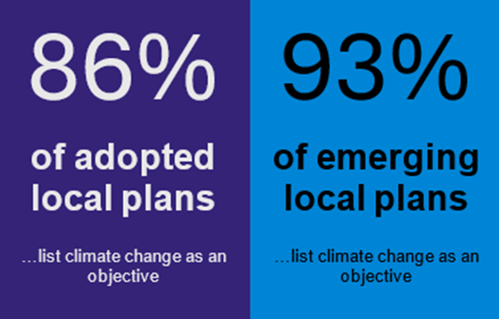
This query seeks to establish the extent to which addressing climate change was treated as a plan priority through being explicitly referenced as a plan objective. The results show that the vast majority of local plans list addressing climate change as one of the objectives of the plan and emerging plans show a higher inclusion rate (93%) compared to adopted plans (86%).
Does the local plan contain a strategic policy on climate change?
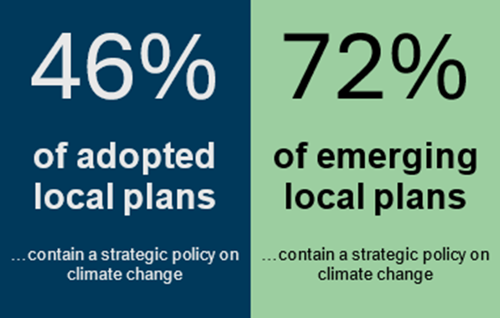
The Climate Guide encourages local authorities to include a strategic policy on addressing climate change, but the data shows that less than half of adopted plans (46%) contain such a policy, although this rises to 72% when looking at emerging plans. Whilst this demonstrates that climate change is increasingly being treated as overarching strategic issue for local plans to address, it also reveals that over a quarter of local plans currently coming through the system do not contain a strategic policy on climate change.
Climate change evidence
The Climate Guide is clear that to effectively address climate change, plans must be informed by robust, locally specific evidence both on climate vulnerability and carbon emissions. This is the clearest route for local plans to demonstrate compliance with the legal requirement on plan making to align with the Climate Change Act. Prompts were developed to interrogate the scale to which this was happening in practice.
Has the plan been informed by a climate vulnerability assessment,
a climate adaptation plan or a climate change risk assessment?
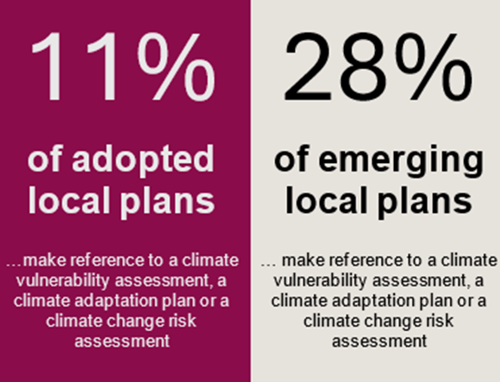
This query sought to explore the extent to which local plans are informed by local understanding of the increasing risks and impacts of climate change. Only 11% of adopted local plans were found to have been informed by climate vulnerability evidence. For emerging plans, the rate is higher but, at 28%, remains a low proportion of all plans.
Has a carbon assessment been undertaken to measure
the carbon impact of plan proposals and policies?
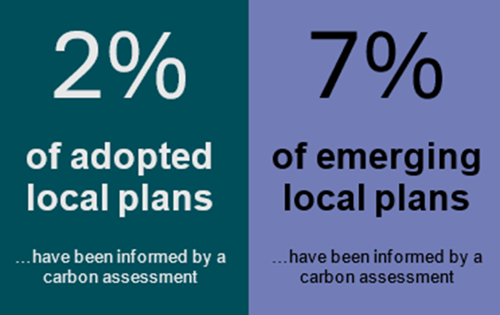
The results here show that very few local plans are undertaking carbon assessments as part of their strategic evidence base. Only 2% of adopted plans appear to have undertaken such an assessment, and this rises modestly to only 7% for emerging plans. This is despite clear legal and policy requirements on plan making to align with the national carbon budgets.
Flood risk, water and coastal change
This section considers the performance of local plans in addressing key issues relating to managing the risk of flooding and coastal erosion, and water management that are promoted in the Climate Guide. Policies addressing river and tidal flooding were not included in the scope of the review, as it was considered a more challenging area to interrogate the success of local plan policies, particularly in isolation from requirements set nationally through the NPPF and National Planning Practice Guidance (NPPG). The prompts here were developed from indicators of policy that seek to address surface water flood risk and promote water efficiency.
Does the local plan require applicants to submit strategies for sustainable drainage?
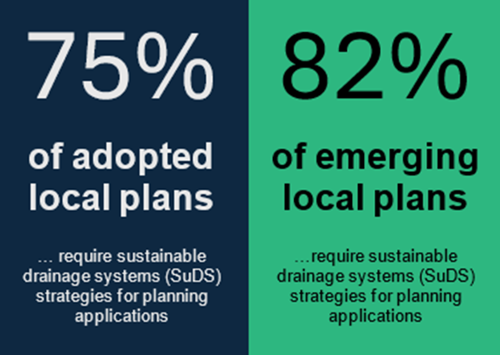
Surface water flooding is the most rapidly increasing source of flood risk, so integrating multifunctional sustainable drainage systems (SuDS) is crucial for the long term resilience of new development. The performance here is fairly strong, with 75% of adopted and 82% of emerging plans including a provision for developers to submit a SuDS strategy with planning applications. However, it is interesting then to note that whilst the majority of both adopted and emerging plans include this requirement, there remain nearly 20% of emerging plans that do not explicitly set such a requirement. This is despite national planning policy strengthening requirements for SuDS provisions in recent years.
Does the local plan set qualitative standards for sustainable drainage?
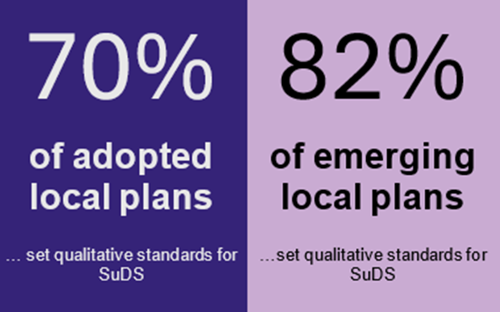
Securing multiple benefits to people and the environment from SuDS, means ensuring that they are designed to high standards. The TCPA and RTPI encourage Local Planning Authorities (LPAs) to set quality standards for SuDS through local plan policy. The results here mirror the previous question, with 70% of adopted and 82% of emerging local plans meeting this criteria. This indicates that where local plan policies are promoting the use of SuDS strategies, they are also setting qualitative standards through SuDS.
Does the local plan set water efficiency targets for new homes?
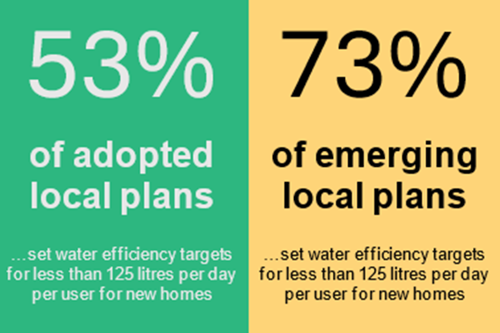
Building regulations set a baseline limit for water usage of 125 litres per person per day. Where local circumstances justify, a target of 110 litres a day can be set. The data here shows that policies going beyond the building regs baseline have increased in coverage, from 53% in adopted to 73% of emerging local plans.
Policies for managing coastal change
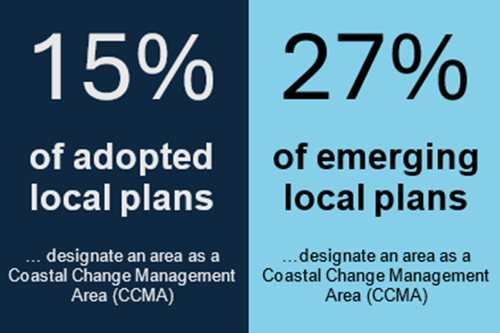
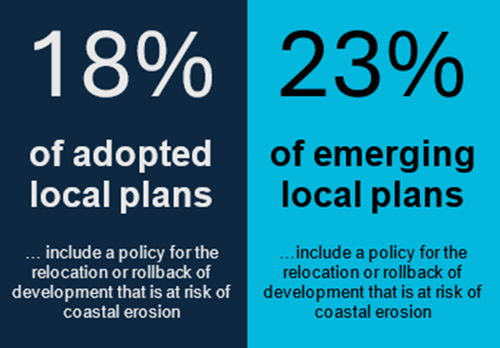
Two prompts relating to planning policies for managing coastal change were run by the large language model, and the results shown here have been applied only to coastal authorities. This shows a steady increase in take up of policies to designate Coastal Change Management Areas (CCMAs) and manage rollback and relocation on the coast, from emerging to adopted plans. This is indicative of the increasing risk from coastal erosion, but with nearly three quarters of coastal authorities not designating CCMAs in local plans, this could indicate a significant underuse of this policy tool.
Reducing overheating
Heatwaves are one of the deadliest climate impacts facing the UK. The most recent Climate Change Risk Assessment warned that ‘the UK is built for a climate that no longer exists today’. Nowhere is change more pressing than in designing buildings and places to withstand extreme heat that the UK simply has not had to deal with before. A set of prompts were developed to explore whether local plans are setting policies to ensure that development manages the risk of overheating.
Does the plan require a cooling or ventilation strategy to manage overheating in new buildings?
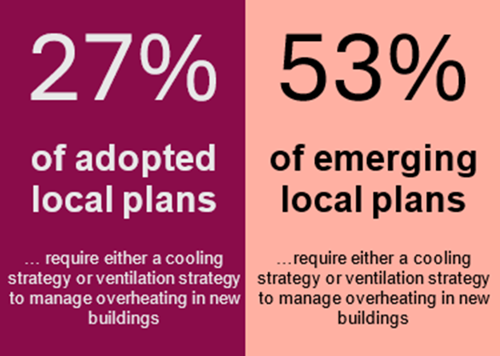
This query sought to establish whether local plan policy sought to address overheating through setting requirements for a cooling or ventilation strategy for new buildings. Just over a quarter of adopted plans set this policy requirement, and this rises significantly to 53% of emerging plans, showing that overheating is a policy issue of increasing concern for local planning authorities. However, even with this increased attention, nearly half of emerging plans are not setting such a requirement.
Are planning proposals required to follow a cooling hierarchy?
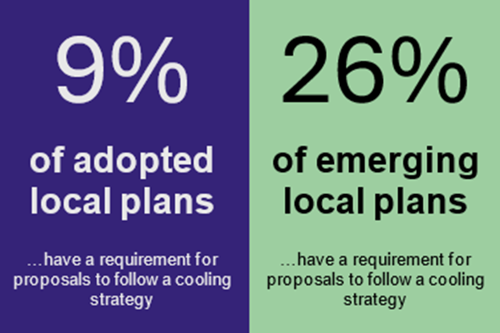
Another recommendation in the Climate Guide is to require new development to follow a cooling hierarchy. A cooling hierarchy for overheating mitigation will inform the design of new buildings to limit heat gain, manage heat within the building and prioritise passive cooling and ventilation approaches. This query reveals that 26% of emerging plans include policies that set this requirement, compared with just 9% of currently adopted plans.
Does the local plan seek to reduce the urban heat island effect?
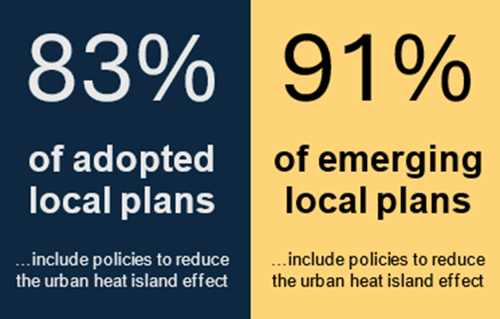
To reduce the impact of heatwaves in built up areas, green and blue infrastructure and nature based solutions should be promoted. These reduce what is called the ‘urban heat island’ (UHI) effect, alongside using building and paving materials that minimise heat absorption. This prompt was designed to identify adopted and emerging plans that sought to reduce the UHI effect through policy. It reveals a high level of policy coverage, with 83% of adopted and 91% of emerging local plans including policies that seek to reduce urban heating.
Green infrastructure
Does the local plan contain policies for green space
and green infrastructure to support climate adaptation?
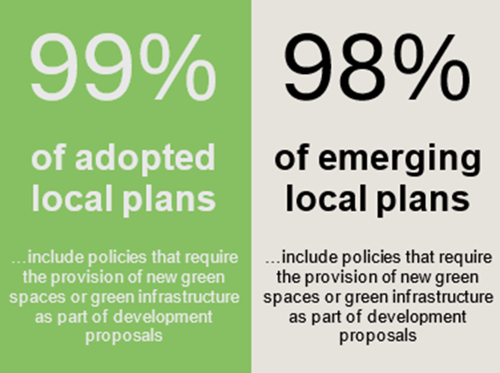
The results from this prompt demonstrate that almost universally, green space and green infrastructure is seen as a key mechanism for supporting climate resilience. The prompt aimed to establish whether local plans promoted green space provision to address climate change risks, and 98% adopted and 99% of emerging plans make clear links between green and blue infrastructure and climate adaptation. It should be noted, however, that there was variation across plans about how strongly this correlation was set as a requirement for development, with a range in approaches from setting clear policy outcomes to use green infrastructure to address overheating and reducing flood risk, to more high level statements outlining potential benefits set in local plan supporting text.
Does the local plan set a requirement for green space provision using a green space factor?
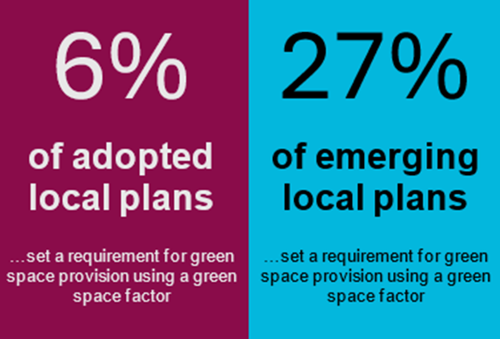
Whilst green space is clearly understood to support climate adaptation, this query aimed to look at whether numerical targets for the delivery of green spaces that reflect best practice were being advocated in policy. The Green Space Factor has been pioneered in London, and is supported through the Natural England Green Infrastructure Framework. The data here shows that whilst an increasing number of plans (27% of emerging plans) do support this in policy, the vast majority do not. Only 6% of adopted plans make reference to a green space factor to encourage green space provision.
Climate mitigation policies
The TCPA and RTPI advise LPAs to take ambitious action on climate mitigation, and for many local authorities a key tool available to them is to reduce the carbon emissions of new development by securing high standards of energy efficiency. However, national policy and legislation surrounding the right of LPAs to set such standards has been confusing and inconsistently interpreted by the Planning Inspectorate. Furthermore, proposed changes in the National Planning Policy Framework (NPPF) seek to limit these opportunities.
To consider the potential impact of this policy change, the queries for the LLM focused on understanding how local plans are seeking to reduce the carbon emissions from buildings.
Does the local plan set energy efficiency standards for
new buildings, using energy based metrics?
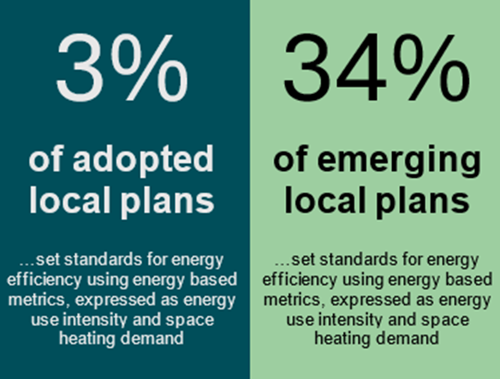
The data reveals that there is increasing interest from LPAs in achieving net zero buildings (for operational energy), with around a third of emerging local plans seeking to set such standards. We also asked the LLM to identify the housing requirement for the plan period set out in the local plans. What this reveals is that there is an ambition in emerging local plans for over 1.1 million new homes to be built to net zero building standards. However, this significant progress risks being undermined by the national policy direction set in the consultation version of the NPPF.
Does the local plan require applicants to complete a whole life carbon assessment?
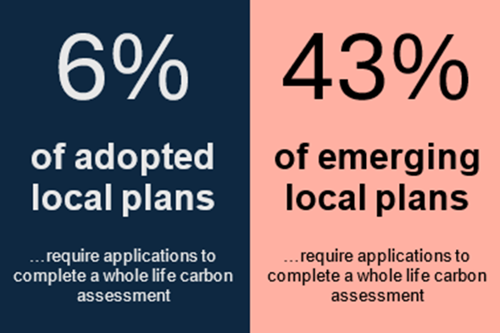
This query was designed to interrogate the extent to which LPAs are seeking information on the carbon emissions from buildings, using a policy requirement for a whole life carbon assessment as a proxy for good practice. This area of policy has shown a rapid rise in coverage when comparing adopted plans to emerging plans, from 6% to 43% of plans respectively. This indicates increasing interest from LPAs in seeking to manage the significant source of carbon emissions from the built environment in the form of embodied carbon as well as operational carbon.
Does the local plan set targets for embodied carbon emissions from new development?
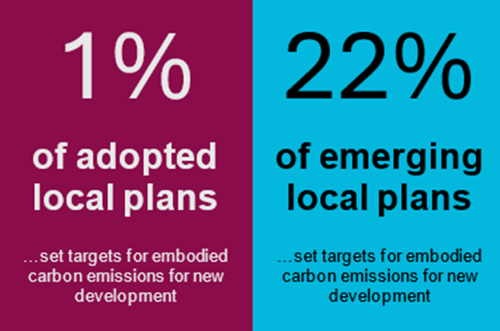
Fewer policies are emerging in local plans that set specific numerical targets for limiting embodied carbon, although this area of policy has also seen an increase from just 1% of adopted plans to 22% of emerging plans.
Summary
The data presented here examines both adopted and emerging local plan policies addressing key climate adaptation and mitigation issues, and whether climate change is positioned as a key objective of the plan.
The results harvested by the queries fed through the LLM in this study indicate that a steadily growing number of emerging local plans are seeking higher standards and pursuing best practice policies on a range of crucial climate change issues, when compared to adopted local plans, with a particular uptake of policies addressing carbon emissions from buildings, overheating, water efficiency and climate risk.
Whilst this progress shows some movement in the right direction, the data does contain some concerning findings. Of particular concern is the limited practice of using up to date climate change evidence to inform local plans. Over 70% of emerging local plans appear to have undertaken no specific climate risk or vulnerability assessment, and only 7% of emerging plans were found to have undertaken a carbon assessment to inform the plan policies and strategy.
This is despite the vast majority of plans including an objective on addressing climate change, revealing a concerning divide between the stated intention of local plans, and the evidence and policy coverage in practice. The data throws into serious doubt whether the scale and pace of change represented here is adequate to meet the urgent challenges that climate change presents. This is particularly important given the long lifespan of local plan policies and the significant level of development the plans will oversee.
For example, despite the data revealing a significant increase in coverage of policies seeking to address overheating, over half of emerging local plans do not require strategies from developers on how overheating will be addressed in new buildings, and only a quarter endorse a cooling hierarchy, despite this being recognised best practice.
There is a significant rise in the number of local plans requiring whole life carbon assessments for new development (from 6% of adopted plans to 43% of emerging), but only 22% of emerging local plans are seeking to set targets to reduce embodied carbon emissions.
The data also indicates limited take up of tools to manage coastal change through planning policy, such as the use of Coastal Change Management Areas.

North East case study
A focus group with senior public sector planners working in the North East was organised with the RTPI North East. Initial findings on the performance of local plans across England and in the North East region were shared with the attendees to frame the discussion. Due to the small sample size (18 plans) of the data from the North East region, results from adopted and emerging plans were presented together. Of the 18 plans, five are under development whilst 13 are adopted.
The following key findings summarise the performance of the North East region’s plans against the queries run through the LLM:
- In the North East, half of the plans have a strategic policy on climate change. This compares to 43% of adopted plans and 72% of emerging plans in England.
- All but one of the plans in the North East have a strategic objective to address climate change.
- Two of the plans have undertaken some form of climate risk assessment, although none were found to have assessed the impact of the plan on carbon emissions.
- Three of the plans ask applicants to address the overheating of buildings, although none of them seek applicants to apply a cooling hierarchy. All but four of the plans require planning proposals to reduce the urban heat island effect.
- Four of the plans seek to address embodied carbon through requiring whole life carbon assessments, although none set numerical targets for embodied carbon. None of the plans were found to set energy efficiency targets using energy based metrics.
- The majority of plans encourage the incorporation of SuDS in new development - 12 of the plans require a SuDS strategy, whilst 14 set qualitative standards for SuDS.
- Whilst all of the North East plans encouraged and supported the delivery of green space and green infrastructure to support climate resilience, none were found to make use of a green space factor to deliver measurable increases in green space.
During the focus group, practitioners reflected on the performance of local plans in different policy areas and shared views on some of the challenges and barriers that constrain local plans from comprehensively addressing key climate change policy issues.
A key theme was the tension between national standards and local standards. The discussion contrasted the example of water efficiency and energy efficiency standards, where national policy restricts the ability of local plans to exceed national standards. Participants felt the bar for evidence to justify higher standards was high, and uncertainty caused by policy created higher risk in taking these approaches forward. The group expressed that nationally set standards could reduce duplication of evidence work across authorities, create greater efficiency and consistency, whilst enabling local authorities to go further than building regulations.
Participants outlined the context of the North East as being particularly constrained by viability concerns, which can prevent local planning authorities from adopting higher standards for energy efficiency, water efficiency, and related measures, even where the need is greatest due to fuel poverty and health inequalities. This was expressed clearly as a social justice issue, whereby viability constraints limit the application of policies for better standards of development that would also reduce fuel bills in areas that have the most to gain from those interventions.
Another key concern was around developer resistance. Examples were given where attempts to set higher standards for development met strong pushback from housebuilders, leading the authority to shift towards procedural guidance notes ‘to take some of the sting out the tail’. Promoting higher climate related standards through guidance rather than policy can achieve compromise with the development sector, but in practice weakens measures to address climate change to voluntary rather than mandatory requirements.
There was extensive discussion on the primary importance of the spatial strategy as an indicator for whether local plans align with climate and sustainability principles, and it was acknowledged that within the scope of this study, this is an important factor that has not been reviewed due to the methodological use of the AI research tool.
Participants stressed that climate outcomes are driven by where development is located (connectivity, access to services, public transport, densification near rail stations), but this may be difficult for an LLM to assess, as most plans use similar sustainability language.
A potential area of further research and experimentation was identified that could test the ability of AI research tools to assess local plans with climate clear objectives and match them with spatial strategies that genuinely align with climate and sustainability principles, while also capturing other workstreams (e.g. retrofit, heat networks) across a local authority area. This would provide an additional layer of insight that is not currently captured by national datasets.
On top of this, concerns were raised that current national mechanisms, such as the Housing Delivery Test, can penalise authorities for pursuing more sustainable cross-boundary development patterns, thereby undermining strategic, climate-led spatial planning.
Participants highlighted the particular challenges faced by rural and geographically large authorities with significant off‑grid communities, noting that sustainability decisions often involve nuanced trade‑offs that binary AI indicators struggle to capture, particularly in relation to political, social, and affordable realities.
The discussion also stressed stronger integration of climate change with health and wellbeing, referencing co-benefits, healthy placemaking, connectivity, Marmot principles, and sustainability appraisals that include carbon and health assessments together.
Conclusions and implications for practice
This report has provided a snapshot of local plan practice in addressing a range of climate change policy issues in England, and has shown that whilst policy coverage in emerging plans compared to adopted plans shows practice is improving, the scale and pace of change remains in need of significant acceleration if planning is to ensure that new development is aligned with national carbon budgets and secures the delivery of climate resilient places.
The findings reveal a stark gap between stated climate ambition and tangible policy action in local plans. Whilst the vast majority of local plans set strategic objectives for addressing climate change, this is not backed up by policy coverage addressing key climate risks. Of particular concern is the limited practice of using up-to-date climate change evidence to inform local plans. Without an evidence-led approach to climate mitigation and adaptation, high level objectives remain tokenistic.
The study demonstrates that there is a clear need for a rapid increase in the uptake and prioritisation of climate policies within local plans in England and suggest that well-recorded challenges in securing climate policies in local plans are still playing out in practice, due to a range of factors - not least a lack of clarity and prioritisation of climate change in national planning policy, and the chronic under resourcing of local planning authorities.
Findings from the policy review were supplemented by a case study of the North East, where practitioners identified that tension between national and local standards and viability challenges inhibited progress on climate action through planning in the region.
The study implies that stronger direction from national policy and practice guidance is needed to encourage evidence led policy responses to the climate crisis, increase the coverage of policies that address climate risks and mitigation in local plans, and to provide clear parameters that support ambitious climate action where it is demonstrably deliverable. The findings also suggest that national guidance is far behind more progressive local planning authorities on a range of issues including overheating, water scarcity, energy efficiency and whole life carbon.
This underscores the value and importance of the Climate Guide, which should continue to be promoted across the planning sector. The guide demonstrates the essential role of planning in addressing the climate crisis, providing practical advice on the scope and effectiveness of climate policy approaches, drawing on credible and proven best practice.
Further research
Two areas of potential further research have been identified, both of which respond to the identified research limitations but have been supported by the findings.
Firstly, there is a clear opportunity to explore the ability of AI research tools to assess the relative success of local plan spatial strategies in relation to environmental and climate objectives, which, alongside policy analysis, would provide a more complete picture of local plan performance in addressing climate change.
Secondly, in acknowledging the research limitations and wider contextual factors, not least the incoming changes to national planning policy and plan making process, these findings are presented as a ‘snapshot’ of practice in early 2026. There is an interesting opportunity therefore to repeat the study in future and compare results, to measure the impact of national planning policy changes on local plan outcomes for climate.