
Welcome to the spring edition of PlaNIt
Research by the International Centre for Local and Regional Development
Launch event
The International Centre for Local and Regional Development has undertaken research for the RTPI, entitled Strategic spatial planning and the framework for co-operation: strengthening alignment on the island of Ireland.
On Wednesday 29 April we held the launch event in Newry, which was attended by a variety of academics and practitioners, including representatives from the Northern Irish Department for Infrastructure, local planning authorities, the Irish government’s Department of Housing Local Government and Heritage, and the Office of the Planning Regulator.
Gavan Rafferty and Linda McElduff, two of the research team members, presented the research. Following that, Dr Caroline Brown RTPI Director of Scotland, Ireland, Research and Practice facilitated a panel discussion. The chief planners of Northern Ireland and the Republic of Ireland (Rosemary Daly and Claragh Mulhern, respectively), Sinéad Mullen from the Office of the Planning Regulator, and Caroline Creamer (ICLRD Director) all provided insightful comments and answers to questions relating to co-operation versus collaboration, the current planning policy landscape on both sides of the border, and how cross-border spatial planning could look in the next decade or so.


Strengthening Alignment on the Island of Ireland
This research provides the most comprehensive assessment to date of cross-border spatial planning practice and strategic alignment between Northern Ireland and the Republic of Ireland.

In this edition
Welcome
Nick Salt, NI Chair - Theme for the year
Community Places Spring Learning Exchange
NI Young Planners Committee
ICLRD research launch
DFI Speed Limit Review 2026
Annual dinner
NI events
Welcome to the spring edition
Welcome to the spring 2026 edition of PlaNIt! The year is already flying by, and as you’ll see, there’s been lots going on (including our annual dinner and the launch of our cross border research) with more to come (including our welcome event in June, conference in September and law update in November).
In addition to the NI activity, there’s more RTPI-wide updates and activity. In March, we welcomed Rachel Fisher as our new Chief Executive. We relaunched our Chief Planners of Tomorrow programme to offer a shadowing opportunity for the next generation of planning leaders, and we are continuing to roll out our school ambassadors programme following Emma Aldridge’s fantastic campaign last year to raise awareness of planning as a career option. Get in touch if you’re interested.
We’re also grappling with issues facing planning practitioners everywhere: abuse in the line of duty. Catherine McKinney (Nations Trustee) and I are working with volunteers to pull together a toolbox of resources for members to support your wellbeing and safety. More on this in the next edition of PlaNIt. We’re also getting a better understanding of how planners are using AI in the workplace, and will be producing a Professional Standards Guidance Note to ensure the ethical and appropriate use of AI aligns with our Code of Conduct.
We’ve already turned our thoughts to May 2027’s Northern Ireland Assembly elections. Over the coming months, we’ll be meeting members and built environment professionals to consolidate a list of key planning-related asks for party manifestos, creating our RTPI Northern Ireland ‘Planifesto’. Look out for your opportunities to get involved via Planifesto workshops to help shape this work.
I’ll be in NI in May, June, September, October and November, so if you’d like to meet up face-to-face, please get in touch.
Mark Hand, RTPI Northern Ireland Director
Planning for Prosperity
Nick Salt, NI Chair
My theme for the year is Planning for Prosperity.
I became a dad very recently, which has put a personal focus for me on the planning system. How do the decisions that I am part of today, or the projects I work on, shape the future prosperity of future generations?
As a collective group of planners, we must find the balance between encouraging investment in Northern Ireland – for its economic prosperity and opportunity for all, with the resulting social and environmental prosperity that the planning system seeks to secure.

There are examples locally where this is being done well, where investment and investor confidence are encouraged and where societal prosperity is a result – in all its forms.
Northern Ireland is a small place with plenty of problems, but with so much untapped potential. We do future generations an injustice by not doing all we can to realise that potential.
I’m conscious that there are just 7 months left in 2026 and I want to avoid any grandstanding. I’m also conscious that we are part of a wider ecosystem influenced by things out of our control.
That said, I want to put Planning for Prosperity into focus over the course of the year, to engage with the wider industry and those with influence throughout society and see how we, as a profession, can build on and improve the contribution we all make towards a more prosperous future for Northern Ireland.
I look forward to working closely with Mark, the team and your wider Executive Committee over the next few months to do this.
Annual conference
Our annual conference, sponsored by William Orbinson KC will explore the theme of Planning for Prosperity on 8 September 2026 at the Europa Hotel.
Are your details correct?
Remember to keep your details updated
We won’t bombard you with emails but it ensures that we can contact you with current news, CPD events and policy updates.
Did you know that you appear on name badges and delegate lists as your current employer on our system so it’s worth updating to avoid issues at the registration desk!
You can keep your record updated by logging into your RTPI Profile and updating your contact and employment details.
NI Consultants Forum
Have you heard about our Consultants’ Forum?
We have had a great turnout at the recent meetings and have welcomed guest speakers including PAC, DfI, Water NI and NIEA.
The Forum meets 4 times a year – if your company would like to attend please contact Julie Sullivan – we’d love to see you there.
Community Places Spring Learning Exchange
This article is by Community Places and Planning Aid Wales
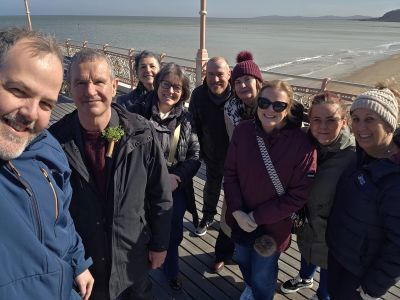 Planning Aid Wales recently welcomed colleagues from Community Places to North Wales for an inspiring two-day knowledge exchange visit, held around St Patrick’s Day.
The visit provided an excellent opportunity to showcase the collaborative work undertaken by Planning Aid Wales and the Bay of Colwyn Town Council in developing a high-impact Place Plan, while also creating space to share ideas, insights and practical approaches to community engagement. Discussions enabled both organisations to explore the similarities and distinct features of their respective devolved planning systems.
A key highlight of the visit was a meeting with the Planning Team at Conwy County Borough Council, where valuable discussions took place on community engagement and experiences arising from the recent Replacement Local Development Plan (RLDP) consultations. Conwy has adopted a forward-thinking, place-based approach and is gaining recognition across Wales as a leading authority, notably through its partnership with Planning Aid Wales.
Katie Clubb Head of Housing, Planning and Place, Conwy Council said:
“We were delighted that Planning Aid Wales chose Conwy for this Learning Exchange visit, showcasing our successful collaboration with Bay of Colwyn Town Council in developing an impactful Place Plan. It was also a fantastic opportunity to share experiences and learning around practical approaches to community engagement. I would like to thank Planning Aid Wales and Community Places for such a successful visit and the opportunity for the team in Conwy to highlight the positive impact that collaborative planning can have on our communities.”
The group also met with officers from the Bay of Colwyn Town Council, alongside members of the Place Plan Steering Group. These sessions brought the Place Plan process to life through firsthand accounts, highlighting the positive changes already underway and new funding opportunities emerging since its adoption. The visit concluded with a walking tour of Colwyn Bay, showcasing the seafront improvements and outlining ambitious regeneration plans aimed at revitalising the town centre.
Paul Roberts, Chief Executive of Community Places said:
“The Conwy visit was a hugely valuable experience, deepening our shared commitment to community-led planning and strengthening vital civic partnerships. We extend our sincere thanks to Bay of Colwyn Town Council, Conwy County Council and Planning Aid Wales for hosting us so warmly. I’m delighted that Community Places is now expanding on this success by planning exchange visits with the other Planning Aid Services, all made possible through the continued support of the Northern Ireland Office’s Connect Fund.”
James Davies, Chief Executive of Planning Aid Wales, said:
“I recognise the long and valued history of collaboration between the Planning Aid organisations across the UK. However, our recent learning exchange experience represents the most focused and impactful bridge-building effort I have encountered. It has strengthened our shared purpose, deepened mutual understanding and created a strong foundation for more meaningful and sustained collaboration in the future.”
Funding for the learning exchange visit and the preceding structured learning programme was awarded by the Northern Ireland Office’s Connect Fund. The Connect Fund provides funding to support groups working in sectors which directly affect Northern Ireland communities, helping them to tackle mutual challenges and opportunities which also affect communities in Great Britain.


NI Young Planners
Northern Ireland Young Planners (NIYP) is a progressive network for young planning professionals and students from across the province. The activities of NIYP are delivered by a small steering group of volunteer members.
If you are a planner in full-time or part-time education, a Student or Licentiate member of the RTPI, a graduate, or a Chartered member of the RTPI within the first ten years of your career, NIYP is here to support you.
You can get involved by:
- Contributing an article to the next PlaNIt newsletter
- Helping the steering group to organise social and CPD events
- Suggesting ideas and themes for events you’d like to be put on
If you have any suggestions about events or issues you would like us to raise please get in touch. We are always looking for fresh ideas so if you are a young planner in the first 10 years of your career and want to get involved please contact Julie Sullivan NI Member Services Officer or speak to one of your representatives.
Representatives
Aoife Murray, Associate Director, Tughans - Chair
Nicole Walsh, Associate Director, Black and White Acquisition - Vice Chair
- Lidia Ballocchi, Assistant Planner, TSA Planning
- Jack Corcoran, Senior Planner, Bell Rolston
- Thomas Ellison, Senior Planner, TSA Planning
- Tiernan Fitzlarkin, PhD Candidate, Ulster University
- Hannah McConville, Graduate Stakeholder Engagement Consultant, AECOM
- Julia Wilson, Spatial Planner, AtkinsRealis
- Emily Wray, Planning Assistant, Causeway Coast and Glens BC (Immediate past Chair)


Research by the International Centre for Local and Regional Development
Joanna Drennan, NI Policy Officer
Spatial planning on the island of Ireland
Over the past 25 years, strategic spatial planning has become an increasingly important mechanism for guiding sustainable development across the island. Northern Ireland’s Regional Development Strategy 2025 (RDS, 2001) and the Republic of Ireland’s National Spatial Strategy 2002- 2020 (NSS, 2002) were the first formal spatial planning documents at whole-jurisdiction scale.
Both were strongly influenced by the European Spatial Development Perspective (ESDP) and so shared many conceptual foundations. The strategies formed the basis for a more co-ordinated approach to infrastructure investment, environmental management, and urban–rural development across the island.
However, political instability, economic shocks, institutional restructuring, and Brexit have been transforming the policy landscape. The Republic of Ireland replaced the NSS with a more robust, legislatively supported National Planning Framework (NPF) in 2018, revised again in 2025.
Northern Ireland continues to rely on the RDS 2035, updated in 2012, and now over a decade old. This temporal gap has created increasing risk of strategic divergence.
This report conducts the first detailed comparison of the RDS 2035 and the revised NPF (2025) through policy analysis, a literature review, interviews with senior planners and policymakers, an online questionnaire, and sector- wide engagement through the RTPI Northern Ireland Annual Planning Conference 2025. It focuses on three key policy areas:
- Transport,
- Health, well-being and quality of life, and
- Economic
Stakeholders perceive “some alignment” across the two spatial strategies but acknowledge that real alignment is neither well understood nor systematically monitored. The revised NPF has advanced more contemporary, climate-aligned and well-being-focused approaches in the three key policy areas examined, while Northern Ireland’s RDS 2035 reflects a more traditional, infrastructure-led paradigm.
- Key findings on the degree of alignment/divergence
- Cross-border co-operation is widely valued and occurring but unevenly
- Greater symmetry has emerged, yet structural and institutional barriers
- ‘Soft spaces’ are necessary for facilitating spatial public diplomacy for addressing bordering
- Alignment between the RDS 2035 and the revised NPF is often assumed, without assessing differences in governance, planning systems, political context, and funding cycles.
- Contextual and policy divergence is increasingly evident and is at risk of
The Framework for Cooperation
The two jurisdictions jointly published the Framework for Cooperation in 2013 to seek to improve coordination, reduce planning inefficiencies, and support collaboration in four priority areas:
- Enhancing competitiveness,
- Competitive places,
- Environmental quality, and
- Spatial analysis


The Framework was intentionally non-statutory to allow flexibility and place-sensitive application; however, this could have contributed to the fact it has not become a consistently used policy instrument. Planning professionals, especially those early in their career, are generally not aware of the Framework for Co-operation, although they would still support the collaborative approach and rationale for co-operation that the Framework espouses.
Key findings on the Framework for Co-operation
- The Framework is a tool to initiate/intensify cross-border co-operation.
- The Framework’s formulation was perceived as an exercise in ‘policy articulation’ rather than directing ‘planned action’.
- The Framework is still relevant but needs to be refreshed.
- Advancing an integrated approach to spatial planning on the island of Ireland is appreciated, but there are nuances.
Future directions for cross-border spatial planning
Research participants identified some key benefits of cross-border collaboration:
- Enhanced policy learning and transfer.
- Strengthened community and social cohesion.
- Shared environmental management.
- Improved competitiveness and innovation, and
- More efficient infrastructure planning, particularly transport, energy, and green/blue infrastructure.
Local authorities emerged as the most active and effective scale for collaboration through this study, exemplified by the North West Strategic Growth Partnership (NWSGP) and Dublin–Belfast Economic Corridor (DBEC) partnerships.
However, significant structural and political barriers to collaboration persist, including different legislative and policy frameworks, data incompatibility, funding and resource limitations, political sensitivities, and limited cross-jurisdictional understanding amongst professionals.
So, what next? From a practical perspective, the research identifies strong support for cross- border collaboration across local, regional, and central government stakeholders. This is particularly important, but also significantly complicated by, the fact that Northern Ireland and the Republic of Ireland are not now both members of the European Union.
The report identifies five key recommendations for the future direction of cross-border spatial planning:
- Review Northern Ireland’s Regional Development Strategy
- Revisit and revive the Framework for Co-operation
- Improve data reconciliation and shared per-formance monitoring
- Strengthen resourcing and professional development training
- Move beyond co-operation to collaboration
The RTPI is committed to supporting both jurisdictions, particularly in improving the quality and availability of data relevant to planning, performance monitoring of the planning system, resourcing, and professional development training of planning professionals.
The RTPI NI would like to thank the research team for this important and timely piece of work:
- Ms Caroline Creamer - Director of the ICLRD and a Research Fellow with the Social Sciences Institute and the Innovation Value Institute at Maynooth University.
- Dr. Gavan Rafferty MRTPI – Senior Research- er at the ICLRD and lecturer in planning at the Belfast School of Architecture and the Built Environment, Ulster University.
- Dr. Linda McElduff - Senior Researcher at the ICLRD and lecturer in planning at the Belfast School of Architecture and the Built Environ- ment, Ulster University.
DFI Speed Limit Review 2026
Joanna Drennan, NI Policy Officer
The Department for Infrastructure (DfI) has undertaken an evidenced based Speed Limit Review from across the UK, Europe and the Republic of Ireland to consider if there are any potential opportunities to improve road safety in Northern Ireland. You can read the full consultation response on our website.
The RTPI Northern Ireland responded to the consultation in favour of Option 1E, which would introduce a 20mph speed limit in all areas that are currently 30mph, with the exception of arterial routes. This would apply a 20mph limit to streets with existing traffic calming measures, streets in the immediate vicinity of schools, streets with lots of pedestrian movements e.g. shopping streets, village main streets, residential streets, distributor roads within residential developments, streets or roads outside hospitals or health centres, and all current 30mph roads, apart from arterial routes (yet to be precisely defined by DfI, but typically known as A roads).
Adoption of a 20mph speed limit would bring us into line with the vast weight of evidence, accepted best transport planning practice, and new guidance coming out. Many cities in the UK have already adopted a 20mph limit for most of their streets, but there are calls for this limit to become the default. For example, the Department for Transport’s new Manual for Streets 3, currently out for consultation, states that the default should be to work to a design speed of 20mph in built-up environments.
Research and evidence from other cities which have already implemented 20mph urban limits is that this brings many benefits, such as reducing the severity of collisions, increasing protection of vulnerable road users, reducing emissions, providing a quieter environment, and encouraging an increase in active travel i.e. walking or cycling (which brings other benefits such as improved health and wellbeing and reduced costs to the NHS). Danger from road traffic is often quoted as a key barrier preventing more people taking up walking and cycling. Safer roads, for example with slower speeds, less traffic and more considerate driving, would encourage 22% of people to walk to school more often, according to statistics from the National Travel Survey 2023. The National Travel Attitudes Study 2023 found that safer roads were the factor that would encourage the largest proportion of people to cycle or cycle more (61% of respondents).
However, the most compelling reason is the massive reduction in Killed or Seriously Injured statistics with 20mph limits, particularly for vulnerable users such as children. Vehicle speed analysis from the Royal Society for the Prevention of Accidents from one year found that: 85% of pedestrians who were killed when struck by cars or car-derived vans, died in collisions that occurred at impact speeds below 40mph, 45% at speeds below 30mph, and just 5% died in collisions below Research and evidence from other cities which have already implemented 20mph urban limits is that this brings many benefits, such as reducing the severity of collisions, increasing protection of vulnerable road users, reducing emissions, providing a quieter environment, and encouraging an increase in active travel i.e. walking or cycling (which brings other benefits such as improved health and wellbeing and reduced costs to the NHS). 20mph. More recent findings by Transport for London, published in May 2025, show that peo- ple killed or seriously injured on borough roads reduced by 34% following implementation of 20mph speed limits and there was a 75% reduction in the number of children killed and a 50% reduction in children’s casualties.
Of course, DfI must take other factors into consideration, such as the costs of implementation, costs of engineering measures and their maintenance, negative environmental impact of engineering measures and costs of enforcement. There might be longer journey times, driver frustration and increased congestion but these are potentially good things, helping to shift people to active travel (which becomes more attractive with better road safety) and public transport, helping us to reach our green- house gas emissions goals. Therefore, the potential disbenefits of a 20mph urban limit are vastly outweighed by the potential benefits. You can read more in this blog on our website.
 NI Annual Dinner
Sponsored by Turley
We held our Annual Dinner, kindly sponsored by Turley on 6 March at the Titanic Hotel Belfast. Following a drinks reception sponsored by TSA Planning guests were treated to a tasty three course meal and the official handover of the Chain of Office from outgoing Chair, Emma Aldridge to incoming Chair Nick Salt. Thank you also to GIA Surveyors for sponsoring RTPI student member places and MCL Consulting for their support.


 NI Annual Conference - Planning for Prosperity
The NI Annual Conference - Planning for Prosperity, kindly sponsored by William Orbinson KC is now open for bookings.
Our conference on 8 September 2026 will explore the role of planning and planners in delivering economic, social and cultural prosperity. Delegates will hear from a wide range of speakers from across government, local authorities, industry and the community sector, sharing insights on key themes including social housing, regeneration, heritage, health, and environmental sustainability, as well as the role of planning in driving economic growth. Our Chief Executive Rachel Fisher will provide closing remarks.
Speakers include:
- Suzanne Wylie - NI Chamber
- Brendan Gallagher - AtkinsRéalis
- Roisin Donnelly - MAG
- Michele Bryans - EastSide Partnership
- Denise Quinn - Radius Housing
- Suzanne McCracken - Derry City & Strabane District Council
- Karen McShane, CIHT Northern Ireland
We will also have a panel discussion Chaired by William Orbinson KC.
Further speakers and panel members to be announced.
Booking is essential and will close on 31 August 2026.
Buy three places get a fourth free (terms and conditions apply) - contact Julie Sullivan to book this package.
Exhibition spaces are available - please contact Julie Sullivan to discuss.
Our annual conference is back and will look at delivering prosperity through planning. Our conference, sponsored by William Orbinson KC, will explore the role of planning and planners in delivering economic, social and cultural prosperity.
Dates for your diary 2026
11 June
Welcome event/Awards announcement (invitation only)
8 September
Annual conference
19 November
Planning Law Update sponsored by Tughans
Further events will be announced in due course - if you have an idea for an event please contact Julie Sullivan.
Booking is essential for all events, please note the closing date for all bookings and ensure you read the booking terms and conditions.
Thank you to all of our contributors to this edition. If you would like to submit an article or discuss advertisement opportunities please contact northernireland@rtpi.org.uk
RTPI NI contacts
Mark Hand
Director
07725 798 3838
mark.hand@rtpi.org.uk
Joanna Drennan
Policy Officer
07455 706 929
joanna.drennan@rtpi.org.uk
Julie Sullivan
Member Services Officer
07455 710 809
julie.sullivan@rtpi.org.uk
RTPI Northern Ireland
PO Box 69
Carrickfergus
BT38 8WX
020 7929 8193
northernireland@rtpi.org.uk
Editorial:
RTPI Northern Ireland
Layout and design: Julie Sullivan
Potential articles and images are welcome. The editor reserves the right to amend articles as necessary.
The opinions expressed are contributors’ own, unless otherwise stated. The RTPI is not responsible for statements made or views expressed in this journal.
The RTPI is a charity registered in England 262865 and Scotland SC 037841