A commitment to invest
“The root of the issue is chronic underfunding, under-resourcing and under-investment, which requires immediate attention. Tackling this underlying issue is the essential first step. Get this right, and planning in Wales has a bright future.” Public Sector Resources Landing Page | Championing the power of planning (2025)
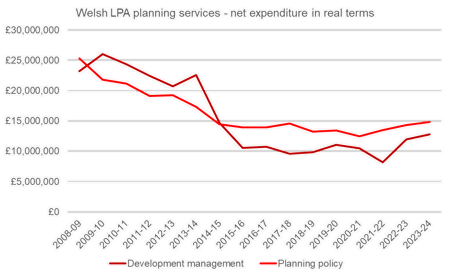
Source: Public Sector Resources Landing Page | Championing the power of planning (2025)
Planning is critical but under pressure from prolonged budget cuts and lack of capacity and resources.
RTPI Cymru’s ‘Big Conversation’ (2023) report’s findings highlight the desperate need for solutions to address workload issues, as the majority of LPA respondents (74%) felt overstretched several or more times a week.
The RTPI Cymru Public Sector Planning Resources in Wales report shows that there is potential to lose 17% (95 planners: those aged 55+) of public sector planners from the workforce within the next five to ten years due to retirement. This figure increases to 42% (234 planners: those aged 45+) when looking at a medium-term horizon of ten to 20 years.
In October, the Chancellor announced plans for £46m investment in resourcing planning departments in England in response to a 20% real term reduction in budgets since 2008 (State of the Profession – England 2025 report). There has been no comparable investment in recruitment or growing the pipeline of planners in Wales despite a far greater (43%) real term reduction in LPA budgets over the same period.

The RTPI Cymru ‘Scoping the potential for digital planning to ease resource pressures and improve planning outcomes’ reveals the keen interest of local authorities in digital planning technologies but also shows the lack of skills and capacity to drive this forward. Respondents expressed a strong desire for training opportunities (81%), peer learning (93%), and exposure to new tools (91%) but often opportunities are not available due to a lack of resources, skills and capacity.
The use of digital planning tools including artificial intelligence, where ethical and appropriate, has the potential to aid planners to plan, make evidence-based decisions and utilise value-based human judgement and expertise.
Other than the Pathways to Planning scheme, there are no planning apprenticeships in Wales supported by the Welsh Government. RTPI Cymru continues to call for Planning apprenticeships in Wales. The Level 7 apprenticeship scheme in England was highly successful and provides a strong model to replicate. Data from the Public Sector Planning Resources in Wales shows that only 24% of the current public sector planning workforce in Wales is under the age of 35. This emphasises the forthcoming issue of losing a high percentage of the planning system in the next coming decades.
Unless robust succession planning is complemented by a strong pipeline of new planners, this loss of planning knowledge and leadership will have a catastrophic impact on service delivery and planning outcomes.
A Chief Planner to champion planning decisions would strengthen decision-making by ensuring long-term spatial planning, sustainability, and place-making are consistently embedded across all policy areas. Such a role would raise overall professional standards and give planning a clear, authoritative direction and support Wales to tackle climate change, the housing crisis and the nature emergency while ensuring the well-being of future generations. A Chief Planner would improve coordination between departments. Scotland has had a Chief Planner Officer since 2024.